
 Worksheets
Age of Revolutions
Total questions: 70
Worksheet time: 1hrs 22mins

___________________ believed that without absolute government, people would fight each other all the time.
Locke
Hobbes
Montesquieu
Rousseau
Americans used _________________'s idea of separation of powers to write the US Constitution.

John Locke believed in what three natural rights?
Life, Liberty, & Property
Life, Equality, & Happiness
Liberty, Equality, & Fraternite
Live Free, Die Hard
Many Kings before and during the Enlightenment believed that they were given the right to rule from God. This idea is called:
Natural Right to rule
Divine Right
Unlimited Power
Absolute Monarchy
The idea that religion should not be involved with government is called:
Separation of Powers
Separation of Church and State
Religious Tolerance
Natural Rights

"I disapprove of what you say, but will defend to the death your right to say it."
Rousseau
Montesquieu
Smith
Voltaire
What is philosophe?
French word for philosopher
a form of government in which the legislative , executive, and judicial branches limit and control each other
a system of thought based on reason is the chief source of knowledge
an 18th century religious philosophy based on reason and natural law
Jefferson was inspired by Enlightenment thinker ___________ _____________, who believed that people have natural rights—rights that belong to them simply because they are human.
John Locke
Thomas Paine
Benjamin Franklin
John Adams
Jefferson's political ideas were influenced by the ______________________, a movement that emphasized science and reason as guides to help see the world more clearly.
Enlightenment
Scientific Revolution
Great Awakening
French Revolution
Clergy: very wealthy: Did NOT have to pay taxes
1st Estate
2nd Estate
3rd Estate
Estate General
Middle class, urban workers, rural peasants. Made up 98% of the population. Had to pay ALL the taxes
1st Estate
2nd Estate
3rd Estate
Estate System
The political prison, symbol of tyranny during the French Revolution
The Bastille
The Tennis Court
Versailles Palace
Paris
Third Estate members vowed to never give up until a constitution was written.
Tennis Court Oath
Estates General
Estates System
Guillotine
Estate
Louis 16th called for a meeting of delegates called
The Meeting of Versailles
National Convention
Committee of Public Safety
Estates General
Who did King Louis XVI agree to help defeat the British?
French
Greeks
American colonists
Italians
Which of the following is an accurate description of the tax system in France in the years preceding the French Revolution?
Only peasants and the clergy paid taxes.
Only about 2 percent of the nobility paid any taxes.
The nobility paid taxes only on land, not on income.
The members of the Third Estate paid almost all of the taxes.
What happened on July 14, Bastille Day?
Robespierre was executed by the guillotine.
French women marched all the way to Versailles.
A mob stormed a prison looking for gunpowder.
All of the above are true.

An assembly of representatives from all three estates that met for the first time in 175 years when Louis XVI called them together.
Estates General
National Assembly
Legislative Assembly
Declaration of the Rights of Man and of Citizen

A pledge made by members of France's National Assembly in 1789 in which they vowed to continue meeting until they had drafted a new Constitution.
Tennis Court Oath
Handball Oath
Declaration of Independence
The Declaration of the Rights of Man
Social conditions where the background to the French Revolution. Which factors were an important part of the French uprising?
Famine
unemployment
rising prices
All of the choices
Some of the causes of France being in debt was because of
Giving financial aid to the American colonies
The overspending by the King on luxuries
Bad harvest and famine
unemployment
All of the choices
One of Louis’ reasons for aiding the American Revolution?
avenge his grandfather's loss in the 30 Years War
avenge his grandfather's loss in the 100 Years War
avenge his grandfather's loss in the 7 Years War
avenge his grandfather's loss in the War of the Roses
Marie Antoinette's nickname was ___?
Madame Enfant Terrible
Madame Hairdo
Madame Deficit
Madame Barren
What was the Great Fear?
A period of peasants rioting and ransacking noble homes.
A period where religious extremists proclaimed the end of the world.
A company of soldiers which raided villages during the Napoleonic Wars.
A period where nobles publicly executed peasants to scare them out of revolting.

Most of the violence took place in Paris in the late summer and early fall of 1792 can be attributed to the group of people represented in the picture. Who were these people?
Girondins
Jacobins
San Culottes
The Boxers
The radical party/group of the Revolution. Robespierre was a member/leader
Jacobins
Girondins
Dantonists
Feuillants
Royalists
This French document drafted and approved by the National Assembly:
1) Set up a limited monarchy
2) Reflecting Enlightenment ideas
3) Ensured equality before the law for all male citizens
Declaration of the Rights of Man
Constitution of 1791
Constitution of 1795
Impeachment and Execution order of Louis XVI
Petition of the Rights of Men and the Citizenry

Assembly under the new Constitution that had the power to create laws and to approve or prevent any war the king declared on other nations.
Legislative Assembly
National Assembly
Estates General
Congress

Native nobles of France who left their country for political reasons during the peasant uprisings (Great Fear)
Sans-Cullotes
Radicals
Emigres
Jacobins
In October of 1789, thousands of women marched to the King’s palace demanding
Money
Food (bread)
Cows and chickens
Cute husbands
Faced with peasant rebellion & foreign invasion, the Nat'l Convention gave broad powers to a special committee of 12 called the...
Committee of Public Safety
National Assembly
Jacobin Club
Dechristianization
The Committee of Public Safety adopted policies known as the ___________, which led to the deaths of 40,000 French people.
Reign of Terror
League of Nations
Constitutional Convention
National Convention
What method was the most often used means of execution during the Reign of Terror in France?
Guillotine
Hanging
Electric chair
Firing squad
Which of these describes the goals of the de-Christianization policy?
Eliminate religion in France as superstition
Encourage more religious devotion
Anyone hoarding grain would be killed
Win the wars against Austria & Prussia
Which of these were examples of the policy of de-Christianization in France? [mark 3]
Notre Dame was converted to a "temple of reason"
The Catholic calendar was replaced
The new Republican Calendar eliminated Christian holidays like Christmas & Easter
The punishment for "monopolizing" was death
Many citizens joined political clubs like the Mountain
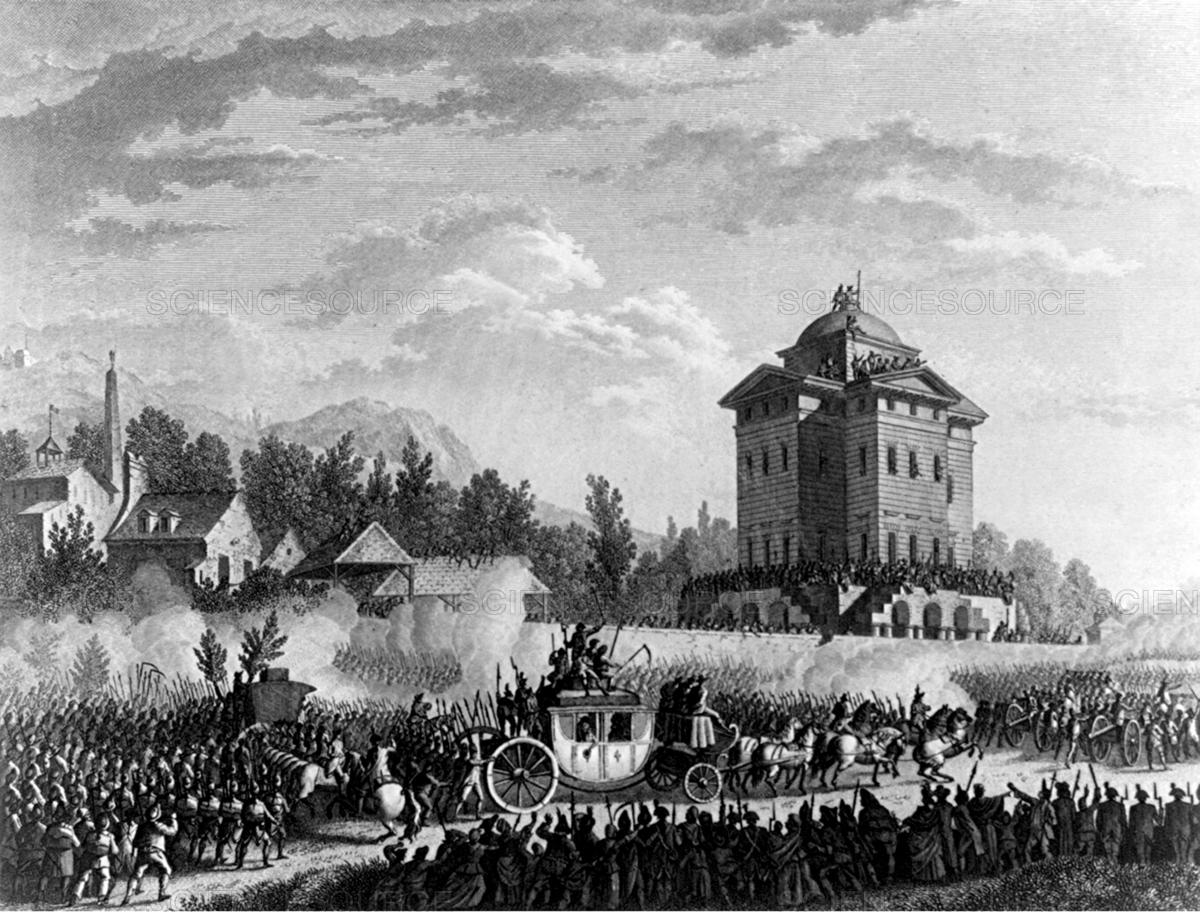
What action by King Louis XVI in June 1791 caused the National Convention to declare him a traitor & eventually condemn him to death?
King Louis tried to flee France & reverse the Revolution.
King Louis invented a new execution machine - the guillotine.
King Louis decreed that each Estate would have one vote.
King Louis ordered his guards to fire on the crowds.
What evidence is there that the Committee of Public Safety did not support human rights?
Anyone suspected in their writings or speech of defying the revolution could be killed
The closing of all Catholic Churches in France
The government denying legal counsel to all accused enemies of the revolution
What happened to Robespierre after the Reign of Terror came to an end?
He retired to his country estate
He became king of France
He was executed on the Guillotine
He wrote a book about his experience and became wealthy
He continued to work in the government
What was the guillotine?
A revolutionary newspaper
A political club
The official uniform of the revolutionaries
A device used to execute people
The building where the revolutionaries met
What did Robespierre call the people he was targeting in the Reign of Terror?
Dangerous
The 1st Estate
Enemies of the Revolution
The 2nd Estate
After the fall of Robespierre and the end of the Reign of Terror, France obtained another constitution where power was transferred to a very corrupt five-member executive branch called
Concordat
Directory
Plebiscite
First Consul

