
 Worksheets
Geometry Angle Proofs
Total questions: 13
Worksheet time: 13mins

What is the "statement" for step 2 of the proof?
∆BAC≅∆DAC
BC=DC
∡B≅∡D
∡BAC≅∡DAC
Name the property.
If A is in the interior of <BDC, then m<BDA + m<ADC = m<BDC.
Reflexive
Transitive
Segment Addition Postulate
Angle Addition Postulate
If <1 and <2 are complementary, then m<1 + m<2 = 90
Addition POE
Subtraction POE
Def of right angle
Def of Complementary Angles
IF <ABC ≅ <DEF, then m<ABC = m<DEF
Reflexive POE
Addition POE
Def. of congruent angles
Def. of right angles
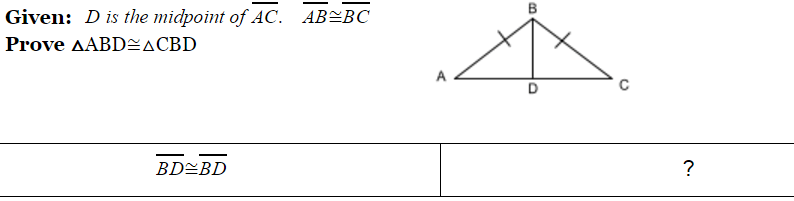
Identify the missing statement or reason
Reflexive Property
Definition of Midpoint
Given
Vertical Angles Theorem
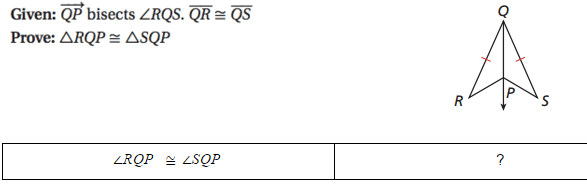
Identify the missing statement or reason
Given
Vertical Angles Theorem
Definition of Angle Bisector
Alternate Interior Angles Theorem
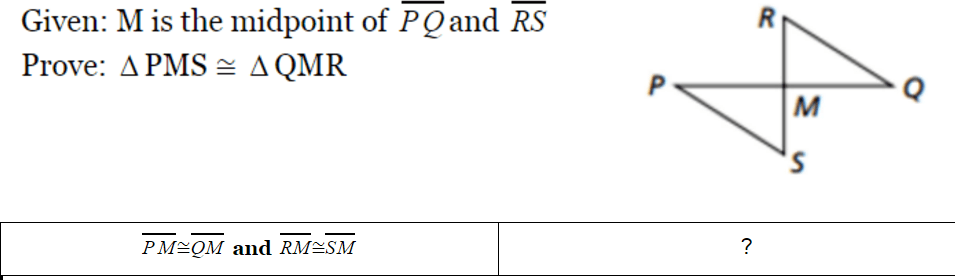
Identify the missing statement or reason
Definition of Angle Bisector
Alternate Interior Angles Theorem
Reflexive Property
Definition of Midpoint

What would be the correct "given" statements for this diagram?
∡A≅∡C, and segment DB is the angle bisector of ∡CDA
BD=BD, and DB=DB
∡A≅∡C, and segment DB is the angle bisector of ∡CBA
∡B≅∡D, segment DB is the angle bisector of ∡DCA.

What is the "statement" for step 3 of the proof?
HA=HA
HA=AH
MA=AM
MA=MA
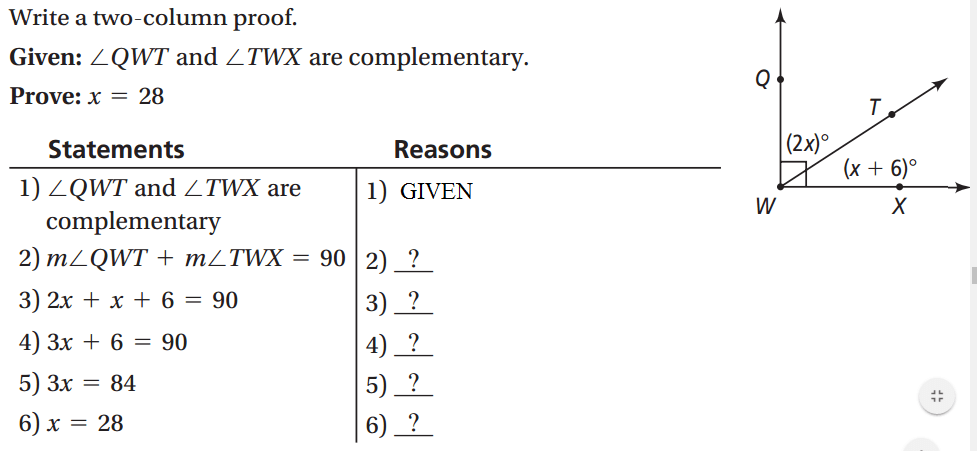
What is the REASON for Statement #2?
Given
Definition of Complementary Angles
Substitution Property
Reflexive Property of Congruence
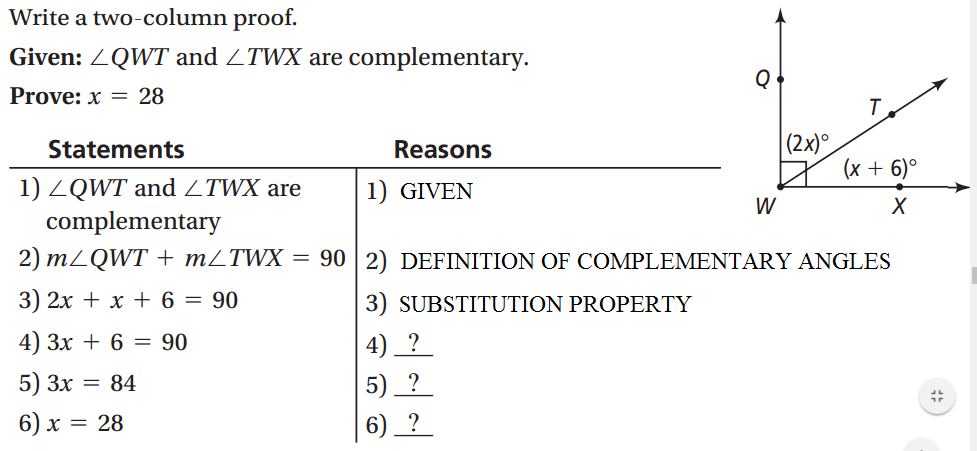
What is the REASON for Statement #4?
Substitution Property
Distributive Property
Transitive Property
Combine Like Terms

What is the reason?
Definition of perpendicular
Definition of Right angle
Definition of 90
Definition of angle
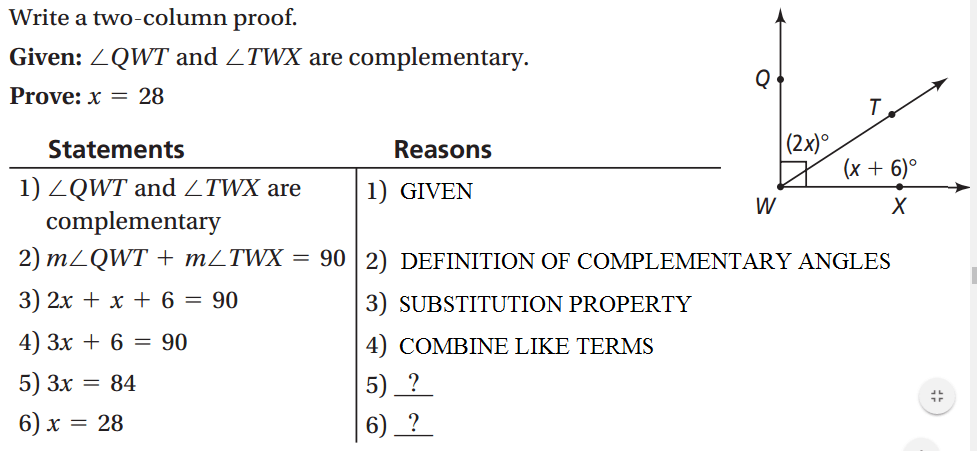
What is the REASON for Statement #5?
Addition Property of Equality
Subtraction Property of Equality
Multiplication Property of Equality
Division Property of Equality

