
 Worksheets
CBA 5 Review- Fossil Fuels/Sediment Rocks/Water Cycle/Conserve
Total questions: 60
Worksheet time: 3600secs
What is the energy source for the water cycle?
the sun
water
the Earth
the moon

What part of the water cycle does this picture show?
condensation
precipitation
evaporation

When water condenses, water vapor in the air gets ______ and changes back into a liquid.
warm
cold
hot
solid

What is the OPPOSITE of condensation?
transpiration
runoff
precipitation
evaporation

How much of our planet is estimated to be covered with water?
10%
25%
50%
75%
What is it called when water droplets fall from the atmosphere in the form of rain, sleet, snow, or hail?
condensation
precipitation
evaporation
transpiration

What do you call the changes of water when it evaporates into the air, condenses into clouds, and then precipitates down to Earth?
run-off
the water cycle
evaporation
precipitation

What is rainfall that is not absorbed by soil and travels to the ocean?
run-off
transpiration
precipitation
evaporation
Condensation is when __________.
water changes from a gas to a liquid
water changes from a liquid to a gas
water turns to ice
all of the above
Evaporation is __________________.
when water changes from a solid to a liquid
when water changes from a liquid to a gas
when water changes from a gas to a liquid
none of the above
What changes water from one state to another?
clouds
the ocean
a change in temperature
none of the above
The greatest amount of water found on Earth is fresh water. True or False?
True
False

The passage of water vapor from a plant to the atmosphere is called ____________.
transpiration
evaporation
hydrosphere
condensation
Most evaporation in the water cycle happens in oceans because
they contain salt
they have ice in them
they are the largest bodies of water

The diagram below shows the water cycle.
At which point does runoff happen?
SC.5.E.7.1
1
2
3
4


Students were asked to generate a list that contained nothing but renewable resources. Which student was the the only one to make a correct list?
Student A
Student B
Student C
Student D
Rosa's neighborhood is only allowed to water their lawns on Tuesdays and Thursdays. What is the most likely explanation for why Rosa's neighborhood can only water their lawns two days a week?
Water is a renewable resource that needs to be conserved.
Water is a nonrenewable resource that needs to be conserved.
Water erodes the soil, and soil is a renewable resource that needs to be conserved.
Water corrodes the soil, and soil is a nonrenewable resource that needs to be conserved.
What is one way scientists are working to conserve natural resources?
Using more gasoline
Creating products that do not use up natural resources
Cutting down more trees
Increasing oil production
What are fossil fuels?
coal, oil, uranium
oil, natural gas, uranium
coal, oil, natural gas
geothemals, coal, natural gas
Renewable resources...
are limited.
cannot be replenished.
are fossil fuels.
can be replenished.

Which diagram models the process of compaction leading to the formation of sedimentary rock? (5.7A)


How long does it take a complete sedimentary rock to form?
millions of years
hundreds of years
a decade
a century
What is the correct order of the sedimentary process?
cementation, compaction, deposition, erosion, weathering
erosion, compaction, cementation, weathering, deposition
weathering, erosion, deposition, compaction, cementation

Which answer choice best explains how sedimentary rock becomes exposed over the years?
from weathering and erosion
from a hurricane
from a tsunami
none of the above


Sediments are falling into the layers. What is NOT needed to make sedimentary rocks?
millions of years
organic matter
layers of sediment
compaction and cementation

Which of the following correctly completes the Sedimentary Rock Cycle?
A = Compaction, B = Erosion, C = Cementation
A = Erosion, B = Compaction, C = Cementation
A = Cementation, B = Compaction, C = Erosion
A = Erosion, B = Cementation, C = Compaction

The diagram below shows the sequence of the processes that turn solid rock into sandstone. Which two processes best complete this diagram?
Melting and cooling
Erosion and compaction
Compaction and cementation
Evaporation and dissolving

Sedimentary rocks are formed when _______.
sediments are pressed together.
lava cools on the Earth's surface.
Which is NOT a type of fossil fuel?
Coal
Oil
Wood
Natural Gas
How are fossil fuels formed?
They are made in factories
Dead plants and animals died millions of years ago and were buried under heat and pressure
Dead plants were buried under heat and pressure
Dead animals were buried under heat and pressure
What do fossil fuels need to form?
High pressure and low heat
High pressure and high heat
Low pressure and low heat
Low pressure and high heat
Which fossil fuel is formed only from dead plants in swamps?
Rubber
Petroleum
Coal
Natural Gas
Coal is created by...
Ancient Swamp environments filled with lots of dead plant life
Ancient oceans filled with lots of dead microscopic animals
Ancient mountains that have turned black over time
New Swamp environments that have lots of green plant life
Oil is created by...
Ancient Swamp environments filled with lots of dead plant life
Ancient oceans filled with lots of dead microscopic animals
Ancient mountains that have turned black over time
New Swamp environments that have lots of green plant life
through heat and pressure water is squeezed out and crystals "glue" sediment together.
Weathering
Erosion
Deposition
Compaction
Cementation
fuels formed over millions of years from the remains of ancient plants and animals; examples include coal, petroleum (oil) and natural gas
deposition
erosion
fossil fuels
weathering
Which process of Fossil Fuels start in a swampy area?
Oil and gas formation
coal formation
Which process of Fossil Fuels start in the ocean floor ?
Oil and gas formation
coal formation
Mr. Shelton’s class has been studying the process of forming fossil fuels. He
places the following cards that list steps of fossil fuel formation on the lab tables in
random order.
Card 1: Heat and pressure where the organisms are buried
increase over time.
Card 2: Organisms are buried in sediment.
Card 3: Fossil fuels are formed.
Card 4: Ancient organisms die.
Which shows the correct order of the formation of fossil fuels?
4, 2, 1, 3
3, 4, 1, 2
1, 2, 3, 4
2, 4, 1, 3
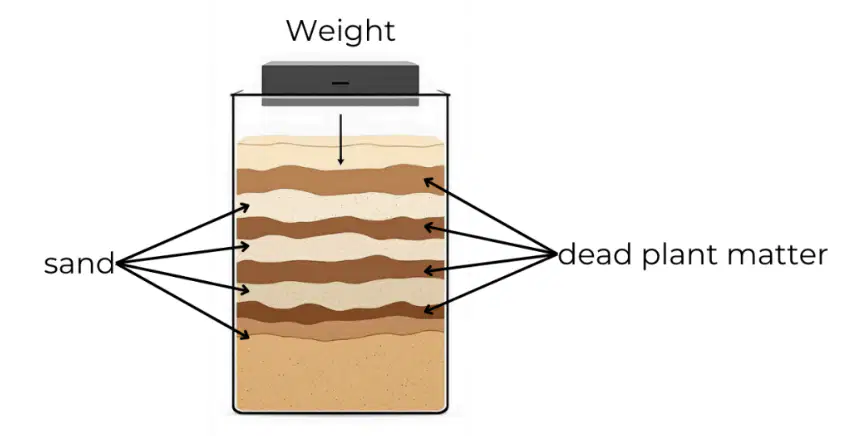
A student is building a model to demonstrate how fossil fuels form over millions of years. The
model includes a container filled with layers of sand and dead plant material, sealed with a lid. A weight is placed on top of the lid.
Which process is being demonstrated by the weight on top of the container?
The pressure that helps change the plant material into coal
The heat that causes the sand to melt and turn into oil
The time it takes for the plant material to decompose into gas
The movement of fossil fuels into underground reservoirs
a liquid fossil fuel formed from marine(sea) organisms that were buried and over time heat and pressure from underground turned them into a fuel.
fossil
oil
natural gas
sedimentary rock
a gas fossil fuel that formed from marine(sea) organisms that were buried and over time heat and pressure from underground turned them into a fuel.
abundant
coal
natural gas
conserve
Which of the following processes leads to the formation of fossil fuels?
horses and cattle eating grass
water evaporating from the ocean
rocks weathered into small pebbles
organisms buried under layers of rock

