
 Worksheets
Caught in or Between Hazards
Total questions: 8
Worksheet time: 4mins
What should you do to avoid caught-in or caught-between accidents while working in a trench?
Wear loose clothing or jewelry
Never work in an unprotected trench more than five feet deep
Enter and exit a trench by climbing on the walls of the trench
Work in unprotected trenches more than five feet deep
To protect their employees from caught-in and -between hazards associated with handling machinery, employers must fit tools with appropriate guards and safety switches, guard exposed moving parts and points-of-operation, and provide a lockout/tagout (LOTO) program. What else must employers do to protect employees from caught-in and -between hazards associated with handling machinery?
Remove guards on power tools
Guard in running nip points
Construct and protect trenches properly
Forbid heavy machinery at the worksite
OSHA requires which of the following trenches to have a protective system installed?
No trenches need protective systems
A trench 3 feet deep
A trench 5 feet deep or more, but less than 20 feet
Which types of objects can contribute to caught-in or caught-between incidents?
Vehicles
Machiner
Equipment
Heavy Materials
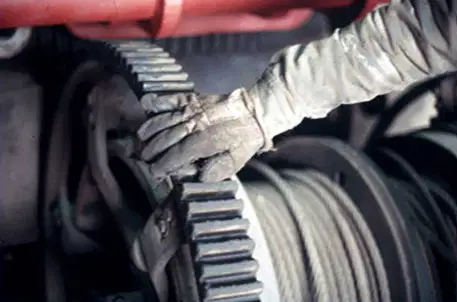
What is the potential hazard in this image?
The worker's loose glove is touching the moving rotary
The worker's hand could be cut by sharp edges
When a body part is entangled in machinery, the spot on the machine where the body part is caught is called the _____.
Vertex
Pinch Point
Point of Impact
Crush Spot
Who is responsible for keeping you safe from caught-in and -between hazards?
Employer
Coworkers
Those you supervise
Which of the following scenarios would be considered a caught-in or caught-between incident?
A person is struck by an improperly-secured load
A person gets caught doing something illegal
A person's legs are crushed between two objects
A person cuts their hand on a contaminated sharp

