
 Worksheets
Math Systems
Total questions: 20
Worksheet time: 20mins
Determine if (4, 1) is a solution for the system of equations.
y = -x + 5
y = 2x - 7
yes
no

How many solutions does this system of equations have?
One Solution
No solution
Infinitely Many Solutions
Two Solutions
If a system of linear equations has one solution, what does this mean about the two lines?
Parallel lines
the same line
Intersecting lines
Does the following system have One Solution, No Solution, or Infinite Solutions.
y = 4x + 8
y = -5x + 3
One solution
No solution
Infinite solution
A customer at a store paid $64 for 3 large candles and 4 small candles. At the same store, a second customer paid $4 more than the first customer for 1 large candle and 8 small candles. The price of each large candle is the same, and the price of each small candle is the same. Which system of equations can be used to find the price in dollars of each large candle, x, and each small candle, y?
4y = 3x + 64
8y = x + 68
4y = 3x + 64
8y = x + 60
3x + 4y = 64
x + 8y = 68
3x + 4y = 64
x + 8y = 60
A customer at a store paid $64 for 3 large candles and 4 small candles. At the same store, a second customer paid $68 for 1 large candle and 8 small candles. The price of each large candle is the same, and the price of each small candle is the same. Which system of equations can be used to find the price in dollars of each large candle, x, and each small candle, y?
4y = 3x + 64
8y = x + 68
4y = 3x + 64
8y = x + 60
3x + 4y = 64
x + 8y = 68
3x + 4y = 64
x + 8y = 60
Two linear equations with the same set of variables
system of equations
function
association
correlation
A customer at a store paid $64 for 3 large candles and 4 small candles. At the same store, a second customer paid $4 more than the first customer for 1 large candle and 8 small candles. The price of each large candle is the same, and the price of each small candle is the same. Which system of equations can be used to find the price in dollars of each large candle, x, and each small candle, y?
4y = 3x + 64
8y = x + 68
4y = 3x + 64
8y = x + 60
3x + 4y = 64
x + 8y = 68
3x + 4y = 64
x + 8y = 60

What is the solution to the system of equations?
(-1, -3)
(3, 1)
(1, 3)
(-3, -1)

What is the solution?
1
-2
(1, 2)
(1, -1)

When you graph the exact same equation twice,
you will have no solution.
you will have one solution.
you will have infinite solutions.
you will graph a giraffe.

What is the solution to the system?
(3, -1)
(2, -6)
No Solution
(6, -2)

Buzz graphed two lines in order to find the solution to a given system of equations.
What is the solution?
(-1, 4)
(1, -4)
(-4, 1)
(4, -1)
Using Substitution, solve for the following system of linear equations: y=2x+1 y=−x+16
(3,-7)
No solutions
Infinitely many solutions
(5,11)
Using Substitution, solve for the following system of linear equations: y=3x 2x−3y=14
No solution
Infinitely many solutions
(-3,7)
(-2,-6)
Using Substitution, solve for the following system of linear equations: y=x+3 y=−2x−3
No solution
(-3,-3)
Infinitely many solutions
(-2,1)
Is the point (2, -1) a solution to the systems of equations below?
Yes
No
Will the solution (-3, -7) make the following system of equations a true statement?
y = 4x + 5
y = x – 4
YES
NO
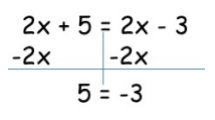
What is the solution to this equation?
one solution
no solution
infinite solutions
none of these
If a system of equations has no solution, what does the graph look like?
intersecting lines
parallel lines
skew lines
intersecting lines

