
 Worksheets
States of Matter Pt2
Total questions: 76
Worksheet time: 1hrs 7mins
Distillation is used to separate ______.
a liquid from its solution.
an insoluble solid from its solution.
a soluble solid from its solution.
Distillation is made up of ___.
evaporation, then condensation
condensation, then evaporation
boiling, then condensation
condensation, then boiling

What is 5?
cooling tube
condenser
distillate
water pump
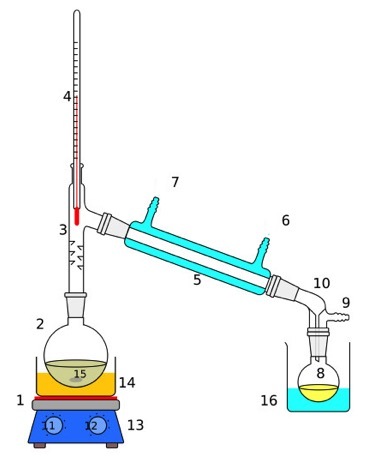
What is 6 and 7?
6: water in / 7: water out
6: water out / 7: water in

What is 8?
distillate
filtrate
residue
solute

This is another method of distillation. What is the equipment called
A solar panel
A solar cell
A solar sill
A thermal sill
What is the name of the process where a gas turns into a liquid?
evaporation
condensing
condensation
freezing
When using distillation to obtain pure water from sea water. Why are you able to separate the water out?
Water has a lower boiling point than salt
Water has a higher boiling point than salt
Water has a lower melting point than salt
Water has a higher melting point than salt
For distillation to work the substances in the mixture must have....
the same melting point
the same freezing point
Different melting points
Different boiling points

Why is the insulation around the sill helpful?
It helps more water to condense
It helps more water to evaporate
It looks cool
What method is used to obtain salt from sea water?
a. decantation
b. sedimentation
c. evaporation
d. filtering
Which of the following examples undergo the evaporation process?
a pail of water under the heat of the sun
brushing your teeth after meal
ironing clothes every weekend
listening to the radio
It is the main factor that causes the evaporation process in separating mixtures.
water
heated
smoke
light
Amira accidentally spills a glass of water in the salt container and she is thinking of a solution on how she’s going to recover salt from water. What will Amira do to return the salt to its original phase?
She will wrap it with newspaper tightly
She will throw it away in the waste can
She will hide it in a dark corner
She will boil the solution
While boiling water in a kettle, Alex noticed that there was smoke coming from the spout of a kettle. He asked his mother, “Why did the smoke rise upward”? What do you think will be the mother’s answer?
because the water reached its cooling point
because the water reached its boiling point
because the water is heated and became water vapor
because the water is freezing
water in the canal becomes less after the rain
undergo the evaporation technique
not undergo the evaporation technique
doormat on the floor
undergo the evaporation technique
not undergo the evaporation technique
wet hair becomes dry
undergo the evaporation technique
not undergo the evaporation technique
chair on the ground
undergo the evaporation technique
not undergo the evaporation technique
cooling after sweating
undergo the evaporation technique
not undergo the evaporation technique
Which is the best way to get salt from salty water?
Evaporation
Filtration
Distillation
Pure water can be separated from inky water by simple distillation because:
Water and ink have different boiling points
Water evaporates leaving the ink particles behind
Ink evaporates leaving the water behind
What is the correct order for obtaining salt from a mixture of sand and salt?
Dissolving in water - filtration - evaporation
Evaporation - filtration - dissolving in water
Filtration - dissolving in water - evaporation
Which method is usually used to separate coloured substances from each other?
Simple distillation
Evaporation
Chromatography
How could you separate iron filings from a mixture of iron and sulfur?
Using a magnet
By adding water and filtering
By distillation
In filtration, what name is used to describe the solid left in the filter paper?
Filtrate
Residue
Distillate
If you wanted to make pure drinking water from sea water, what process would you use?
Filtration
Distillation
Evaporation
Crude oil can be separated into several liquids that have different boiling points. What is the name of this process?
Simple distillation
Chromatography
Fractional distillation
In chromatography, where are the spots of coloured substances placed?
Randomly on the piece of paper
In a vertical line on the paper
On a horizontal line on the paper
What is the name of the piece of paper at the end of a chromatography experiment?
Chromatogram
Filtrate
Residue
Choose 3 answers
A mixture...
can contain elements and compounds
is two or more elements bonded together
contains substances that are not chemically bonded
can be separated
is in the periodic table
Distillation is
a process of separating a solvent and a solute using evaporation and condensation using difference in boiling points
a process of separating a soluble solid from a liquid by turning the liquid into a gas
separation of dissolved colours
Filtration is
using magnetism to separate metals from non-metals.
a process that separates a solid from a liquid based on the size of their particles.
a process of separating mixtures by boiling.
A solute is
a mixture that forms when one substance dissolves another
a liquid substance capable of dissolving other substances
incapable of being dissolved
a substance that is dissolved
A solvent is
able to be dissolved
a mixture that forms when one substance dissolves another
a liquid substance capable of dissolving other substances
a substance that is dissolved
Which statement best describes diffusion?
Particles constantly moving
Particles moving together under pressure
Particles moving for a high to a low concentration
A change of state
What key term is used to describe when a solute does not dissolve in water?
Soluble
Solute
Insoluble
Solution

Type of mixture that has the SAME COMPOSITION in every part.
Homogenous
Heterogeneous


Julia wanted to know what substances were in the ink in her pen. What process should she use to do this?
chromatography
evaporation
filtration
sifting

Ink can be separated by a method of -----------------------------------------------
distillation
filtration
chromatography
sedimentation
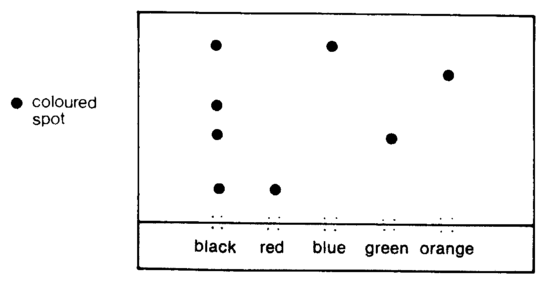
A pure substance shows ------------------ spot on chromatogram
0
1
2
3
A substance is soluble if it can be dissolved.
In paper chromatography, the most soluble solute _____________________ .
does not move from the start point
stays closest to the start point
travels furthest away from the start point
can be found in the middle of the chromatogram
What is the correct image of paper chromatography???


What is chromatography?
A way to see pretty colors
A laboratory technique used to separate a mixture.
A form of distillation
Two or more substances that are mixed together but not chemically combined create a...
solvent
compound
mixture
What molecules move up the paper to carry the different colors of ink?
color
fat
water
Which of the following mixture/s is/are separated by chromatography?
Pigments from natural colours
Colours in a dye
Colours of flowers extracts
All the above
Which of the following is correct about chromatography?
It separates those solutes that dissolve in the same solvent.
It separates those solutes that dissolve in different solvents.
It separates a solute that dissolves in a solid solvent.
It separates gaseous solutes from liquid solvents.
If a substance is not soluble in the solvent, what happens to the spot placed on the start line?
a) Dot moves to the top of the paper
b) Dot does not move at all
c) Dot moves to the left or right
d) Dot moves down to the bottom of the paper
In paper chromatography, the LEAST soluble solute ____.
does not move from the start point
stays closest to the start point
travels furthest away from the start point
can be found in the middle of the chromatogram


Blue loves water.
Yellow loves water.
Green loves water.
What is a solvent
A liquid that will dissolve a solid solute
Another word for solution
A thing that make drinks change colour
Usually the solid about to be dissolved
The ___ is the thing being dissolved.
solute
solvent
mixture
solution
If I dissolve salt in water, what is the solvent?
salt
water
salt & water
none of the above
If I dissolve sugar in water, what is the solution?
water
sugar
sugary water
none of the above
If I dissolve salt in water, what is the solute?
water
salty water
none of the above
salt
Define the term soluble.
Can dissolve in water
Cannot dissolve in water
Partially dissolves in water
Define the term insoluble.
Can dissolve in water.
Cannot dissolve in water.
Partially dissolves in water.

gravel
soluble
insoluble

soluble
insoluble

soluble
insoluble
______ refers to the ability of a substance to combine and form a solution
solvent
solute
solution
solubility

