
 Worksheets
Macroeconomics Exam 1-5 Review
Total questions: 60
Worksheet time: 30mins
You should decide to go to a movie
if the marginal cost of the movie exceeds its marginal benefit.
if the marginal benefit of the movie exceeds its marginal cost.
if your income will allow you to buy a ticket.
because movies are enjoyable.
Economic analysis assumes "purposeful behavior," which means that people will pursue decisions or actions
that will increase their well-being.
always based on full or complete information.
with minimal consideration for their emotions.
without making any logical mistakes.

Suppose Taran can only watch one of his favorite teams play. Assuming the cost to watch each team is the same, which team will Taran choose to watch?
Manchester United
Seattle Mariners
Seattle Storm
Seattle Sounders
A positive statement is concerned primarily with
some goal that is desirable to society.
what should be.
what is.
the formulation of economic policy.
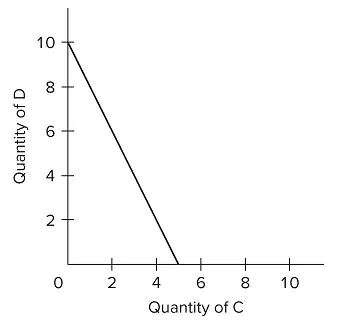
Refer to the budget line shown in the diagram. Which of the following combinations of goods is attainable for this consumer?
4 units of C and 2 units of D
1 unit of C and 10 units of D
2 units of C and 8 units of D
4 units of C and 6 units of D
Assume that a consumer has a given budget or income of $12 and that she can buy only two goods, apples or bananas. The price of an apple is $1.50 and the price of a banana is $0.75. What is the slope of the budget line if the quantity of apples were measured on the horizontal axis and bananas on the vertical axis?
−0.5
−0.8
−1.6
−2
Which of the following would not be considered a capital resource by economists?
the secret recipe used in a restaurant's signature dish
100 shares of stock in a major corporation
an electric drill used by a construction worker
the songs written and produced by a professional musician

Refer to the tables. Suppose that technology and the quality of resources are the same in both countries. We can conclude that
Duckistan has more resources than Herbania.
Herbania has more resources than Duckistan.
Duckistan has greater opportunity costs than Herbania.
prices are twice as high in Herbania as in Duckistan.
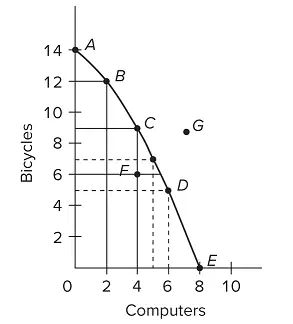
Refer to the diagram. If society is currently producing 9 units of bicycles and 4 units of computers and it now decides to increase computer output to 5, the cost
of doing so cannot be determined from the information given.
will be zero because unemployed resources are available.
will be 2 units of bicycles.
will be 1 unit of bicycles.
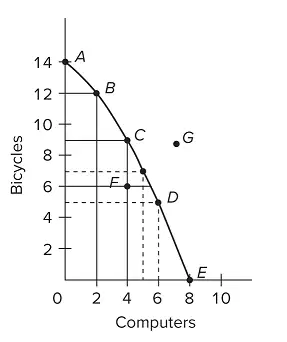
Refer to the diagram. Suppose this economy is currently producing at point D. For this economy to produce at point G, it would have to
expand its resources or improve its technology.
use existing resources and technology more efficiently.
change its preferences.
implement policies that increase government spending.
The law of increasing opportunity costs is reflected in a production possibilities curve that is
an upward-sloping straight line.
a downward-sloping straight line.
bowed out from the origin.
bowed in toward the origin.
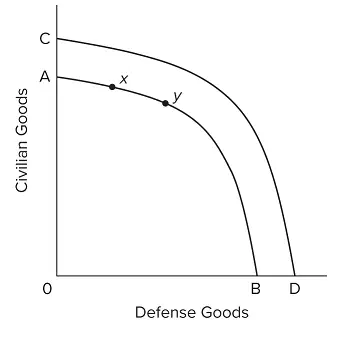
Refer to the diagram. The direct economic impact of the destruction and loss of lives caused by the terrorist attacks of September 11, 2001, is illustrated by the
shift of the production possibilities curve from CD to AB.
shift of the production possibilities curve from AB to CD.
move from x to y on production possibilities curve AB.
move from y to x on production possibilities curve AB.
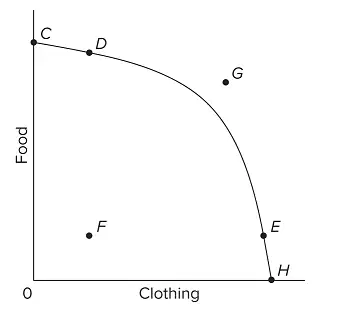
Refer to the provided graph. Which of the following statements about combination G is true?
The nation cannot produce combination G even if the nation gets additional resources.
The nation can currently produce combination G, but not if the nation specializes and trades with another nation.
The nation may not be able to produce combination G, but it can consume that combination if it specializes and trades with other nations.
The nation would much prefer to be at combination F than at combination G.
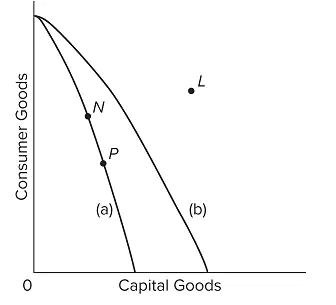
Refer to the provided production possibilities curves. Curve (a) is the initial curve for the economy, and the nation is initially producing combination P. A shift from curve (a) to curve (b) suggests that the economy can then increase its production of capital goods
only if it reduces its production of consumer goods.
so as to produce the combination L.
and consumer goods simultaneously.
but will have to hold constant its production of consumer goods.
The slope of a graph with "income" on the horizontal axis and "saving" on the vertical axis is +0.2. This means that if
income is $100, then saving is $20.
income is 0.20, then saving is zero.
income increases by $100, then saving will rise by $20.
saving rises by $100, then income will rise by $20.
An economic system
requires a grouping of private markets linked to one another.
is a particular set of institutional arrangements and a coordinating mechanism used to respond to the economizing problem.
requires some sort of centralized authority (such as government) to coordinate economic activity.
is a plan or scheme that allows a firm to make money at some other firm's expense.
Freedom of enterprise
is a characteristic that is common to most economic systems.
in a market system means that entrepreneurs can obtain and use economic resources without any legal restraint.
allows businesses, within broad limits, to choose what goods to produce.
refers primarily to the right of consumers to purchase what they want.

On the basis of the information, it can be said that
no coincidence of wants exists between any two states.
a coincidence of wants exists between Michigan and Washington.
a coincidence of wants exists between Texas and Washington.
a coincidence of wants exists between Michigan and Texas.
An increase in consumer desire for apples is most likely to
decrease the price of apples.
reduce the supply of apples.
decrease the need for bushel baskets.
increase the profits of apple growers.
In a market economy, the distribution of output will be determined primarily by
consumer needs and preferences.
consumer income and product prices.
government regulations that provide a minimum income for all.
a social consensus as to which distribution of income is most equitable.

Answer the question based on the following information: Suppose 30 units of product A can be produced by employing just labor and capital in the four ways shown below. Assume the prices of labor and capital are $2 and $3, respectively.
If the price of product A is $0.50, the firm will realize
an economic profit of $4.
an economic profit of $2.
an economic profit of $6.
a loss of $3.
The invisible-hand concept suggests that
market failures imply the need for a national economic plan.
big businesses are inherently more efficient than small businesses.
the competitiveness of a capitalistic market economy invariably diminishes over time.
assuming competition, private and public interests will coincide.
In the product market,
resources flow to households.
businesses earn revenue from selling goods and services.
the price of land is determined.
resources flow to businesses.
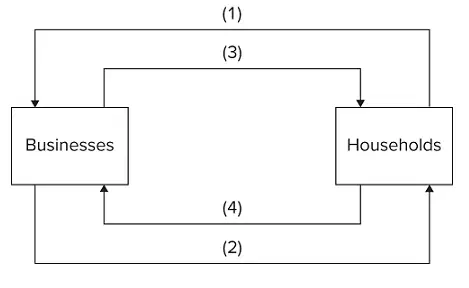
Refer to the diagram. Arrows (1) and (2) represent
goods and resources, respectively.
money incomes and output, respectively.
output and money incomes, respectively.
resources and goods, respectively.
Economic systems differ from one another based on who owns the factors of production and
how many resources are available in the economy and where they are located.
how economic activities are coordinated and directed.
what kinds of products are produced in the economy and how they are sold.
how big the population is and the makeup of the population.
The economies of North Korea and Cuba are
similar in that they are both basically command systems.
similar in that they are both basically market systems.
different in that North Korea has a command system, while Cuba has a market system.
different in that Cuba has a command system, while North Korea has a market system.

The following table illustrates alternative production techniques for producing 18 golf balls that can be sold for $1 each for a total revenue of $18.
If the price per unit of labor were to increase from $2 to $3, the most efficient production technique would then be
C
D

Answer the question based on the following information: Suppose 24 units of product Y can be produced by employing just labor and capital in the four ways shown below. Now assume the prices of labor has risen to $6 but the price of capital is still $5, respectively.
Now which technique is economically most efficient in producing Y? How much profit will be made producing the 24 units of Y if the price of Y has risen to $2 and total revenues are now $48?
1; $6
2; $5
3; $3
4; $4

Answer the question based on the following information: Suppose 45 units of product Y can be produced by employing just labor and capital in the four ways shown in the following table. Now assume the price of labor has risen to $10 but the price of capital is still $9, respectively.
Now which technique is economically most efficient in producing Y? How much profit will be made producing the 45 units of Y if the price of Y has risen to $2 and total revenue is now $90?
4; $23
1; $5
3; $4
2; $3
In a market system, the task of assessing and managing the business risk of a firm is taken on by the firm's
labor.
capital suppliers.
entrepreneurs
customers.
A market
reflects upsloping demand and downward sloping supply curves.
entails the exchange of goods, but not services.
is an institution that brings together buyers and sellers.
always requires face-to-face contact between buyer and seller.
Which of the following would shift the demand curve for beef?
a new subsidy for cattle producers
an increase in the number of cattle ranches
an increase in cattle feed
a widely publicized study that indicates beef consumption increases one's cholesterol
Smartphones and SIM cards are
substitute goods.
complementary goods.
independent goods.
inferior goods.
Assume that the demand curve for product C is downward sloping. If the price of C rises from $1.75 to $2,
the demand for C will increase.
a smaller quantity of C will be demanded.
a larger quantity of C will be demanded.
the demand for C will decrease.
The location of the product supply curve depends on
production technology.
the number of buyers in the market.
the tastes of buyers.
the location of the demand curve.
Assume a drought in the Great Plains reduces the supply of wheat. Noting that wheat is a basic ingredient in the production of bread, and potatoes are a consumer substitute for bread, we would expect the price of wheat to
rise, the supply of bread to increase, and the demand for potatoes to increase.
rise, the supply of bread to decrease, and the demand for potatoes to increase.
rise, the supply of bread to decrease, and the demand for potatoes to decrease.
fall, the supply of bread to increase, and the demand for potatoes to increase.

Refer to the table. Suppose that demand is represented by columns (3) and (2) and supply is represented by columns (3) and (5). If the price were artificially set at $10,
demand would change from columns (3) and (2) to columns (3) and (1).
a surplus of 20 units would occur.
a shortage of 20 units would occur.
the market would clear.

Which of the diagrams illustrate(s) the effect of a decrease in incomes on the market for second-hand clothing?
A and C
A only
B only
C only
(Advanced analysis) The demand for commodity X is represented by the equation P = 30 − 0.2Q and supply by the equation P = 12 + 0.2Q. The equilibrium price for X is
$21.
$22.
$12.
$9.
Price floors and price ceilings both
cause shortages.
cause surpluses.
cause the supply and demand curves to shift until equilibrium is established.
interfere with the rationing function of prices.
Other things being equal, the law of demand suggests that as
the demand for iPads increases, this will cause the price to increase.
income increases, the quantity of iPads demanded will increase.
the price of iPads decreases, the quantity demanded will increase.
the price of iPads decreases, the quantity demanded will decrease.
The idea of the Law of Demand, as applied to electric cars, assumes which of the following to be constant?
price of electric cars
price of gasoline cars
quantity of electric cars demanded by buyers
how much sellers are charging customers for electric cars

The table below shows the weekly demand for hamburgers in a market where there are just three buyers.
At a price of $6, the weekly market quantity demanded for hamburger is
17.
23.
18.
24.
The market system automatically corrects a surplus condition in a competitive market by
raising the price of the product in question while increasing the quantity demanded.
raising the price of the product in question while decreasing the quantity demanded.
reducing the price of the product in question while increasing the quantity demanded.
reducing the price of the product in question while decreasing the quantity demanded.
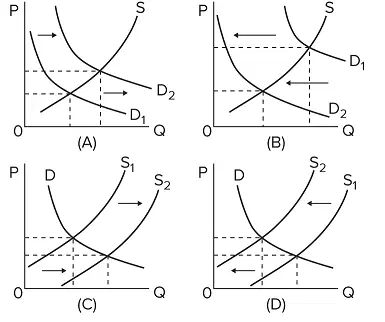
In the diagrams below, the subscript "1" refers to the initial position of the curve, while the subscript "2" refers to the final position after the curve shifts.
In which diagrams would we see a shortage at the initial price after the indicated curve has shifted?
A and D
B and D
B and C
A and C
Nonrivalry and nonexcludability are the main characteristics of
consumption goods.
capital goods.
private goods.
public goods.
Which of the following is an example of a private good?
your nearest state park
weather warning sirens
toothbrush
air traffic control
Which of the following statements is not true?
Some public goods are paid for by private philanthropy.
Private provision of public goods is usually unprofitable.
The free-rider problem results from the characteristics of nonrivalry and nonexcludability.
Public goods are only provided by government.
All of the following are private goods or services except
a coffee drink from your favorite coffee shop.
your laptop.
concert tickets.
light beams projected from lighthouses.
The opportunity cost of providing public goods
only includes the cost of the labor used in the production of the public goods.
is zero since the economy's resources are unlimited.
is incalculable since the government does not keep track of its spending.
includes the resources that are no longer available for the production of private goods.
Which of the following is considered a potential solution to some regulatory capture?
bringing industry experts into the regulatory process
creating a standard set of regulations for all industries
deregulation of the industry
government subsidies for firms in the industry
Proponents of deregulation point to all of the following industries as examples of successful deregulation except for
airlines.
pharmaceuticals
railroads
interstate trucking.
A situation in which society may not be able to rank its preferences consistently through paired-choice majority voting refers to
logrolling.
the paradox of voting.
the median-voter model.
the special-interest effect.
The city is contemplating making street improvements on a street with only two residents. The marginal cost of the project would be $5,000. One of the residents anticipates a marginal benefit of $3,000. At least how much will the marginal benefit of the other resident need to be to make this street project efficient?
$5,000
$8,000
$2,000
$3,000
Suppose three roommates cannot agree on the size of a pizza to order. Domino argues for a medium pizza, Godfather contends a large pizza will be needed, and Little Caesar wants a super-large pizza. Assuming no paradox of voting, majority voting will result in a decision to order
a medium pizza
a larger pizza
a super-large pizza
two medium pizzas

Suppose a college economics department decides to use a single economics text for all sections of principles of economics. Also assume that the three individual members of the textbook selection committee have the following preferences
Assuming all other textbook qualities except analytical level are the same, majority voting will result in the committee
being deadlocked and unable to decide on a book
selecting the C/F book
selecting the M/B book.
selecting the O/S book.
The situation where politicians make decisions that will raise their chances of reelection, even if those decisions are detrimental to the general public, is referred to as the
moral hazard problem
principal-agent problem
adverse selection problem.
common good problem.
Some economists contend that government agencies are generally less efficient than private businesses due to the following reasons, except
government bureaucracies do not face the profit motive, which is a major incentive that guides private firms.
government bureaucrats tend to deal with failing programs by putting more resources into the programs, rather than eliminating the program.
incompetent workers gravitate toward government, while motivated workers gravitate toward the private sector.
bureaucrats, along with the special-interest groups they serve, often gain enough political clout to keep their agencies going regardless of performance.
Problems with government decision making, politics, and elections are subjects that are studied in an area of economics called public
finance
choice
policy
interest
The trading of votes to secure favorable outcomes on decisions that would otherwise be defeated is called
median-voter trading.
the special-interest effect.
political logrolling.
the paradox of voting.

