
 Worksheets
Eco w/ PFL Final Exam
Total questions: 65
Worksheet time: 37mins
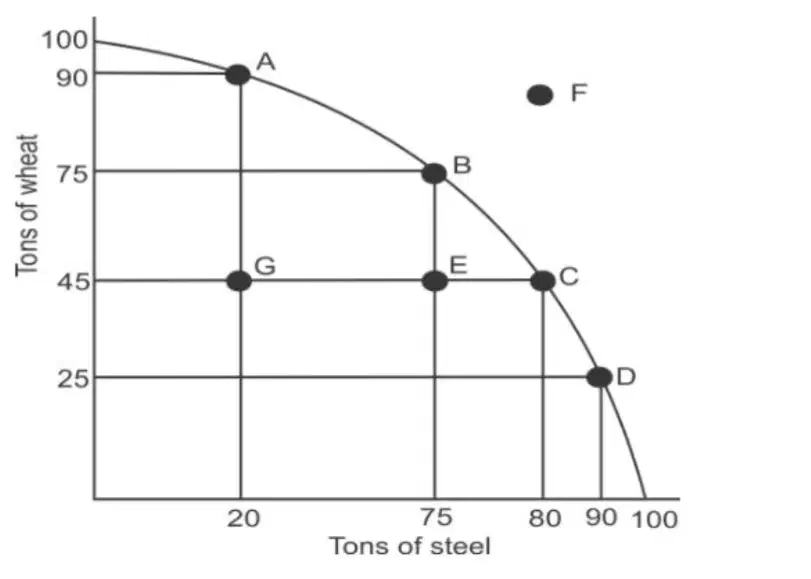
What is the opportunity cost in tons of wheat when moving from point A to point B?
5 tons of wheat
10 tons of wheat
15 tons of wheat
20 tons of wheat
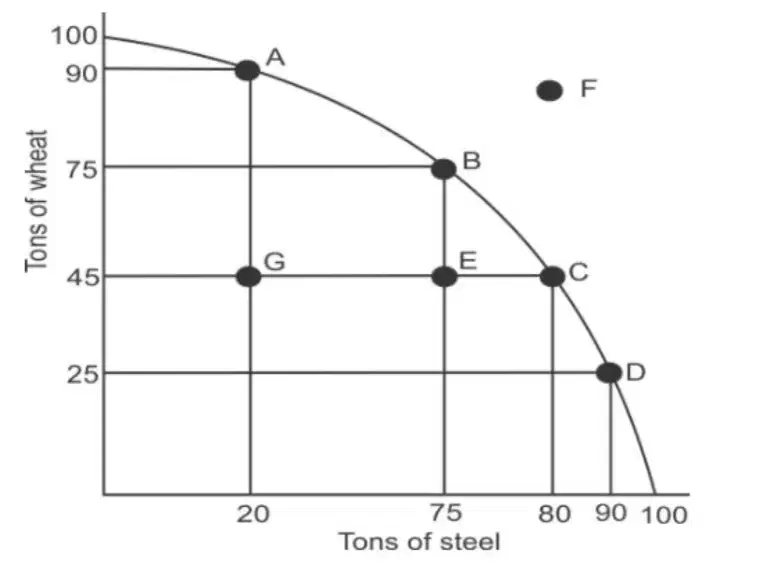
What does point F indicate?
Point F is the desired production
Point F is currently impossible
Point F is a lack of production
Point F shows only steel production
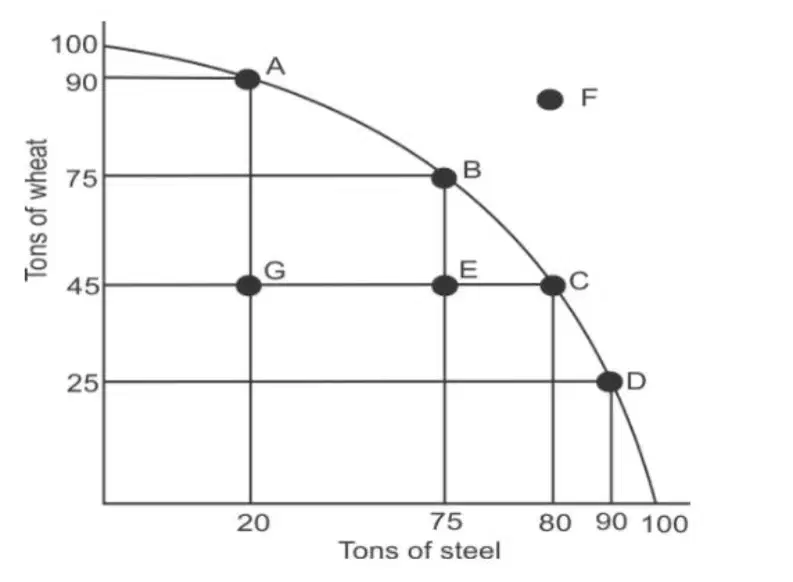
What is the opportunity cost in tons of steel when moving from point D to point C?
10 tons of steel
90 tons of steel
80 tons of steel
75 tons of steel
Which of the following best explains the meaning of opportunity cost?
the initial cost of starting a new business
the cost of business failure
the cost of choosing one alternative over another
the risk associated with producing a new item
Societies are faced with which three basic questions about production of goods?
what, how, and why
what, where, and when
what, how, and for whom
when, where, and for whom
Scarcity forces people to choose, and when they choose...
They bear an opportunity cost.
They pay higher prices.
Total economic output increases.
The frontier shifts outward.
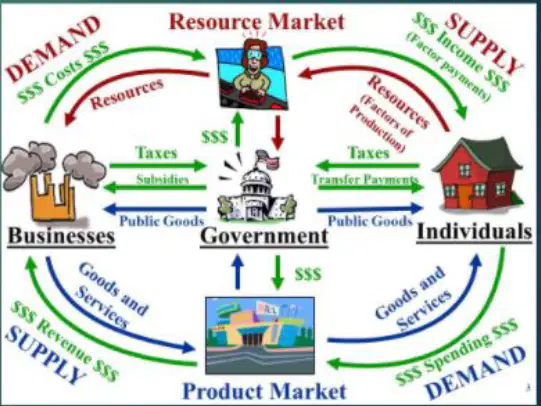
What is the primary purpose of the circular flow model shown above?
How the government makes money
How money exchanges hands and reaches all aspects of the economy
How individuals create jobs
How taxes are earned and created
Which of the following would result in a change in the production possibilities frontier in a nation?
An influx of immigrants from other countries.
The discovery of an abundant natural resource.
A long drought.
All of the above.
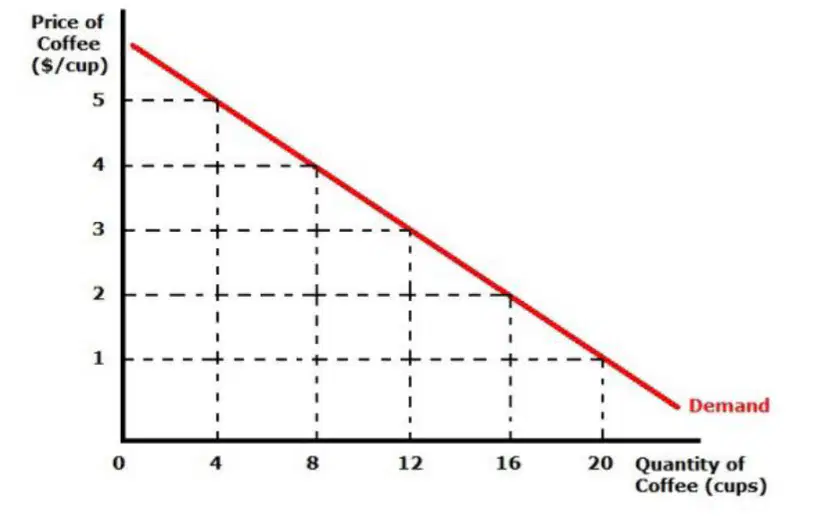
How many cups of coffee are demanded at $4 per cup?
4
8
12
16
A demand schedule is best described as _______.
a graph.
an incentive.
data on a chart.
a time line
Which of these names the only thing that can cause movement along a demand curve?
unit elastic demand
a substitution
a change in price
diminishing satisfaction
Which would an economist consider a likely substitute for coffee?
water
tea
chicken
donuts
Suppliers buy new technology in hopes that it will cause..
inelasticity of supply of that item
a repeal of subsidies for production of that item
a shift of the supply curve for that item to the left
a shift of the supply curve for that item to the right
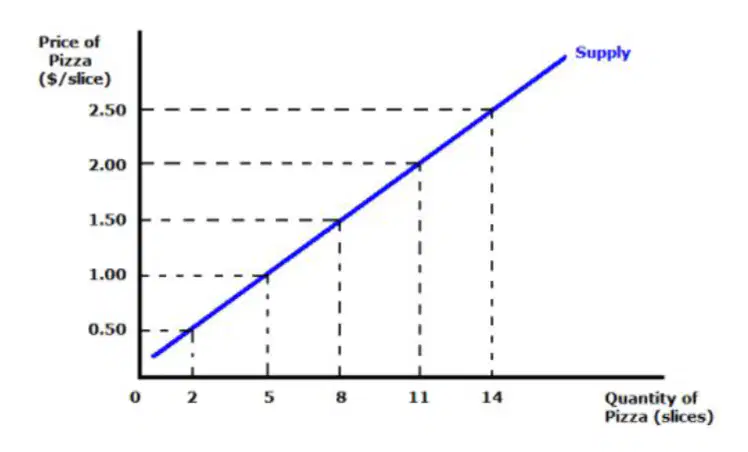
How many slices of pizza are supplied at $2.50 per slice?
14
11
8
5
Which is TRUE about sticker price and net price?
Net price is the sticker price minus loans.
Sticker price is the published cost of going to a school.
Net price is the sticker price minus scholarships and grants.
Why should you file the FAFSA as early as possible?
It can help your chances of being accepted into schools.
Aid is given out on a first-come, first-serve basis.
You're guaranteed to get more merit-based scholarships.
You'll get a lower interest rate on federal student loans.
How do scholarships and grants differ?
Scholarships are need-based; grants are merit based.
Grants are private forms of aid; scholarships are federal.
Grants are need-based; scholarships are merit-based.
They're not different.
Which is TRUE about the FAFSA?
You only need to file the FAFSA one time in your college career.
Your parents must earn below a set amount for you to apply.
You need to file at the start of every quarter/semester.
There is no cost to file the FAFSA.
In what order should you accept different types of financial aid?
Scholarships, work-study, federal loans, private loans.
Work-study, scholarships, federal loans, private loans.
Private loans, scholarships, work-study, federal loans.
Scholarships, work-study, private loans, federal loans.
Net pay is the amount of money you receive...
After taxes and deductions have been taken out
Before taxes and deductions have been taken out
After bonuses and overtime have been added to your base pay
Before bonuses and overtime have been added to your base pay
Each of the following sections is commonly found in a job posting EXCEPT…
Benefits
Qualifications
Job description
List of current applicants
Business organization that is usually owned by multiple stockholders and operates as a separate legal entity.
Proprietorship
Partnership
Limited Liability Corporation
Corporation
Which structure legally protects the owner(s) from liability but still requires the owner(s) to report profits and losses on their personal taxes?
Sole proprietorship
Corporation
LLC
Partnership
Which of the following is a reason to separate your business money from personal money?
To protect your personal assets if the business fails
To qualify for special tax deductions
To increase your personal credit score
To gain access to business loans
What is the difference between a subsidized and unsubsidized student loan?
A subsidized loan does not accrue interest while in school; an unsubsidized loan does.
A subsidized loan has a higher interest rate than an unsubsidized loan.
An unsubsidized loan is only for vocational training.
A subsidized loan is repaid after graduation, while an unsubsidized loan must be repaid during school.
What is the difference between salary and wage?
Salary is based on hours worked, while wage is a set amount.
Salary is taxed differently than wage.
Salary is a set amount regardless of hours worked, while wage is based on hours worked.
Wage includes benefits while salary does not.
Why are intermediate products, second hand sales, and non-market transactions excluded from the GDP?
because only industries found in all nations are counted in the GDP
because these products and services are not common
because these have lower prices
because they are not new production/service sales in a nation
Why is the GDP Per Capita a good figure to look at?
because it also shows the population growth rate of a nation
because it allows for a more accurate comparison of living standards between different nations
because it allows for a comparison of the different capital cities which are often symbolic of a nation’s success
because it includes the unemployment rate in its measure
Real GDP is a good figure to use because it allows for a better comparison of a nation from year to year.
True
False
Which of the following is the formula to determine Gross Domestic Product?
Consumption + Business Costs + Government Expenditures + Net Exports/Imports
Consumption + Investment + Government Expenditures + Net Exports/Imports
National Income + Investment + Government Expenditures + Net Exports/Imports
Consumption + Investment + Government Expenditure + Exports
Which of the following is NOT an influence on the business cycle?
External shocks
Speculation and "Bubbles"
Fiscal policy of the government
Net national income
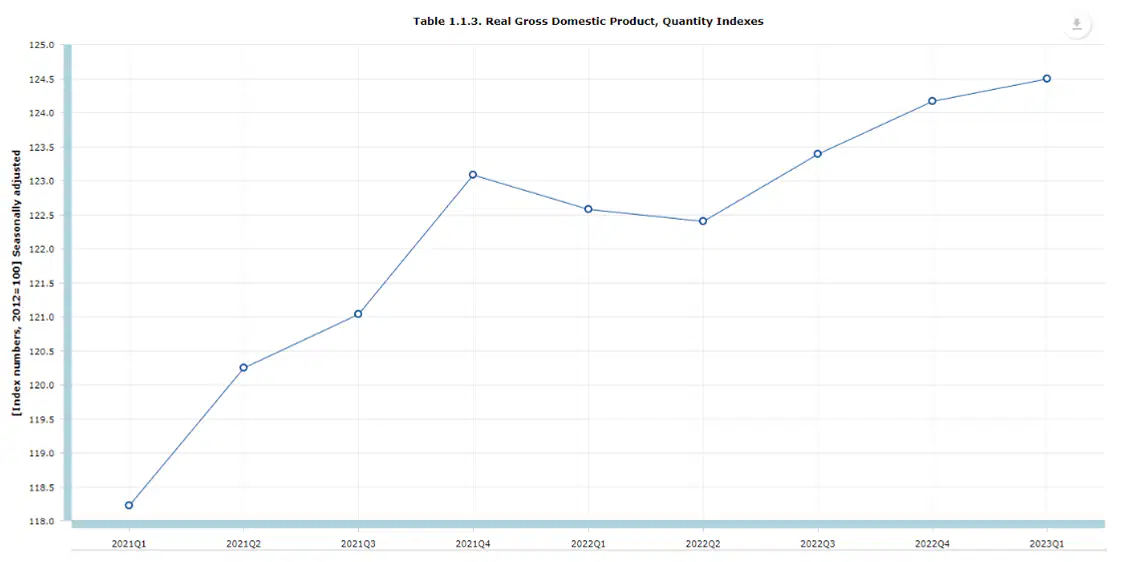
What phase of the business cycle did we experience in 2021Q3?
Expansion
Contraction
Rise
Fall
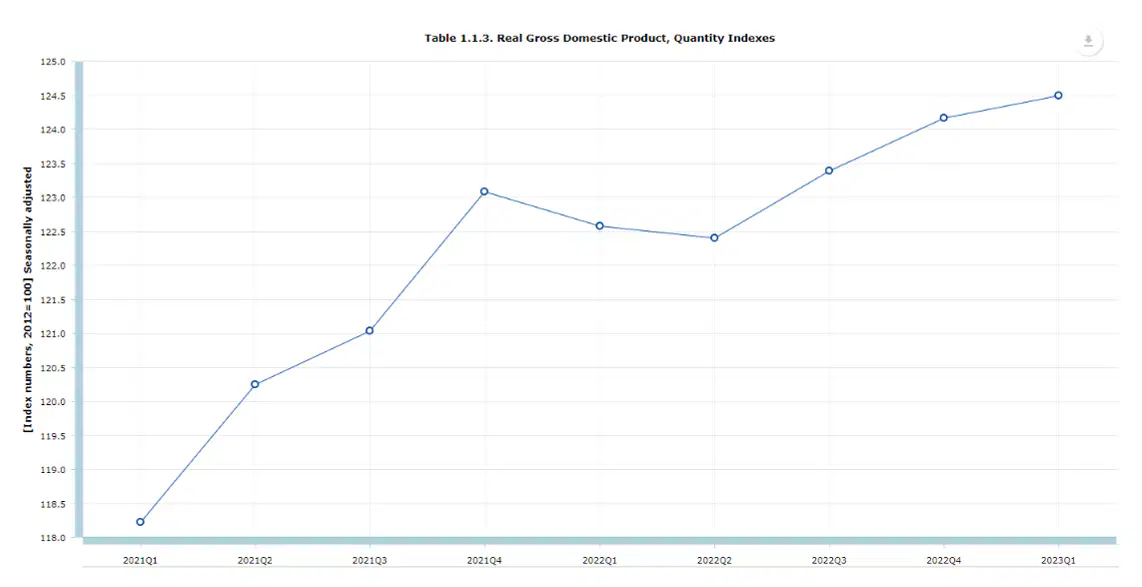
What phase of the business cycle did we experience in 2022Q2?
Ceiling
Floor
Peak
Trough
Why are population projection tools useful in making economic decisions?
because they allow businesses and the different levels of govt to calculate production and infrastructure needs
because they allow the different levels of govt to prevent high poverty and unemployment
because they allow individuals to make better personal finance decisions
Net Immigration means adding up the number of immigrants and the number of emigrants.
True
False
Which of the following would indicate that we have entered a recession?
GDP Increases for at least two quarters.
GDP Decreases for at least three months.
GDP Increases for at least three months.
GDP Decreases for at least two quarters.
Which economic system involves the least amount of government involvement?
Socialist
Command
Mixed
Free Market
Which of the following is not one of the 3 big questions all economic systems must answer?
How much to produce?
How to produce
What to produce
Who will get it?
Which type of economy would fit with a dictatorship?
Command
Traditional
Market
Socialist
High levels of unemployment combined with high levels of inflation could indicate that the business cycle has entered a period of -
recession
stagflation
expansion
investment
What is the role of government in the economy?
Decrease taxes for all citizens
price stability, full employment, and economic growth
Predict business cycles
Increase government spending in all sectors

A key difference between saving and investing is
Saving is for everyone, investing is for the wealthy
Your money is insured when investing, it is not in savings
Investing has a guaranteed return, savings does not
Saving is for emergencies & goals, investing is for long-term wealth

Why is compound interest more beneficial than simple interest?
Your money grows faster when it is compounded
Your taxed on simple interest, but not compound interest
Fees for compound interest are greater than simple interest
Compound interest is hard to calculate, so fewer use it

Which would be considered the highest risk investment type?
Stock
Mutual Fund
Bond
Savings Account

The relationship between risk and return can be stated as
Higher risk indicates higher return
Higher risk indicates lower return
Lower risk indicates higher return
No relationship exists between risk and return

If Jonathan is earning 2% on an investment and inflation is increasing by 3%, what is happening to his purchasing power?
It's increasing
It's decreasing
It's not changing
Inflation and purchasing power are not related

What is the main appeal of an index fund?
They are always actively managed to add a human touch
They are typically low cost and diversified investments
They are always managed by a robo-advisor to remove human bias
They give you partial ownership of a single company

A diversified portfolio is desirable because
It limits investment choice
It's a good predictor on rate of return
It increases risk and return
It decreases risk

What is Social Security?
Social Security is a private retirement fund run by your company
Social Security is another name for a 401(k)
Social Security is a government run retirement program
Social Security is a program that matches your 401(k) contributions

Why is it important to start investing as soon as possible?
You take less risk when you are young, so money will be safe
You have more time for your money to compound
Investing is an easy way to make quick money
Fees on investments are cheaper when you are younger

What is a deductible?
The cost you and your insurance share
The amount your insurance pays before you pay
The discount you get on your health insurance every year
The amount you pay before your insurance begins to pay

How do banks make money off of the credit they issue?
They charge a large, one-time fee at the start of the loan
They take out a small fee each month from your checking account
They charge a high interest rate on the loan
This is a trick question - they DON'T make money!

How do you avoid paying interest on your credit card (or any other loan for that matter)?
Always make the minimum payment over time
Pay interest 1st, then pay what you can on leftover balance
Always make the full payment on time
Pay the principal 1st, then pay what you can on interest

Which statement is true about debit and credit cards?
More businesses accept credit cards than debit cards
You get a monthly statement for a credit card, but not for a debit card
Credit cards withdraw money directly from a bank account; debit cards don't
Debit cards withdraw money directly from a bank account; credit cards don't

Which of the following factors will most likely INCREASE the overall cost of your loan?
A lower interest rate
A longer loan term
Offering collateral to secure the loan
Paying a higher down payment

Which of the following is true about a college education?
College is the only way to get a stable, high paying job
College grads have higher lifetime earnings on average than HS grads
College grads have a higher rate of unemployment
More education is related to lower unemployment

A pre-tax employer sponsored retirement program is called...
Traditional IRA
Roth IRA
Mutual Fund
401(k)
Which is NOT a typical goal for a savings account?
Saving for retirement
Saving for a down payment on a house
Saving for a vacation
Saving for a new car

Which of the following does NOT contribute to your credit score?
Your payment history
Which banks issued your credit cards
Your debt-to-credit ratio
Length of credit history

When applying for a loan, why might a lender be interested in your credit score?
To determine if you actually need a loan
To set the loan's interest rate and terms based on risk
To know how much money you have in your bank account
To sell your personal information to third parties
Which of the following taxes is applied to wages, salaries, dividends, and interest earned?
Corporate Income Tax
Income Tax
Estate Tax
Excise Tax
Match the factor of production term with its definition.
Natural resources needed to produce goods.
Land
Tools, equipment, machinery, and factories used in the production of goods and services.
Capital
People and all of their abilities, efforts, and skills to produce goods and services.
Labor
Individual who accepts risk in investing in a new company.
Entrepreneurship
Match the following terms from Unit 1 to their definitions.
A situation in which quantity supplied is greater than quantity demanded.
Surplus
A situation in which quantity supplied is less than quantity demanded.
Shortage
A product that can be used to replace the purchase of a similar products when prices rise
Substitutes
products related in such a way that an increase in the price of one reduces the demand for the other.
Compliments
Match the following
The condition in which virtually all who are able and willing to work are employed.
Full Employment
Increase in a nation's total output of goods and services over time.
Economic Growth
Systematic changes in real GDP marked by alternating periods of expansion and contraction, with peaks and troughs marking the change.
Business Cycles
Fundamental feature of capitalism, which allows individuals to own and control their possessions as they wish; includes both tangible and intangible property.
Private Ownership
Match the following
Money borrowed to pay for education that can be subsidized (no interest while in school) or unsubsidized (pay interest while in school).
Student Loan
Student aid coming from the state or federal government, the school, or from private sources that does not need to be repaid.
Student Grant
A business owned and run by a single individual. Easiest form of business to set up but has unlimited liability.
Proprietorships
Form of business organization recognized by law as a separate legal entity with all the rights and responsibilities of an individual, including the right to buy and sell property, enter into legal contracts, and to sue and be sued.
Corporations

