
 Worksheets
Vibrations and Waves
Total questions: 56
Worksheet time: 53mins
Name
Class
Date
1.
Vibrations are known as:
a)
a wiggle in time
b)
back and forth movement
c)
wavelengths
2.
A wiggle in both space and time is called:
a)
vibration
b)
back and forth movement
c)
wave
3.
The time required for a pendulum to make one to-and-fro swing is known as the
a)
period
b)
crest
c)
frequency
4.
The high point of a wave is called the
a)
crest
b)
trough
c)
cycle
5.
The low point of a wave is called the
a)
trough
b)
crest
c)
amplitude
6.
The distance from the midpoint to the maximum (crest) of a wave, or from the midpoint to the minimum (trough) is known as the
a)
crest
b)
amplitude
c)
wavelength
7.
Wavelength is
a)
the distance from the top of one crest to the top of the next crest
b)
the distance from the bottom of the trough to the bottom of the next trough
c)
both
8.
Frequency is
a)
the number of events per unit time
b)
the distance between the midpoint and crest
c)
positions where the largest amplitude occurs
9.
Hertz is a unit of
a)
cycles per one second
b)
distance per unit time
c)
accleration
10.
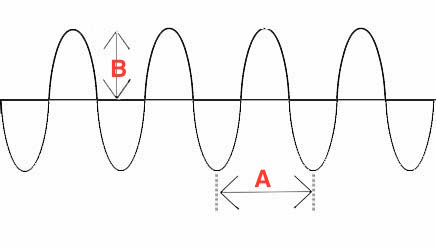
What property of this wave is represented by the letter "A"
a)
amplitude
b)
crest
c)
trough
d)
moanawavelength
11.
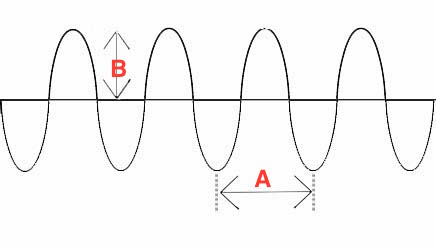
What property of the wave is represented by the letter "B"?
a)
amplitude
b)
crest
c)
trough
d)
wavelength
12.
The number of wavelengths that pass a point each per second is:
a)
frequency
b)
period
c)
longitudinal
d)
transverse wave
13.
The type of waves that require medium to pass:
a)
Mechanical Waves
b)
Electromagnetic Waves
14.

Which vocabulary term is used to identify the distance between points C & G?
a)
Amplitude
b)
Crest
c)
Frequency
d)
Wavelength
15.
When the frequency of a wave increases, what happens to the wavelength?
a)
The wavelength is not directly affected by the frequency of a wave.
b)
The wavelength increases.
c)
The wavelength decreases.
d)
More specific information is needed to form a conclusion about the wavelength.
16.
A mechanical wave cannot travel through...
a)
a vacuum(empty space).
b)
water.
c)
air.
d)
glass.
17.
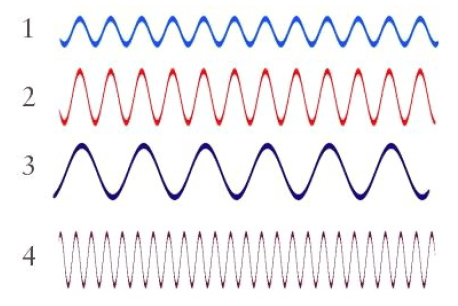
Which wave in the diagram has the greatest frequency?
a)
1
b)
2
c)
3
d)
4
18.
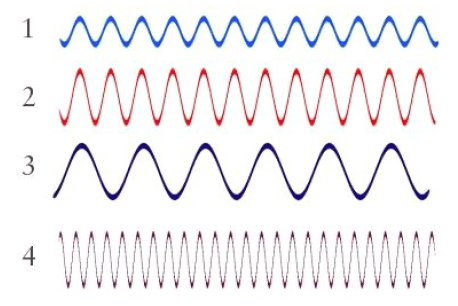
Which wave in the diagram has the greatest wavelength?
a)
1
b)
2
c)
3
d)
4
19.

What kind of wave is pictured below?
a)
compressional wave
b)
transverse wave
c)
sound wave
d)
mechanical wave
20.
All waves carry
a)
energy
b)
light
c)
matter
d)
particles
21.
Constructive interference will cause the wave to
a)
Increase its displacement
b)
Decrease its displacement
c)
Make its displacement stay the same
22.
A standing wave appears to be staying in one place.
a)
True
b)
False
23.
Destructive interference is
a)
When the two waves affect each other in a negative way
b)
The two waves add together and produce a single wave of greater amplitude
c)
Are in phase
24.

In a standing wave, destructive interference creates points of zero amplitude called nodes. Which letters represent this.
a)
A,E,F
b)
B,D,F
c)
B,C,D
d)
A,C,F
25.

In a standing wave, constructive interference creates larger amplitudes. The points of maximum amplitude are antinodes. The letters for these are?
a)
B,C,D
b)
A,E,F
c)
A,C,F
d)
B,D,E
26.
A pair of trapeze performers at the circus is swinging from ropes attached to a large elevated platform. Suppose that the performers can be treated as a simple pendulum with a length of 16 m. Determine the period for one complete back and forth cycle.
a)
2 sec
b)
12 sec
c)
8 sec
d)
10 sec
27.
An amusement park ride has a frequency of 0.064 Hz. What is the ride’s period?
a)
0.064 sec
b)
6.4 sec
c)
2pi / 0.064
d)
15.625 sec
28.
A mass attached to a spring vibrates back and forth. At the equilibrium position, the
a)
acceleration reaches a maximum.
b)
velocity reaches a maximum.
c)
net force reaches a maximum.
d)
velocity reaches zero.
29.
For a system in simple harmonic motion, which of the following is the time required to complete a cycle of motion?
a)
amplitude
b)
period
c)
frequency
d)
revolution
30.

What type of wave is this?
a)
Longitudinal Wave
b)
Standing Wave
c)
Bubble Wave
d)
This is not a wave.
31.
Wave particles are parallel to the wave direction in ________waves.
a)
Transverse
b)
Longitudinal
32.
Wave particles are perpendicular to the wave direction in ________waves.
a)
Transverse
b)
Longitudinal
33.
Constructive interference is
a)
When two waves affect one another in a positive way.
b)
Produce a single wave of greater amplitude (add together)
c)
Both
34.
In-phase is
a)
Constructive interfence
b)
Destructive interference
c)
Longitudinal
35.
Out-of-phase is
a)
Destructive interference
b)
Constructive interference
c)
Transverse
36.
The apparent change in frequency due to the motion of the source of the receiver is known as
a)
Frequency
b)
Doppler Effect
c)
Shock wave
37.
In light, the Doppler effect also takes place, when the frequency increases we call this
a)
Red shift
b)
Blue shift
c)
Bow wave
38.
When the frequency decreases in light, we call this
a)
Red shift
b)
Blue shift
c)
shock wave
39.
What is created when two waves at nearly the same frequency interfere with each other?
a)
Resonance
b)
Wave Reflection
c)
Standing Wave
d)
Beats
40.
Waves transfer ________, but they do not transfer _________.
a)
Matter, Energy
b)
Energy, Matter
41.
Frequency is measured in what SI unit?
a)
Hertz
b)
m/s
c)
Waves
d)
Seconds
42.
The amount of time it takes for one complete wavelength to pass a point in a medium is known as what?
a)
Frequency
b)
Wave Speed
c)
Wavelength
d)
Period
43.
Sound travels FASTEST through which of these materials?
a)
Air
b)
Empty space
c)
Metal
d)
Water
44.
Sound is caused by?
a)
force
b)
vibrations
c)
instruments
45.

What is frequency?
a)
the number of vibrations per second
b)
how high or low a sound is
c)
the loudness or softness of a sound
d)
the back and forth movement of matter
46.

Sound moves in a _________.
a)
Transverse wave
b)
Longitudinal wave
47.

Area of a longitudinal wave where particles are CLOSE together.
a)
Compression
b)
Rarefaction
48.

Area of a longitudinal wave where particles are APART.
a)
Compression
b)
Rarefaction
49.

Which device measures sound waves?
a)
Oscilloscope
b)
Stethoscope
c)
Radio
d)
I don't know
50.

The reflection of sound waves off of a hard surface can create ______.
a)
A wave
b)
An echo
51.

Soft surfaces _______ sound waves.
a)
Reflect
b)
Absorb
52.

___________ measures how close or far particles are.
a)
Amplitude
b)
Frequency
53.

____________ is determined by sound wave's frequency.
a)
Compression
b)
Pitch
54.

_______ is the number of waves that pass a certain point at an specific time.
a)
Frequency
b)
Pitch
c)
Amplitude
d)
I don't know
55.

If you had to make some headphones to isolate sound, which material would you use?
a)
Soft, because they absorb sound.
b)
Hard, because they reflect sound.
56.
Sound travels slowest through _________ .
a)
gas
b)
solids
c)
liquids
d)
metal
100 %

