

wayground logo

Free Printable Worksheets

NEW

Font size

S
M
L
XL
Worksheets

Photosynthesis and Plant Adaptation

Total questions: 28

Worksheet time: 14mins
Name
Class
Date
1.

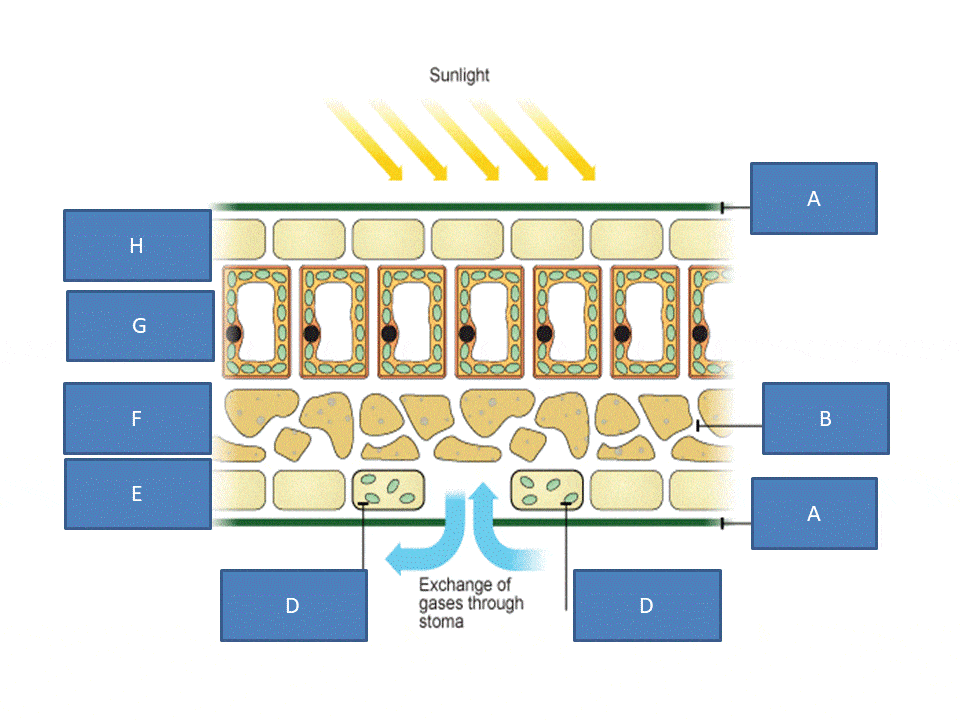
What is the name of the clear layer of cells (H) on top of the leaf?

a)

Cuticle

b)

Air space

c)

Guard cell

d)

Upper epidermis

2.
The leaf has a shiny, waxy cuticle around it to
a)
increase the rate of photosynthesis
b)
attract more light
c)
control water loss
d)
stop carbon dioxide and oxygen gases escaping
3.

What is the name of cells (part D) that surround the pores of a leaf?

a)

Palisade cells

b)

Guard cell

c)

Spongy layer

d)

Lower epidermis

4.
The role of the guard cell is to
a)
help control the temperature of the plant
b)
control how much water enters the leaf
c)
control how much glucose is stored
d)
control the movement of water vapour & gases 
5.
If guard cells are swollen with water, then the are more likely to be ... 
a)
OPEN with stomata
b)
CLOSED with no stomata
c)
Cannot tell - the water amount doesn't affect it at all.
6.

What is the name of the elongated, packed cells (part G) directly under the upper epidermis?

a)

Palisade cells

b)

Guard cell

c)

Spongy layer

d)

Lower epidermis

7.
carries water and minerals from roots to other parts of the plant
a)
xylem 
b)
phloem
c)
stoma
d)
guard cell
8.
Which cells of a leaf undergo the MOST photosynthesis?
a)
Guard cells
b)
Palisade cells
c)
Epidermal cells
d)
Cells in the spongy layer
9.
Most plants appear green because chlorophyll
a)
absorbs green light.
b)
absorbs violet light.
c)
reflects green light.
d)
does not absorb violet light.
10.
What is chlorophyll's main function?
a)
to make the plant a vegetable
b)
to blend into their environment
c)
to capture energy from sunlight for photosynthesis
d)
to help prevent water loss
11.
After photosynthesis, plants store their energy as _________ .
a)
chlorophyll
b)
pigment
c)
glucose (sugar)
d)
Oxygen
12.

____________ cells open and close the stomata

a)

palisade

b)

guard

c)

xylem

d)

epidermis

13.
Xylem and phloem are examples of _ tissue
a)
Spores
b)
Nonvascular
c)
Seeds
d)
Vascular
14.
The Xylem in plants transport what throughout the plant?
a)
Sunlight
b)
Oxygen
c)
Blood
d)
Water
15.
Vascular tissue that transports water and minerals UPWARDS from a plant's roots is know as ______.
a)
Chlorophyll
b)
Phloem
c)
Stomata
d)
Xylem
16.
Vascular tissue that carries dissolved food from leaves to other parts of the plant
a)
Xylem
b)
Phloem
c)
Cortex
d)
Cambium
17.

What is excess water being released from the leaves called?

a)

transpiration

b)

perspiration

c)

chemosynthesis

d)

photosynthesis

18.
Some plants have spines or _________ that cause pain if an animal touches them.
a)
thorns
b)
wax
c)
stalks
d)
smells
19.

Identify structure 1 in the diagram.

a)

Spongy mesophyll

b)

Vascular bundle

c)

Waxy cuticle

d)

Palisade mesophyll

20.

Identify structure 2 in the diagram.

a)

Stomata

b)

Upper epidermis

c)

Vascular bundle

d)

Xylem

21.

Identify structure 4 in the diagram.

a)

Spongy mesophyll

b)

Guard cell

c)

Phloem

d)

Palisade mesophyll

22.

Identify structure 7 in the diagram.

a)

Guard cell

b)

Phloem

c)

Stomata

d)

Upper epidermis

23.

Recall the main role of the specialised plant cell below.

Guard cells

a)

Absorb water/mineral

b)

Open/close stomata

c)

Photosynthesis

24.

Recall the main role of the specialised plant cell below.

Root hair cells

a)

Open/close stomata

b)

Photosynthesis

c)

Absorb water/minerals

25.

Recall what substance is used to test for photosynthesis.

a)

Ethanol

b)

Iodine solution

c)

Biurets

d)

Benedicts solution

26.
The leaf has a shiny, waxy cuticle around it to
a)
increase the rate of photosynthesis
b)
attract more light
c)
control water loss
d)
stop carbon dioxide and oxygen gases escaping
27.
Most of the chloroplast cells are found in the
a)
upper epidermis
b)
pallisade mesophyll layer
c)
lower epidermis
d)
stomata
28.
In a chemical equation, which is true? 
a)
reactants--> products 
b)
products--> reactants
