wayground logo

Free Printable Worksheets

NEW

Font size

S
M
L
XL
Worksheets

Plate Boundaries

Total questions: 30

Worksheet time: 24mins

Name
Class
Date
1.

The place where two plates come together is known as a _______

a)

transform boundary.

b)

divergent boundary.

c)

convergent boundary.

d)

rift valley.

2.
What are the two types of crust?
a)
continental and oceanic
b)
ocean and basin
c)
lower and upper
d)
thick and thin
3.

_____________ is a plate boundary where two plates move away from each other.

a)

Convergent boundary

b)

Transform boundary

c)

Divergent boundary

d)

Insurgent boundary

4.

A _____________ is when two plates move past each other in opposite directions.

a)

emergent boundary

b)

divergent boundary

c)

transform boundary

d)

convergent boundary

5.
Which explains that the continents were once joined together and over time they broke up and then drifted apart?
a)
Plate Tectonic Theory
b)
Continental Drift 
6.
Name the boundary
a)
convergent boundary
b)
divergent boundary
c)
transform boundary
d)
sergent boundary
7.
Name the boundary
a)
convergent boundary
b)
divergent boundary
c)
transform boundary
d)
sergent boundary
8.

Any trace of an ancient organism that has been preserved in rock is called a

a)

landform

b)

continent

c)

fossil

d)

landmass

9.
A plate boundary where two plates move away from each other is called
a)
Divergent Boundary
b)
Convergent Boundary
c)
Transform Boundary
d)
Subduction
10.
A Plate Boundary where two plates move toward each other is called
a)
Convergent Boundary
b)
Divergent Boundary
c)
Transform Boundary
d)
Subduction
11.
Convergent Plate Movement can create
a)
Rifts
b)
Mountains
c)
Ocean Ridges
d)
Radiation
12.
Convergent Plate Movement can create
a)
Rifts
b)
Mountains
c)
Ocean Ridges
d)
Radiation
13.
The process by which molten material adds new oceanic crust to the ocean floor is called ___________.
a)
Divergent boundary
b)
Sea-floor spreading
c)
Convergent boundary
d)
Renovating 
14.

Plates slide past each other at _________________ boundaries.

a)

divergent

b)

convergent

c)

transform

d)

universal

15.

Where do most earthquakes occur?

a)

along edges of continents

b)

along plate boundaries

c)

random places in oceans

16.

Tectonic plates meet at _________________.

a)

plate boundaries

b)

plate meeting areas

c)

plates don't meet

17.

All are proofs that plates were together millions of years ago EXCEPT :

a)

Fossils

b)

Similar landforms on each continent.

c)

Rocks

d)

Continental Drift

18.

What geologic feature/event would you most likely to find at a divergent boundary between two pieces of continental crust?

a)

Mid-Ocean Ridge

b)

Mountain

c)

Rift Valley

d)

Island Arc

19.

Transform Boundaries ______

a)

Collide

b)

Slide

c)

Break

d)

Build

20.
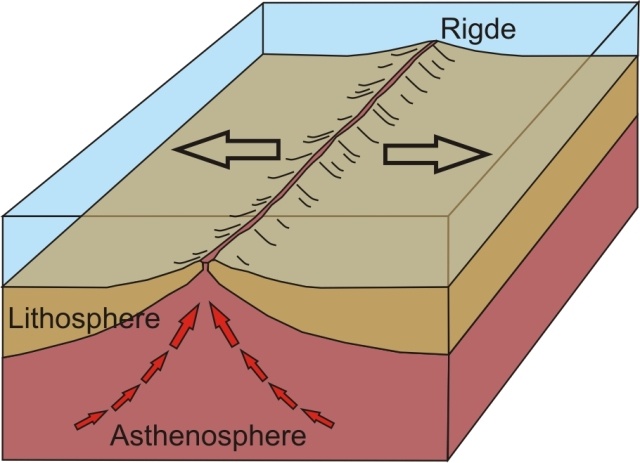
What kind of plate boundary is shown here?
a)
divergent
b)
convergent
c)
transform
d)
submergent
21.

What kind of plate boundary is shown here?

a)

divergent

b)

convergent

c)

transform

d)

subducting

22.

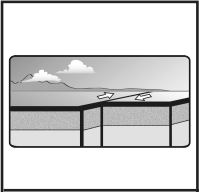
What type of boundary is this?

a)

convergent

b)

divergent

c)

transform

23.

What type of boundary is this?

a)

convergent

b)

divergent

c)

transform

24.

This is demonstrating a ...

a)

divergent boundary

b)

convergent boundary

c)

transform boundary

25.

This is demonstrating a ...

a)

divergent boundary

b)

convergent boundary

c)

transform boundary

26.

Where would you find OCEANIC Crust?

a)

In the Oceans

b)

On the Continents

27.

Where would you find CONTINENTAL Crust?

a)

In the Oceans

b)

On the Continents

28.
What geologic feature/event you be most likely to find at a transform boundary?
a)
Earthquakes
b)
Volcanoes
c)
Mountains
d)
Rift Valleys
29.
What geologic feature/event would you most likely to find at a convergent boundary between two pieces of continental crust?
a)
Volcano
b)
Mountain
c)
Rift
d)
Island Arc
30.
Mountains are created when....
a)
Two continental plates collide
b)
Two oceanic plates pull apart
c)
An Oceanic plate subducts under a Continental Plate
d)
Two continental plates pull apart