
 Worksheets
Biology Cell Membrane Transport
Total questions: 20
Worksheet time: 15mins
Name
Class
Date
1.

The yellow and brown portion of this image is:
a)
protein
b)
phopholipid
c)
carbohydrate
d)
cholesterol
2.
The purple regions of the image represent:
a)
phospholipid
b)
cholesterol
c)
proteins
d)
carbohydrates
3.
Examples of particles that can diffuse across through the phospholipid bilayer include:
a)
oxygen and carbon dioxide
b)
sugar
c)
water
d)
calcium ions
4.
A phospholipid has 2 parts. What are they called?
a)
Hydrophilic Head, Hydrophobic Tail
b)
Hydrophobic Head, Hydrophilic Tail
5.
"Water Loving"
a)
Hydrophobic
b)
Hydrophilic
c)
Hydroelectric
d)
Hydroloric
6.
"Water Fearing"
a)
Hydrophobic
b)
Hydrophilic
c)
Hydroelectric
d)
Hydroloric
7.
Describes the arrangement of the cell membrane as bendable and made of many parts.
a)
The Fluid Mosaic Model
b)
The Major Mobility Model
c)
The Crazy Cell Model
d)
The Maze Model
8.
Something is ___________ ____________
when some molecules can cross the membrane while others cannot.
when some molecules can cross the membrane while others cannot.
a)
Selectively (or Semi) Permeable
b)
Totally Transparent
c)
Liquid Licorice
d)
Heavily Patrolled
9.
How does a cell maintain homeostasis?
a)
Regulates what enters and leaves the cell
b)
Flexibility
c)
Protective barrier
d)
Structure and support
10.
Controls the passage of materials inside and outside of the cell.
a)
Cell Membrane
b)
Lipid Cleric Layer
c)
Membrane Gate
d)
Protein Receptors
11.
The cell membrane is selectively permeable, which means...
a)
All materials can enter and leave the cell
b)
Certain things can enter while others cannot
c)
The cell manually sorts through all materials
d)
Only certain cells can interact with the cell.
12.
Which of the following is NOT part of the cell membrane?
a)
Lipids
b)
Carbs
c)
Proteins
d)
Nucleic Acids
13.
What is diffusion?
a)
when molecules move
b)
when molecules move from a high concentration to a low.
c)
no movement
d)
molecules move everywhere
14.
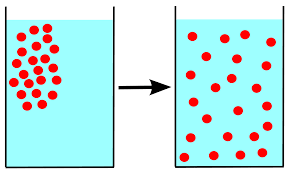
The picture below is an example of _________________.
a)
osmosis
b)
isotonic
c)
diffusion
d)
active transport
15.
Osmosis is the movement of _____ across a membrane.
a)
food
b)
energy
c)
oxygen
d)
water
16.
During osmosis
a)
water moves from high to low concentration
b)
large or oddly shaped molecules move across a cell membrane
c)
water moves when energy is used
d)
proteins are built
17.
When both inside and outside of a cell have the same amount of water it is said that the cell has reached a state of
a)
Osmosis
b)
Diffusion
c)
Equilibrium
18.
A person should never drink salty water because their cells would
a)
shrink
b)
expand
19.
If there is 5 percent water inside a cell and 5 percent water outside a cell
a)
more water will move inside the cell
b)
more water will move outside the cell
c)
There will be no movement of water cells
20.
Passive transport requires no
a)
concentration gradients
b)
osmosis
c)
motion
d)
energy
100 %

