
NEW
Font size
S
M
L
XL
 Worksheets
1D Dynamics
Total questions: 21
Worksheet time: 14mins
Name
Class
Date
1.
The closeness of a measurement to its true value is a measure of its:
a)
precision
b)
accuracy
c)
reproducibility
d)
usefulness
2.
Three different people weigh a standard mass of 2.00 g on the same balance. Each person obtains a reading of exactly 7.32 g for the mass of the standard. These results imply that the balance that was used is:
a)
accurate but not precise
b)
precise but not accurate
c)
both accurate and precise
d)
neither accurate nor precise
3.
A scalar is a quantity that is fully described by ____
a)
magnitude alone
b)
both its magnitude and its direction
c)
both its displacement and its velocity
d)
both its distance and its speed
4.
For any given motion, the distance is ____.
a)
the direction which an object moves
b)
the scalar of the object's velocity
c)
how far out of place which the object finishes relative to the starting location.
d)
the amount of ground which is covered by the moving object.
5.
A vector is a quantity that is fully described by ____.
a)
both its magnitude and its direction
b)
magnitude alone
c)
both its distance and its speed
d)
both its displacement and its velocity
6.
For any given motion, displacement is ____.
a)
the direction which an object moves.
b)
the magnitude which the object moves.
c)
how far out of place which the object finishes relative to the starting location.
d)
the amount of ground which is covered by the moving object.
7.
A teacher does the following motion in 10 seconds: (i) walks 2 m, south (ii) walks 4 m, east (iii) walks 2 m, north (iv) walks 4 m, west. The average speed of the teacher is ____.
a)
0.0 m/s
b)
0.83 m/s
c)
1.2 m/s
d)
An average speed cannot be determined since individual speed values are not given.
8.
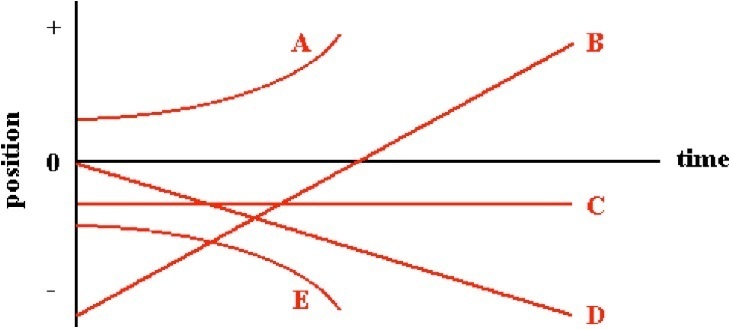
The motions of five objects - A, B, C, D, and E - are represented by lines on a position-time graph. Write the letter for the object that has the greatest constant velocity.
a)
B
b)
C
c)
D
d)
E
9.
A teacher does the following motion in 10 seconds: (i) walks 4 m, south (ii) walks 8 m, east (iii) walks 4 m, north (iv) walks 8 m, west. The average velocity of the teacher is ____.
a)
0.0 m/s
b)
0.6 m/s
c)
1.2 m/s
d)
2.4 m/s
10.

An old car has a leaky engine and leaves the following oil drop trace on the street; the drops hit the street at regular time intervals. The oil drop pattern depicts
a)
a constant velocity
b)
an accelerated motion
c)
... it's impossible to tell without any distance-time data.
11.
The slope of a position-time graph represents the _____ of the object.
a)
displacement
b)
acceleration
c)
velocity
d)
none of these
12.
The position-time graph for an object with a positive velocity would be a line with ____
a)
no slope
b)
positive slope
c)
changing slope
d)
a curve
13.
The position-time graph for an object with a velocity of zero would be a line with ____.
a)
zero slope
b)
upwared slope
c)
constant positive slope
d)
changing slope
14.
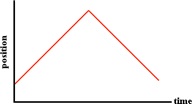
As represented by this position-time graph, this object is ____.
a)
speeding up, changing directions, and then slowing down
b)
accelerating, first with a positive and then with a negative acceleration
c)
speeding up and then slowing down, all while moving in the same direction
d)
moving in the positive direction and then in the negative direction, both at constant speed
15.
Acceleration is defined as ____.
a)
the rate at which the position changes
b)
the rate at which the displacement changes
c)
the rate at which the speed changes
d)
the rate at which the velocity changes
16.
Which of the following represent an accelerated motion?
a)
An object that remains at rest.
b)
An object moving in a circle at constant speed.
c)
An object moving at constant speed in the same direction.
d)
An object that changes its velocity
17.
A car with a rightward velocity and a leftward acceleration is ____.
a)
moving to the right and speeding up
b)
moving to the right and slowing down
c)
moving to the left and speeding up
d)
moving to the left and slowing down
18.
The slope of a velocity-time graph represents the _____ of the object
a)
displacement
b)
velocity
c)
acceleration
19.
The velocity-time graph for an object with a constant positive acceleration would be a line ____.
a)
that curves upward
b)
that curves, either upward or downward
c)
with no slope
d)
that has changing slope
20.
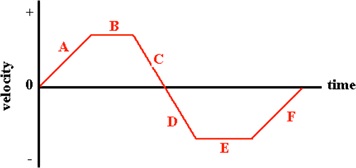
The motion of an object is depicted by a velocity-time graph. Various time intervals during the motion are depicted by a letter. During which time interval(s) is the object moving with a positive acceleration?
a)
A
b)
C
c)
D
d)
E
21.
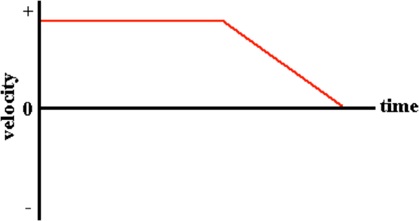
As represented by this velocity-time graph, this object is ____.
a)
at rest for several seconds and then accelerates in the negative direction
b)
moving at a constant speed and then slowing down
c)
at rest for several seconds and then moves in the negative direction
d)
... nonsense! None of these appropriately describe the object's motion
Reset

