wayground logo

Free Printable Worksheets

NEW

Font size

S
M
L
XL
Worksheets

Chapter 6 Running Water and Groundwater

Total questions: 54

Worksheet time: 27mins

Name
Class
Date
1.

What is the unending circulation of Earth's water supply______

a)

The water cycle

b)

the carbon cycle

c)

the solar cycle

2.

The movement of surface water into rock or soul through cracks and pore spaces

a)

Infiltration

b)

Penatration

c)

groundwater

3.

Balance in the water cycle means_____

a)

the average annual precipitation over Earth equals the amount of water that evaporates and transpires.

b)

the world is functioning at a great rate.

c)

all live forms on earth are alive

4.

The ability of a stream to erode abd transport materials depends largely on ___.

a)

velocity

b)

stream channel

c)

gradient

5.

The course the water in a stream follows

a)

A stream channel

b)

Discharge

c)

Down stream

6.

The slope or steepness of a stream channel.

a)

gradient

b)

slope

c)

upstream

7.

The ___ of a stream is the volume of water flowing past a certain point in a given unit of time.

a)

discharge

b)

tributary

c)

meanders

8.

While graident decreases between a stream's headwaters and mouth, discharge_____

a)

increases

b)

decreases

c)

stays the same

9.
The circulation of the earth's water, in which water evaporates from the sea into the atmosphere, where it condenses and falls as rain or snow, returning to the sea by rivers or returning to the atmosphere by evapo-transpiration is called the...
a)
carbon cycle
b)
nitrogen cycle
c)
water cycle
d)
rock cycle
10.
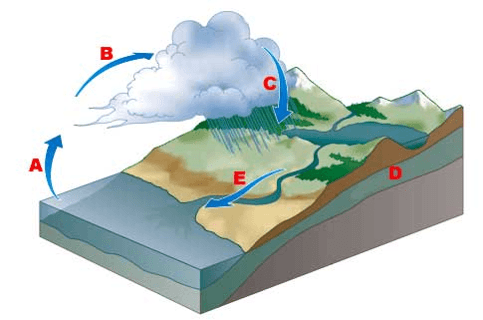
What is occurring at A in the diagram?
a)
runoff
b)
precipitation
c)
evaporation
d)
condensation
11.
What process is happening at C in the diagram?
a)
runoff
b)
precipitation
c)
condensation
d)
transpiration
12.
The processes of the Water Cycle are…
a)
physical changes
b)
chemical changes
c)
phase changes
d)
physical and phase changes
13.
An area of land in which all of the water falling or flowing over it drains to the same location is a/an…
a)
watershed
b)
watertable
c)
river
d)
aquifer
14.
Water that is located in the ground in the pores within rock is called…
a)
watershed
b)
surface water
c)
groundwater
d)
water cycle
15.
An underground layer of permeable rock that holds groundwater which can be extracted by drilling a well.
a)
water table
b)
aquifer
c)
watershed
d)
river
16.
The area of an aquifer in which rock pores are completely filled with water.
a)
water table
b)
watershed
c)
zone of saturation
d)
surface water
17.
The top boundary of the zone of saturation in an aquifer which can fluctuate based on precipitation and the amount of draw from wells
a)
aquifer
b)
water table
c)
watershed
d)
drainage system
18.
Groundwater is found in permeable rock.  Permeable means…
a)
porous
b)
nothing can pass throughc
c)
caves and caverns
d)
answer not shown
19.
How can surface pollutants contaminate groundwater?
a)
runoff with water and penetrate soil
b)
seep into ground and rock
c)
spread in aquifer to contaminate large areas
d)
all answers are correct
20.
Groundwater contamination…
a)
is easily cleaned up
b)
is difficult to clean or remove
c)
is not a problem for modern people
d)
does not affect the United States
21.
How do people extract groundwater?
a)
groundwater cannot be extracted
b)
by drilling wells and pumping water out of the ground
c)
mining water from the Earth
d)
answer not shown
22.
Excessive pumping of groundwater can cause subsidence.  This is a problem in Texas and Louisiana.  What would happen to homes and buildings that were built on land which subsided?
a)
settling and breaking of foundations
b)
flooding
c)
both answers are correct
d)
neither answer is correct
23.
What do all the sources of groundwater contamination shown have in common?
a)
caused by humans so it is preventable
b)
naturally occurring so it cannot be prevented
24.

water cycle

a)

the continuous movement of water between the atmosphere, the land, the oceans, and living things

b)

the change of state from a liquid to a gas that usually occurs at the surface of a liquid over a wide range of temperatures

c)

the process by which plants release water vapor into the air through stomata; also the release of water vapor into the air by other organisms

d)

the change of state from a solid directly to a gas

25.

evaporation

a)

the process by which plants release water vapor into the air through stomata; also the release of water vapor into the air by other organisms

b)

the change of state from a gas to a liquid

c)

at constant pressure and water vapor content, the temperature at which the rate of condensation equals the rate of evaporation

d)

the change of state from a liquid to a gas that usually occurs at the surface of a liquid over a wide range of temperatures

26.

transpiration

a)

a cloud that forms near the ground and results in a reduction in visibility

b)

a collection of small water droplets or ice crystals suspended in the air, which forms when the air is cooled and condensation occurs

c)

the process by which plants release water vapor into the air through stomata; also the release of water vapor into the air by other organisms

d)

any form of water that falls to Earth's surface from the clouds

27.

condensation

a)

the change of state from a gas to a liquid

b)

any form of water that falls to Earth's surface from the clouds

c)

at constant pressure and water vapor content, the temperature at which the rate of condensation equals the rate of evaporation

d)

the change of state from a liquid to a gas that usually occurs at the surface of a liquid over a wide range of temperatures

28.

precipitation

a)

any form of water that falls to Earth's surface from the clouds

b)

the change of state from a gas to a liquid

c)

the process by which plants release water vapor into the air through stomata; also the release of water vapor into the air by other organisms

d)

the change of state from a liquid to a gas that usually occurs at the surface of a liquid over a wide range of temperatures

29.

cloud

a)

the change of state from a gas to a liquid

b)

a collection of small water droplets or ice crystals suspended in the air, which forms when the air is cooled and condensation occurs

c)

at constant pressure and water vapor content, the temperature at which the rate of condensation equals the rate of evaporation

d)

any form of water that falls to Earth's surface from the clouds

30.

dew point

a)

at constant pressure and water vapor content, the temperature at which the rate of condensation equals the rate of evaporation

b)

the change of state from a liquid to a gas that usually occurs at the surface of a liquid over a wide range of temperatures

c)

the process by which plants release water vapor into the air through stomata; also the release of water vapor into the air by other organisms

d)

the change of state from a gas to a liquid

31.

fog

a)

any form of water that falls to Earth's surface from the clouds

b)

cloud that forms near the ground and results in a reduction in visibility

c)

at constant pressure and water vapor content, the temperature at which the rate of condensation equals the rate of evaporation

d)

the change of state from a gas to a liquid

32.

surface water

a)

all the bodies of fresh water, salt water, ice, and snow that are found above the ground

b)

the water that is beneath Earth's surface

c)

the upper surface of underground water; the upper boundary of the zone of saturation

d)

the path that a stream follows

33.

groundwater

a)

all the bodies of fresh water, salt water, ice, and snow that are found above the ground

b)

the water that is beneath Earth's surface

c)

the area of land that is drained by a river system

d)

a body of rock or sediment that stores groundwater and allows the flow of groundwater

34.

water table

a)

the path that a stream follows

b)

a body of rock or sediment that stores groundwater and allows the flow of groundwat

c)

the upper surface of underground water; the upper boundary of the zone of saturation

d)

the boundary between drainage areas that have streams that flow in opposite directions

35.
What are 3 places  that water constantly moves through?
a)
the atmosphere, the solid Earth, and the biosphere
b)
the air, the water, and the earth
c)
stuff
d)
things
36.
Which are three processes involved in the water cycle?
a)
precipitation, evaporation, infiltration
b)
condensation, sublimation, and precipitation
c)
transportation, procrastination, infiltration
d)
evaporation, precipitation, sublimation
37.
True or False: All water is from surface runoff
a)
True
b)
False
38.
True or False: Gaining stream loses water from groundwater
a)
False
b)
True
39.
The ability of a stream to erode and transport materials depends largely on its ________.
a)
velocity
b)
volume
c)
gradient
d)
length
40.
Which is a factor that decreases downstream?
a)
volume
b)
length
c)
gradient
d)
velocity
41.
During droughts, lack of rain can lead to wells drying up. This is because the drought has lowered the ____.
a)
water trough
b)
zone of aeration
c)
water table
d)
zone of porosity
42.
Ocean -> Evaporation -> Condensation
Which of these would come next in the water cycle?

a)
Aeration
b)
Deposition
c)
Sedimentation
d)
Precipitation
43.
Sinkholes are associated with what kind of bedrock?
a)
Granite
b)
Limestone
c)
Gneiss
d)
Basalt
44.
In karst regions, caves are carved by the flow of water through limestone bedrock. How do the stalagmites and stalactites in the caves develop?
a)
They are granite intrusions that remain behind after water dissolves the surrounding limestone
b)
They are carbonate deposits formed by dripping water in air-filled cavities
c)
They are carvings made in limestone by the swirling water as it hollows out the cavern
d)
They are crystals that grow as water hollows out the cavern
45.
Which of the following is an example of chemical weathering?
a)
Splits in a rock due to tree roots
b)
Pulverized rock resulting from a landslide
c)
A rock broken into chunks after being carried by rapidly flowing water
d)
The dissolving of limestone by acid rain
46.
Caves are found in Virginia's Valley and Ridge province because the area is underlain by____.
a)
limestone
b)
gneiss
c)
shale
d)
granite
47.
Organic matter in soil is made from ____.
a)
weathered parent rock
b)
decayed plants and animals
c)
acid rain
d)
carbon dioxide
48.
A common kind of mechanical weathering is called _____.
a)
leaching
b)
carbonation
c)
ice wedging
d)
oxidation
49.
All of the following are causes of mechanical weathering EXCEPT
a)
ice
b)
oxidation
c)
tree roots
d)
animals
50.
Which best represents the most common arrangement of zones in a water table
a)
surface, aerated zone, bedrock, saturated zone
b)
surface, bedrock, aerated zone, saturated zone
c)
surface, aerated zone, saturated zone, bedrock
d)
surface, bedrock, saturated zone, aerated zone
51.
What is located beneath soil layers?
a)
Bedrock
b)
Humus
c)
Lava
d)
Tundra
52.
Which of these substances plays the most important part in chemical weathering?
a)
Wind
b)
Water
c)
Ice
d)
Frost
53.
When water can pass through rock or sediment it is said to be ____.
a)
impermeable
b)
transparent
c)
permeable
d)
extrusive
54.
Deposition by moving water in a river is most likely to occur as the
a)
water slows down
b)
water speeds up
c)
water becomes warmer
d)
riverbed becomes steeper