
NEW
Font size
 Worksheets
Gravity Force Problems Physics
Total questions: 24
Worksheet time: 15mins
When placed at equal distances apart, the greatest gravitational attraction will be between two
skateboards
bowling balls
school buses
Which is needed to determine the amount of gravitational force between two objects?
distance and mass
weight and time
area and weight
The gravitational force exerted by an object depends on its
volume
mass
weight
A student drops a bowling ball and an apple from a third-story window. Both objects hit the ground at the same time. From the experiment, the student should conclude that
the apple weighs more than the bowling ball
more air friction is acting on the apple than on the bowling ball
gravity pulls on both objects, causing them to fall at the same time.
Amanda weighs about 600 N on Earth, but would only weigh about 100 N on the Moon. Which BEST explains why Amanda would weigh less on the Moon than on Earth?
The circumference of the Moon is smaller than Earth, therefore it has less gravity.
The lack of air pressure on the Moon weakens the gravitational force of the Moon.
The mass of the Moon is less than that of Earth, therefore it has a weaker gravitational force.
The amount of gravitational attraction between the Moon and an astronaut standing on its surface depends on the astronaut's distance from the center of the Moon and the astronaut's
height
shape
mass
What is the relationship between mass and gravitational pull?
Higer mass creates higher gravitational pull
Lower mass creates higher gravitational pull
Lower gravitational pull creates more mass
The gravitational force on an object on the surface of the Moon is 1/6 that of the gravitational force on the same object on the surface of Earth. Why is gravity acting on the object on the Moon less than the gravity acting on the object on Earth?
because the distance from Earth to the object has increased
because the mass of the Moon is less than the mass of Earth
because Earth is rotating at a faster rate than the Moon is rotating.
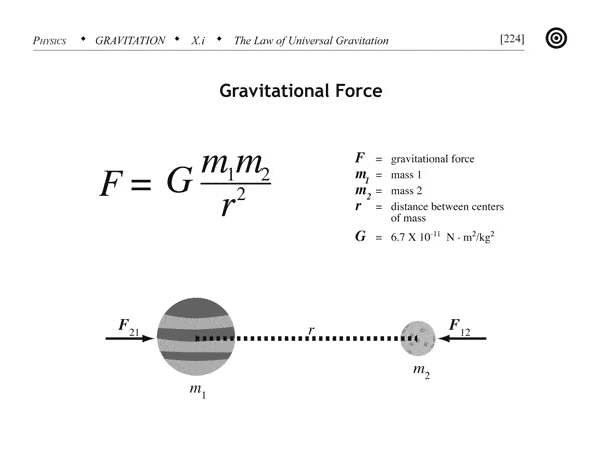

An astronaut way out in space is considered to be “weightless". This is because–
his mass is so small relative to the earth that gravity doesn’t affect him.
gravitational force increases greatly over long distances.
gravitational force pushes objects away from each other at long distances.
objects far away from the earth have less mass.

Which of the following claims is supported by the data?
Gravitational forces increase as the masses of the two objects increase
Gravitational forces are strongest between objects with identical masses.
Gravitational forces are weakest when one object is more massive than the other.
Gravitational forces can never exceed an upper limit, regardless of the masses.
Which of the following does not affect the gravitational force between the earth and the sun?
The mass of the earth
The mass of the sun
The distance between the earth and the sun
The net electrical charge of the earth
Which of the following data would support the claim that the gravitational force between objects depends on mass?
An object’s weight can change depending where it is on Earth.
The further a planet is away from the sun, the smaller the gravitational force.
Gravitational force is stronger on more massive planets.
A rocket can escape Earth’s gravity by traveling at high speed.
What is the tendency for one object to pull other objects toward it?
attractive
force
gravitational force
interacting objects
What are Objects that affect one another?
attractive
force
gravitational force
interacting objects
What is a measure of how much matter is present in a substance?
mass
force
gravitational force
weight
Force of gravity on mass = ?
mass
force
gravitational force
weight
What two qualities of objects does gravity depend on?
What each object is made up of and the distance between them
What each object is made up of and the material between them
Each object’s mass and shape
The mass of objects and the distance between them
which statement below is FALSE
Gravity acts on any object with mass.
The closer objects are, the stronger the gravitational force between them.
The farther you are from the center of Earth, the less gravitational force you feel.
Gravitational force depends on what the object is made of.
What happens if the distance between objects with mass increases?
Gravitational attraction between the objects decreases.
Gravitational attraction between the objects increases.
Gravitational force is attractive. Is this force a push or a pull?
push
pull
Gravitational forces are...
attractive
repellant
both

