
 Worksheets
Physics of Sound
Total questions: 73
Worksheet time: 54mins
Name
Class
Date
1.
When you make sounds by plucking a rubber band, you make the rubber band move back and forth very quickly. This movement is called.
a)
loudness
b)
amplitude
c)
pitch
d)
vibration
2.
The highness or lowness of a sound is the
a)
pitch
b)
loudness
c)
vibration
d)
resonance
3.
If you tie a string around a doorknob, pull on the string slowly, and keep plucking it with your finger as you pull, what happens to the pitch?
a)
As you tighten the string, the pitch gets lower
b)
The pitch stays the same
c)
As you tighten the string, the pitch gets higher
d)
You can't tell unless you try it
4.
The loudness of a sound is called
a)
the sound wave
b)
the volume
c)
the amplitude
d)
the pitch
5.
A student holds two vibrating objects. Object A is vibrating faster than object B. Which statement is true?
a)
A is louder than B
b)
B is louder than A
c)
A will have a higher pitch than B
d)
B will have a higher pitch than A
6.
Which of the following would produce the highest pitch?
a)
phone
b)
whistle
c)
truck horn
d)
dog's growl
7.
Which of the following would produce the loudest sound?
a)
jet plane
b)
pin falling
c)
doorbell
d)
whisper
8.

If you tap each one, which will produce the highest pitch?
a)
The lowest amount of water
b)
The fullest bottle
9.

How is sound produced by these instruments?
a)
Striking the surface
b)
vibrating columns of air
c)
plucking the strings
10.

Which instrument plays the lowest notes
a)
the smallest (flute)
b)
middle size (clarinet)
c)
Largest (sax)
11.

Which instrument will make the highest notes?
a)
the smallest (flute)
b)
the middle (clarinet)
c)
the largest (sax)
12.
Sound is a
a)
Longitudinal wave
b)
Transverse wave
13.
Sound is a
a)
pressure wave
b)
mechanical wave
14.
What physical characteristic of a sound wave should be changed to alter the pitch of sound?
a)
Frequency
b)
Amplitude
c)
Wavelength
d)
Velocity
15.
What physical characteristic of a sound wave should be changed to alter the loudness of sound?
a)
Frequency
b)
Amplitude
c)
Wavelength
d)
Velocity
16.
How many times greater is the sound pressure level of a typical rock concert (110 dB) than a normal conversation (50 dB)?
a)
60 times
b)
12 times
c)
5 times
d)
30 times
17.
How many times greater is the sound pressure level of a typical alarm clock (80 dB) than a whisper 1 m away (30 dB)?
a)
50 times
b)
10 times
c)
2 times
d)
2.67 times
18.
Why can't sound waves travel in a vacuum?
a)
The pressure is too low in a vacuum.
b)
The vibrations would not be detected.
c)
The temperature cannot be raised high enough.
d)
There are no particles to collide.
19.
What is sound energy ultimately converted to by the human ear?
a)
Sound energy
b)
Brain vibrations
c)
Electrical energy
d)
It is still unknown
20.
Sound level is a measure of _______.
a)
Frequency
b)
Amplitude
c)
Wavelength
d)
Pitch
21.

The eardrum
a)
C
b)
D
c)
E
d)
F
22.
The malleus
a)
A
b)
B
c)
C
d)
D
23.
The incus
a)
A
b)
B
c)
C
d)
D
24.
The stapes
a)
A
b)
B
c)
C
d)
D
25.
The Cochlea
a)
C
b)
D
c)
E
d)
F
26.
The Auditory Nerve
a)
A
b)
B
c)
C
d)
D
27.
The part(s) of the ear responsible for converting pressure waves into mechanical vibrations.
a)
Malleus, incus, and stapes
b)
Eardrum
c)
Auditory nerve
d)
Cochlea
28.
The part(s) of the ear responsible for converting mechanical vibrations to fluid waves in the inner ear.
a)
Malleus, incus, and stapes
b)
Eardrum
c)
Auditory nerve
d)
Cochlea
29.
The part(s) of the ear responsible for detecting fluid waves and for converting them into electrical signals.
a)
Malleus, incus, and stapes
b)
Eardrum
c)
Auditory nerve
d)
Cochlea
30.
The part(s) of the ear responsible for transferring, to the brain, electrical signals generated by the ear.
a)
Malleus, incus, and stapes
b)
Eardrum
c)
Auditory nerve
d)
Cochlea
31.
Sound travels fastest in ________.
a)
30ºC air
b)
25ºC air
c)
15ºC air
d)
0ºC air
32.
Sound travels faster in _____.
a)
Air
b)
Helium
33.
Sound travels faster in _____.
a)
Air
b)
Water
c)
Iron
d)
Helium
34.
The doppler effect is the apparent change in the _______ of a wave caused by the relative motion between the source of the wave and the observer.
a)
Wavelength
b)
Amplitude
c)
Frequency
d)
Speed
35.

When the car moves away from you, its horn seems...
a)
Low pitched
b)
High pitched
c)
Normal
36.

True or False: The Doppler effect occurs when a wave source moves towards an observer.
a)
True
b)
False
37.

True or False: The Doppler effect occurs when an observer moves towards a wave source.
a)
True
b)
False
38.

When a car moves towards you, the sound of its horn seems relatively...
a)
Low pitched
b)
High pitched
c)
Normal
39.
When you use a thicker guitar string, the sound is ___________.
a)
higher
b)
lower
c)
louder
d)
softer
40.
True or False? Sound is a vibration.
a)
True
b)
False
41.
The characteristic of a wave that is measured in hertz and by how many waves pass a point in 1 second is its....
a)
freqency
b)
amplitude
c)
wavelength
d)
loudness
42.

If the distance represented by the letter A were increased, how would it change the way the sound was heard?
a)
The sound would be higher.
b)
The sound would be lower.
c)
The sound would be softer.
d)
The sound would be louder.
43.

What is A?
a)
crest
b)
trough
c)
compression
d)
rarefaction
44.
In a pitch-black night, you hear a police siren is getting higher and higher, could you tell if the car is coming toward you or driving away from you?
a)
coming toward you
b)
away from you
c)
going circles around you
d)
parking still
45.
What is the frequency heard by a person driving at 18 m/s toward a blowing factory whistle (800. Hz) if the speed of sound is 340.6 m/s?
a)
835 Hz
b)
845 Hz
c)
760 Hz
d)
735 Hz
46.
What is the frequency heard by a person driving at 15 m/s away from a blowing factory whistle (800. Hz) if the speed of sound is 340.6 m/s? Write the number only.
a)
835 Hz
b)
845 Hz
c)
760 Hz
d)
735 Hz
47.
A cop car’s siren has a frequency of 700. Hz. If you are standing on the sidewalk as the cop car approaches you at a speed of 15.0 m/s, what frequency would you hear? The speed of sound is 343 m/s.
a)
671 Hz
b)
732 Hz
c)
346 Hz
d)
599 Hz
48.
Two identical cars are driving toward one another and sounding their horns. You’re the driver of one of the cars. You measure your car’s horn to be sounding at 512 Hz, but you measure the horn of the other car to be sounding at 600. Hz. The speed of sound is 345 m/s. If you are traveling at 26.8 m/s (60 mph), how fast is the other car traveling?
a)
23 m/s
b)
28 m/s
c)
33 m/s
d)
26 m/s
49.

What is frequency?
a)
the number of vibrations per second
b)
how high or low a sound is
c)
the loudness or softness of a sound
d)
the back and forth movement of matter
50.

Measure of how high or low a sound is
a)
amplitude
b)
compression
c)
speed of sound
d)
pitch
51.
This is the unit used to measure the volume of a sound.
a)
Decibel
b)
Medium
c)
Vibration
d)
Oscilloscope
52.
To make a sound from a stringed instrument louder you must
a)
hit it
b)
pluck it harder
c)
hold it higher
d)
pluck it softer
53.

Based on the Doppler effect, what can you tell about the motion of this object?
a)
It is moving left.
b)
It is moving right quickly.
c)
It is standing still.
d)
It is moving up slowly.
54.

Based on the Doppler effect, what can you tell about this object's motion?
a)
It's velocity is to the North.
b)
It's velocity is to the South.
c)
It's velocity is to the West.
d)
It's velocity is to the East.
55.
The speed of a wave is its wavelength multiplied by its ___________
Or the formula
C = λ x f
Or the formula
C = λ x f
a)
amplitude
b)
vibration
c)
frequency
d)
reflection
56.
The distance from one point to the next corresponding point on a wave is called the ________________.
a)
waveform
b)
peak
c)
amplitude
d)
wavelength
57.
What is the lowest point on a wave?
a)
amplitude
b)
peak
c)
trough
d)
wavelength
58.
The maximum distance from the center line to the top of the crest or the bottom of the trough is called the __________ of the wave.
a)
amplitude of the wave
b)
wavelength of the wave
c)
frequency of the wave
d)
speed of the wave
59.
Solve this problems using the equation: v = λ x f
A speaker emits a sound of wavelength of 0.23 m. What is the frequency of this radiation?
(Convert to m first).The velocity of sound is 343 m/s.
A speaker emits a sound of wavelength of 0.23 m. What is the frequency of this radiation?
(Convert to m first).The velocity of sound is 343 m/s.
a)
1500 Hz
b)
1300 Hz
c)
1700 Hz
d)
344 Hz
60.
A sound wave has a frequency of 5000 Hz. Its wavelength (λ) is ________. Assume the speed of sound is 343 m/s.
a)
1,700 km
b)
14.71 m
c)
0.068 m
d)
Impossible to know
61.
You see an explosion and hear the boom 2.5 seconds later. How far away was it? Assume the speed of sound is 343 m/s.
a)
850 m
b)
136 m
c)
850 km
d)
136 km
62.
Your music is too loud. You turn it from 60dB to 30dB. Did you turn the volume down by half?
a)
Yes
b)
No
c)
What is a dB?
d)
Don't pick me!
63.

Which letter represents the wave crest?
a)
A
b)
B
c)
C
d)
D
64.
The number of crest or troughs that pass by over a certain amount of time.
a)
Resting Point
b)
Crest
c)
Amplitude
d)
Frequency
65.
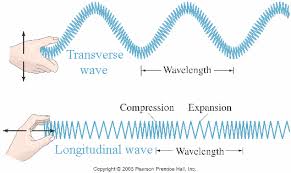
Sound waves are ALWAYS what type of wave?
a)
Transverse
b)
Longitudinal
c)
Depends
d)
always different
66.
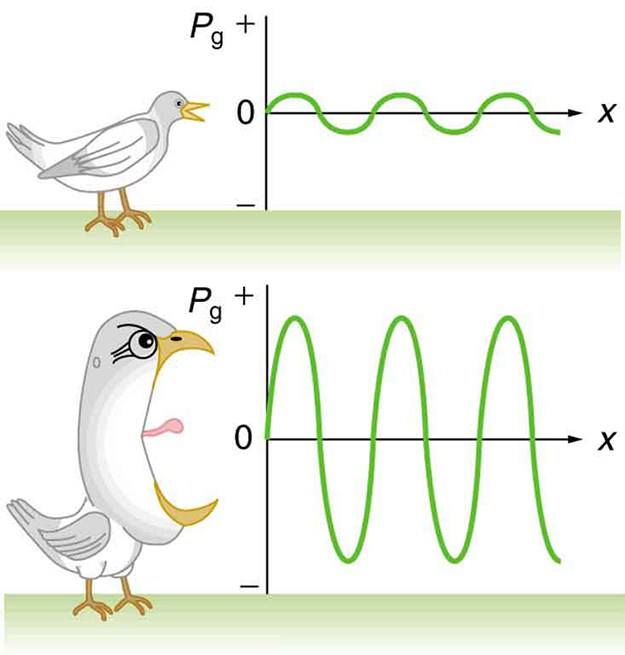
When a sound is louder what measurement gets bigger?
a)
Frequency
b)
Amplitude
c)
Wavelength
d)
Crest
67.
Waves transfer _____________ from one place to another
a)
Particles
b)
Energy
c)
Force
d)
Gravity
68.
The fundamental resonance frequency of an open pipe of length L is _____.
a)
2L
b)
4L
c)
L/4
d)
L/2
69.
The fundamental resonance frequency of closed pipe of length L is _____.
a)
2L
b)
4L
c)
L/4
d)
L/2
70.
For a given wavelength λ, what length with the resonance frequency of an open pipe occur?
a)
λ/2
b)
λ/4
c)
2λ
d)
4λ
71.
For a given wavelength λ, what length with the resonance frequency of a closed pipe occur?
a)
λ/2
b)
λ/4
c)
2λ
d)
4λ
72.
The third resonance frequency for wavelength λ occurs in an open pipe of wavelength ____.
a)
λ/2
b)
λ
c)
3λ/2
d)
3λ/4
73.
Two students in a speed of sound lab found adjacent resonance lengths at 0.30 m and 0.67 m. If the frequency of the tone was 455 Hz, what is the speed of sound?
a)
337 m/s
b)
343 m/s
c)
322 m/s
d)
333 m/s
100 %

