
 Worksheets
Camera, Telescope. Microscope
Total questions: 76
Worksheet time: 5hrs 12mins

What does "Photograph" mean?
Taking a nice selfie
Capturing images from the world
Writing with light
To use a camera

Instant, automatic and manual are three of the many different types of...
Photographies
Cameras
Polaroids
Photographers

If you punch a hole in a wall in a completely dark room, you'll see an inverted image of the outside projected on the opposing wall. This effect is called...
Photography
Light sensor
Camera obscura
Daguerreotype

When was the Daguerreotype invented?
2010
1534
1995
1839

How long did the Daguerreotype take to capture an image?
1 hour
60 secods
3 days
5 seconds

What do cameras do?
Take screenshots
Capture images into regular paper
Focus light onto film
Focus light onto the retina

Film is a light-sensitive material that captures light
True
False

Is a Sensor the digital version of film?
True
False

What are pixels?
Like minecraft!
Pieces of film that capture light
Colored lights that look funny
Tiny squares that form digital images

What part of the camera focuses the light?
Shutter
Lens
Film
Battery

What's a shutter?
A door that lets light into the camera
The button to take a photo
The lens that focuses light
The film inside a camera

The pinhole camera requires electricity to function (work properly).
True
False

The image shows a simplified diagram of a pinhole camera.
Which statement describes the image formed?
Diminished, upright and real
Diminished, inverted and real
Magnified, upright and real
Magnified, inverted and real

The image shows a simplified diagram of a pinhole camera.
Moving the camera further away from the object will make the image.
Smaller
Blurry
Bigger
Sharper
Which of the following describes an image formed in a pinhole camera?
Horizontally inverted (Left becomes Right; Right becomes Left)
Vertically inverted (Up becomes Down; Down becomes Up)
Remains the same as how we normally see
A smaller pinhole will cause my image to be
clearer
blurry
brighter
dimmer
What does SLR stand for?
Solar Lens Rotation
Stand Leaning Rope
Single-Lens Reflex
What is a Viewfinder?
A hole through which light
enters the camera.
A way to control how long
light enters the box.
A way of focusing light for a
sharp image.
A way to aim the camera so you can see what you are photographing.
A way to hold the film in the correct
place to receive the focused light.
How light or how dark an image is called...
histogram
rule of thirds
exposure
bokeh
The three pillars of camera settings (Exposure Triangle) are...
...exposure, white balance, and ISO
...depth of field, exposure, and flash
...aperture, portrait, and focus
... shutter speed, aperture, and ISO
The hole inside the lens that allows the amount of light through is called...
exposure
shutter speed
flash
aperture
What is a camera's aperture?
It's a small mirror that flips an image so that it's not reversed.
It's the button or dial that allows you to change the focus on your camera.
It's the opening/hole that allows an amount of light to pass through the lens to the film/sensor.
What refers to how much of an image is in focus?
shutter speed
exposure
histogram
depth of field
What determines how sensitive the camera is to light?
flash
exposure
long exposure
ISO
What is a Shutter?
A hole through which light
enters the camera.
A way to control how long
light enters the camera.
A way of focusing light for a
sharp image.
A way to aim the camera.
A way to hold the film in the correct
place to receive the focused light.
An image that has been exposed for a long time, or uses a long shutter speed is called a...
histogram
long exposure
manual mode
bokeh
Microscopes allow us to view objects in great _____________.
detail
magnification
objective
body
The portion of the specimen that can be seen through the microscope is called the ________________.
stage clips
field
mirror
focus knob
The __________________ reflects light into the microscope.
mirror
stage clips
field
focus knob
Always place your microscope on a (a) surface.
You should never touch the _________ of a microscope.
stage
lenses
base
arm
The ____________ are used to hold the slide in place.
stage
lens
stage clips
flat
The _____________ revolves and allows you to change the objective lenses.
stage
stage clips
nose
nosepiece
Always place the specimen you want to view on the _________.
stage
stage clips
slide
lens
When carrying a microscope, hold the:
Arm
Base
Arm & Base
Eyepiece
The eyepiece usually has a magnification of:
10x
20x
30x
40x
If an object is so thick that light cannot pass through, it will appear:
black
white
clear
blue
What part is between the eyepiece and the objective lenses?
body tube
stage
diaphragm
light source
What controls the amount of light?
Diaphragm
Stage
Eyepiece
Objective lenses
True or False: Low power lenses require less light to see clearly.
True
False
The objective lenses are held by the:
Revolving nosepiece
Arm
Stage
Coarse adjustment knob
True or False: The lowest power lens has a magnification of 10x.
True
False
The microscopes we use are called
compound microscopes
dissecting microscopes
stereo microscopes
electron microscopes
What word means "to be composed of two or more elements."
Compound
Microscope
Telescope
Lens
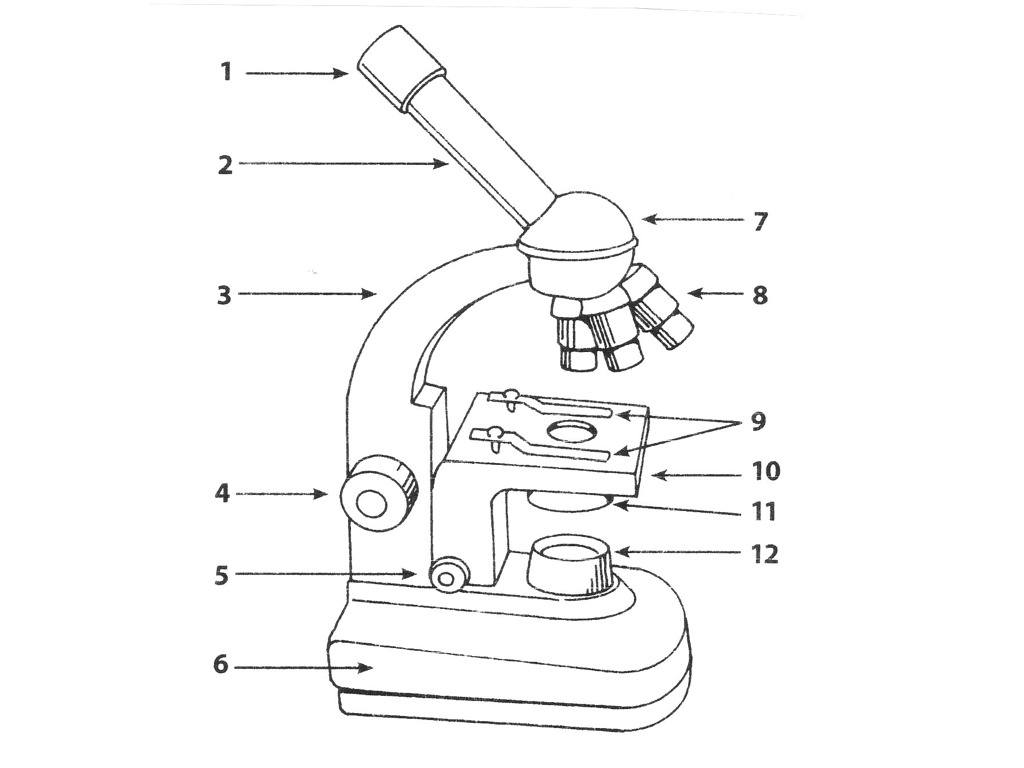
Used to bring the specimen into sharp focus.
Fine adjustment
Stage
high power
Base
Lenses used to change the magnification of the specimen
Body Tube
Eyepiece
Objective lenses
Diaphragm
Which objective lens should you ALWAYS begin your observation with?
low power objective
medium power objective
high power objective
extra high power objective
When observing a specimen using a 10x eyepiece and an objective that magnifies 40x, what is the total magnification that the specimen is being observed?
400X
40X
100X
50X
Fill in the blank: When you use a higher power objective, the field of view _____.
decreases (gets smaller)
increases (gets larger)
remains the same
What is the primary function of a telescope?
To see distant objects
To cook food
To play music
To write books
What is the role of the eyepiece in a telescope?
To magnify the image
To cook food
To play music
To write books
What is the main advantage of reflecting telescopes over refracting telescopes?
More powerful
Less powerful
Cheaper
Heavier
Where is the curved mirror located in a reflecting telescope?
At the bottom of the tube
At the top of the tube
Outside the tube
Inside the eyepiece
What is the main component of a refracting telescope?
Lenses
Mirrors
Prisms
Filters
Who improved the design of a telescope in 1609?
Isaac Newton
Albert Einstein
Galileo Galilei
Nicolaus Copernicus
What type of telescopes were developed along with spacecraft in the 1950s?
Refracting telescopes
Reflecting telescopes
Radio telescopes
Infrared telescopes
What is a common feature of radio telescopes?
They are colorful
They are portable
They collect radio waves
They are underwater.
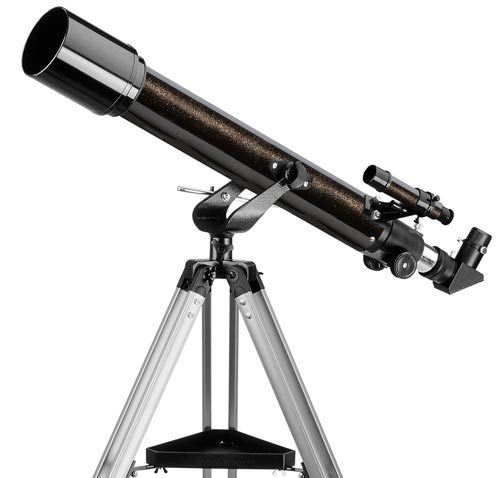
A refracting telescope uses _______ to focus light.
Lenses
Mirrors
Lasers
Water
What kind of lenses do reflecting telescopes use?
convex lenses
mirrors
What is the primary purpose of a radio telescope?
To observe visible light
To detect radio waves
To magnify images
To focus light
Which scientist is credited with inventing the first practical reflecting telescope?
Galileo Galilei
Isaac Newton
Albert Einstein
Johannes Kepler
True or False. The James Webb Space Telescope detects infrared light.
True
False
True or False. Radio telescopes collect radio waves to send to the moon's surface.
True
False
What is infrared radiation?
a type of X-ray
a type of radio wave
a type of lens
a type of heat
True or False. Telescopes have helped scientists to see that there is water vapor in other parts of the Milky Way galaxy.
True
False
This is an optical instrument that makes distant objects appear closer and larger.
Telescope
Magnifies
Craters
Astronomers
This person was the first person to observe moons orbiting another planet.
Mrs. Dorf
Galileo Galilei
Astronomers
Hubble Space Telescope
This was a very important instrument that was placed in Earth's orbit in 1990.
A new observatory
Craters
Hubble Space Telescope
The Solar System
Who invented the telescope?
Hans Lippershey
Galileo Galilei
Isaac Newton
When was the Hubble Space Telescope sent into space?
In 1990
In 1993
In 2021

What was Galileo's contribution to the telescope?
He invented it
He discovered it
He promoted it
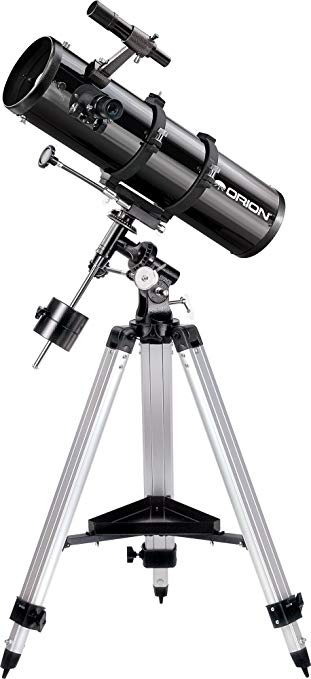
Reflecting telescopes use _______ to focus light.
Lenses
Flat mirrors
Curved Mirrors
A refracting telescope uses _______ to focus light.
Lenses
Mirrors
Lasers



