
Font size
 Worksheets
Tenants of Natural Selection
Total questions: 22
Worksheet time: 25mins
Why are advantageous traits more likely to be passed onto offspring?
Because they are more likely to survive and reproduce.
Because they come from dominant alleles.
Because they come from recessive alleles.
Because the trait is an acquired phenotype.
In natural selection, the selective agent is the
humans
mutations
breeders
environment
The development by scientists of a new color in a rose is the result of
natural selection
artificial selection
descent with modification
overproduction
All the rabbits living in a particular area would be an example of a(n)
population
species
fossil
individual organism
A bird that can easily outcompete other birds for food and that can produce many eggs has a high
life expectancy
mutation rate
fitness
adaptability
Which of the following describes natural selection?
It acts on genetic material directly
It acts on existing physical traits
It forms new traits
It forms new genetic material

What is the definition of natural selection?
The process in which genes are chosen by humans such as farmers and ranchers
The process in which organisms are chosen by environmental pressures such as climate, available food, predators and habitat.
If an organism changes during their life in order to adapt to its environment, those changes are passed on to its offspring.
The process in which genes are chosen by scientist and academics.

The Aztecs and Maya Tribes of Mexico where some of the first humans to slowly change wild corn to the corn we know today. What process did these tribes use?
Natural Selection
Artificial Selection
Mitosis
adaptive radiation
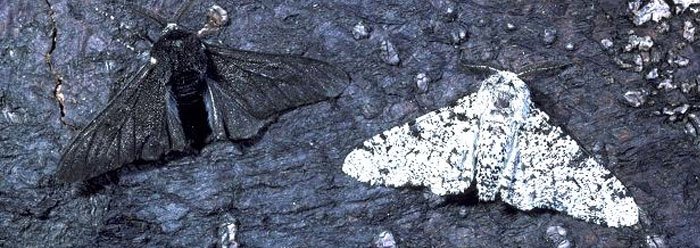
The trees these moths used to live on were white, but have been covered in soot from coal factories causing the trees to become black. Which moth will be more successful in this new, darker environment?
Dark moth
Light moth
Both will be equally successful
Neither will be successful
All of the meerkats that live in the same place at the same time make up a ____________.
Community
Ecosystem
Population
Biosphere
A population of finches that have 3 different beaks live on an island. Each beak type is adapted to one of 3 specific food sources. Two of the three food sources are eliminated during a hurricane. What will happen to the finch population?
The food source will adapt to the remaining finches
All 3 finches adapt to the remaining food source
All 3 finches will die
The finch that is adapted to the remaining food source will survive
There is a species of beetle that has two variations in the population: brown beetles and green beetles. About 82% of all brown beetles survive to adulthood while only 31% of green beetles survive to adulthood. Which of the following statements is true about the fitness of these beetles?
The green beetles have higher fitness
The brown beetles have higher fitness
The green beetles have more adaptations
The brown and green beetles have the same level of fitness
SELECT ALL of the principles of natural selection below.
Overproduction
Selection
Fitness
Variation
Differences in members of a population that can be passed from parents to offspring is called:
Variation
Heritable Variation
Family Variation
Ancestral Variation

