
 Worksheets
AP Chemistry Electrochemistry Galvanic and Electrolytic Cells
Total questions: 25
Worksheet time: 50mins
In a Galvanic Cell, the anode is...
positive
negative
In a Galvanic Cell, the cathode is...
positive
negative
Oxidation occurs at the...
anode
cathode
Reduction occurs at the...
anode
cathode
In a Galvanic cell, the electrons flow from the...
anode to the cathode
cathode to the anode
Ecell =
Ered - Eox
Ered + Eox
Eox - Ered
Eox + Ered
In the list of standard electrode potentials, the strongest reducing agent is...
K
K+
F2
F-
In a redox reaction, the oxidising agent... (choose two options)
is oxidised
is reduced
increases its oxidation number
decreases its oxidation number
In a Galvanic Cell, the salt bridge...
completes the circuit so that electrons can flow through the wire
maintains charge balance
is soaked in an unreactive electrolyte such as KNO3
all of the above
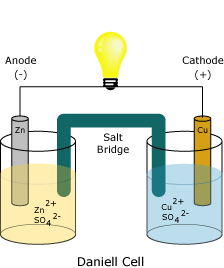
In the above Galvanic Cell, which half cell is undergoing reduction?
Cu | Cu2+
Zn | Zn2+
Consider the galvanic cell reaction Zn (s) + Cu2+ (aq) → Cu (s) + Zn2+ (aq) When the cell is running spontaneously, which is the only true statement?
The copper electrode loses mass and the zinc electrode is the cathode.
The copper electrode gains mass and the copper electrode is the cathode.
The zinc electrode gains mass and the zinc electrode is the anode.
The zinc electrode loses mass and the zinc electrode is the cathode.
A certain galvanic cell has for its spontaneous cell reaction: Zn + HgO → ZnO + Hg
Which is the half-reaction occurring at the anode?
HgO + 2 e- → Hg + O2-
Zn2+ + 2 e- → Zn
Zn → Zn2+ + 2 e-
ZnO + 2 e- → Zn
A certain galvanic cell has for its spontaneous cell reaction: Zn + HgO → ZnO + Hg
Which is the half-reaction occurring at the cathode?
HgO + 2 e- → Hg + O2-
Hg → Hg2+ + 2 e-
Zn → Zn2+ + 2 e-
ZnO + 2 e- → Zn
ANOTHER NAME FOR A SPONTANEOUS ELECTROCHEMICAL CELL
SALT BRIDGE
VOLTMETER
ELECTROLYSIS CELL
VOLTAIC CELL

WHICH IS ANODE?
COPPER ELECTRODE
ZINC ELECTRODE
ZINC SULFATE SOLUTION
SALT BRIDGE
If an electrochemical reaction is spontaneous, what will Ecell be?
positive
negative


As an element is oxidized, its oxidation number
decreases as electrons are lost
increases as electrons are lost
decreases as electrons are gained
increases as electrons are gained

The passage of electricity through an electrolyte causes the metallic ions to migrate towards the _______ and the non-metallic ions to migrate towards the _______. (use and in between to separate the answers)
(a)
Cations are negatively charged ions.
True
False


