
 Worksheets
Centripetal
Total questions: 23
Worksheet time: 14mins
Name
Class
Date
1.
A horse gallops around a circular arena. The centripetal force on the horse is ___.
a)
directed outward
b)
tension
c)
directed toward the center of the arena
d)
9.8 N
2.
What relationship exists between the radius of a circle and the centripetal acceleration?
a)
direct
b)
inverse
c)
exponential
d)
inverse squared
3.
Which of the following units is used for tangential velocity?
a)
m/s2
b)
N
c)
J
d)
m/s
4.

Bruno the bat flies at a speed of 0.5 m/s in circle of radius 1 m. What is his acceleration?
a)
0.25 ms-2
b)
0.5 ms-2
c)
1 ms-2
d)
2 ms-2
5.

What object experiences uniform circular motion?
a)
A car speeding up as it turns left
b)
A car traveling around a roundabout at a constant speed
c)
A car slowing down as it crests a tall hill
d)
A car traveling down the road at a constant speed
6.
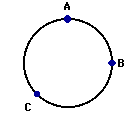
What is the direction of the acceleration at point B, if the ball is revolving clockwise?
a)
up
b)
right
c)
down
d)
left
7.

What is the direction of the acceleration at point A, if the ball is revolving clockwise?
a)
up
b)
right
c)
down
d)
left
8.
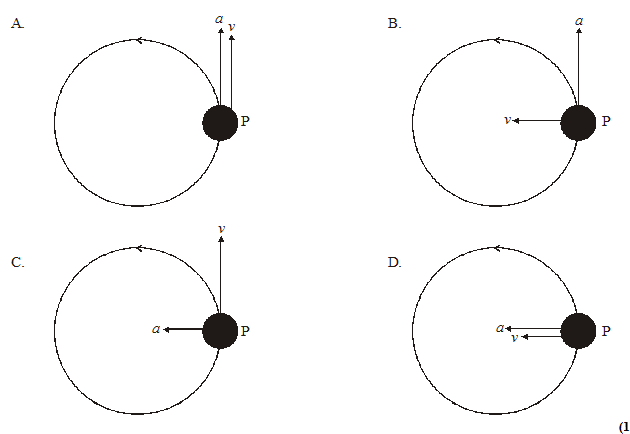
A particle P is moving in a circle with uniform speed. Which one of the following diagrams correctly shows the direction of the acceleration a and velocity v of the particle at one instant of time?
a)
A
b)
B
c)
C
d)
D
9.
A horse gallops around a circular arena. The centripetal force on the horse is ___.
a)
directed outward
b)
tension
c)
directed toward the center of the arena
d)
9.8 N
10.
An object moves in a circle at a constant speed. Which of the following is NOT true of the object?
a)
its centripetal acceleration points toward the center of the circle
b)
its tangential speed is constant
c)
its velocity is constant
d)
a centripetal force acts on the object
11.
Which of the following terms means "center seeking"?
a)
centrifugal
b)
centrifuge
c)
centripetal
d)
centenarian
12.
A car traveling at 15 m/s on a flat surface turns in a circle with a radius of 25 m. What is the centripetal acceleration of the car?
a)
2.4 x 10⁻² m/s2
b)
0.60 m/s2
c)
9.0 m/s2
d)
zero
13.
What is the relationship between centripetal force and the mass of an object?
a)
direct
b)
inverse
c)
exponential
d)
inverse squared
14.
Which of the following is the unit for centripetal force?
a)
J
b)
m/s2
c)
kg⋅m/s
d)
N
15.
What happens to the centripetal force exerted on an object if you triple the velocity?
a)
it increases to 3X
b)
it decreases to 6X
c)
it increases to 6X
d)
it increases to 9X
16.
What is the definition for mechanical advantage?
a)
the number of times a machine increases the input force
b)
the number of times a person can lift a weight
c)
how much work is done in a given amount of time
d)
the rate of doing work
17.
What is the equation for Ideal Mechanical Advantage?
a)
Input distance/output distance
b)
Output force/input force
18.
What is the equation for Actual Mechanical Advantage?
a)
input distance/output distance
b)
output force/input force
19.
What is the idea mechanical advantage if you push down a lever 10 m from the fulcrum and the load is 2 m from the fulcrum?
a)
5
b)
10
c)
2
d)
1
20.
As distance between two objects increase the pull of gravity
a)
Increases
b)
Decreases
c)
Stays the same
21.

This graph shows the change in the force of gravity. The graph will never reach zero. Which statement BEST supports this hypothesis?
a)
Gravity cannot cross space.
b)
The force of gravity does not change regardless of distance.
c)
Every object exerts gravitational force on every other object.
d)
More distant objects exert a stronger gravitational force on other objects.
22.

Considering the factors that affect gravitational pull, in which location would the gravitational pull from the Earth the LEAST on you?
a)
when you visit friends at the beach
b)
when meeting friends on the second floor of the mall
c)
when climbing to the top of the world's highest mountain
d)
when deep sea diving to search for sunken treasure
23.
What two variables affect the gravitational force between objects?
a)
weight and mass
b)
volume and weight
c)
distance and mass
d)
rotation and distance
100 %

