
 Worksheets
Rate Laws Collision
Total questions: 24
Worksheet time: 45mins
Which of the following statements about a chemical reaction rate is/are correct?
I. It measures the change in the concentration of a reactant or a product per unit of time
II. It measures the amount of reactant used or the amount of a product produced in a reaction
III. It measures the amount of time needed to complete the reaction
IV. It measures the energy change during the reaction per unit of time
I only
II and III only
III and IV only
I, II, III and IV
I and III only
The rate law of the reaction 3X + Y --> 2Z is: Rate= k[X]2[Y]3. The overall order of this reaction is _________.
2
3
4
5
1
What is the order of a reaction with respect to reactant A if the rate law expression for the reaction is Rate=k[A][B]2?
1st order
2nd order
4th order
0 order
3rd order
Chemical kinetics is the study of:
I. Heat
II. Reaction Mechanisms
III. Reaction Rates
I
II
III
I and II
II and III
Raising the temperature of gas particles
Increases both collision energy and favorability of orientation
Increases neither collision energy nor favorability of orientation
Increases collision energy but does not increase favorability of orientation.
Increases favorability of orientation but does not increase collision energy.
Decreases favorability of orientation
If a collision between molecules is very gentle, the molecules are
More likely to be favorably oriented.
Less likely to be favorably oriented
More likely to react.
More likely to rebound without reacting.
More likely to collide
To have an effective collision, the following are required
Sufficient energy
A favorable orientation
Low temperature
A reaction mechanism
Sufficient energy and a favorable orientation
Which of the following best describes a reaction rate
the change in temperature of a reactant or a product per second
the change in the concentration of a reactant per unit of time
The amount of time for a reaction to be begin
The appearance of colour for a reaction per mole
The moles of product that are produced per liter
A short-lived structure formed during a collision is referred to as:
Activated Complex
Reagent
Catalyst
Reactant
Product
What takes place when an activated complex is formed
Reactants are produced
Bonds are broken
Bonds are formed and broken
A catalyst is made
Energy is released
Which of the following affect reaction rates
Nature of reactants
Particle size of reactants
Presence of catalyst
Temperature
All of the answers are correct
What criteria must be met for reactant collisions to result in a successful product?
The reactants must collide with each other
The reactants must collide with enough energy and be in the right positions
The reactants must have enough energy to form the activated complex
The most common way of expressing a reaction rate is in terms of:
mol/L
g/L⦁s
mol/L⦁s
mol/s

Use the table to determine the average rate of sulfuric acid being consumed in this reaction between 4 and 8 seconds.
2Fe + 3H2SO4→ 3H2 + Fe2(SO4)3
-0.0156 M/s
-0.0117 M/s
-0.00195 M/s
none of these
As a reaction proceeds, the concentration of reactants will _______ and the concentration of products will ________.
increase, decrease
increase, increase
decrease, decrease
decrease, increase
Calculate the rate of formation of iron(II) sulfide if sulfur is being consumed at a rate of 0.440 mol/L⦁s.
8 Fe(s) + S8(s) → 8 FeS(s)
0.440 mol/L⦁s
3.52 mol/L⦁s
0.0550 mol/L⦁s
none of these is correct
When we investigate the rate of reaction we are looking at the...
amount of product formed
speed of reaction
concentration of reacting particles
combining reactants with products
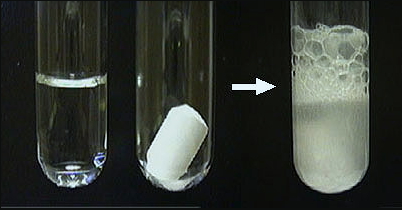
How could we make this reaction happen more quickly?
Decrease the concentration of the acid
crush the chalk to increase the surface area
Put the test tube in an ice bath
When surface area is decreased the rate of reaction...
Decreases, because there are LESS possible sites for correct collisions
Increases, because there are LESS possible sites for correct collisions
Decreases, because there are MORE possible sites for correct collisions
Increases, because there are MORE possible sites for correct collisions
What is the rate of reaction?
How much energy is needed for a reaction to occur.
The energy required to break a bond.
The time it takes for a reaction to occur.
Collision Theory

