
NEW
Font size
S
M
L
XL
 Worksheets
Eog Heat Transfer Review
Total questions: 35
Worksheet time: 26mins
Name
Class
Date
1.
what is conduction?
a)
transfer of heat through fluids
b)
transfer of heat through contact
c)
transfer of heat through electromagnetic waves
d)
none of the above
2.
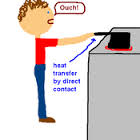
Johnny accidentally grabbed the handle of the hot pot.
a)
conduction
b)
convection
c)
radiation
3.
What happens to the molecules in an object when they heat?
a)
move faster
b)
move slower
c)
stay still
d)
none of the above
4.
On a hot summer day, a student dropped an ice cube onto a park bench. Within minutes, the ice cube melted. Which bestdescribes the process the student observed?
a)
radiation
b)
combustion
c)
conduction
d)
convection
5.
Ironing a shirt is an example of...
a)
condensation
b)
conduction
c)
convection
d)
radiation
6.
What heat transfer happens when you burn your hand by touching a fire?
a)
Radiation
b)
Conduction
c)
Convectio
d)
I don't know!!!!!!!!!!!
7.

This is a lava lamp. When the light bulb heats the wax, the wax rises. When the wax cools, it falls. This cycle of rising/falling is an example of:
a)
Conduction.
b)
Convection.
c)
Radiation.
8.

The baby chickens are kept warm from the heat lamps demonstrates what type of heat transfer?
a)
conduction
b)
convection
c)
radiation
9.

The Gulf Stream is a current that brings warm ocean water from the south to the north. What type of heat transfer is this?
a)
conduction
b)
convection
c)
radiation
d)
Insolation
10.
A great conductor of energy is:
a)
wood
b)
plastic
c)
metal
d)
cloth
11.
Mittens help keep your hands warm in winter because:
a)
They are conductors of heat.
b)
They are fuzzy.
c)
They are conductors of electrical energy.
d)
They are insulators.
12.
How does heat energy from the sun reach Earth?
a)
conduction
b)
convection
c)
insulation
d)
radiation
13.
Which is the best example of heat transfer by convection?
a)
frying bacon in a pan
b)
sea breeze at the beach
c)
melting ice in your hand
d)
burning your finger on the stove
14.

Blow drying your wet hair.
a)
conduction
b)
convection
c)
radiation
15.

A group of friends gather around a fire to stay warm.
a)
conduction
b)
convection
c)
radiation
16.
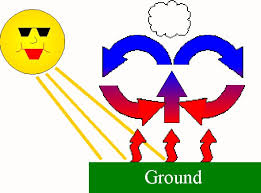
Warm air rises and the cool air sinks.
a)
conduction
b)
convection
c)
radiation
17.

In this experiment, the WARM red dye and the COLD blue dye was placed in the water at the same time. The warm red dye rose to the top while the cold blue dye sank to the bottom.
a)
conduction
b)
convection
c)
radiation
18.

How is the cat being heated?
a)
condensation
b)
conduction
c)
convection
d)
radiation
19.

How is the man being heated?
a)
condensation
b)
convection
c)
conduction
d)
radiation
20.

How is the teapot being heated?
a)
condensation
b)
conduction
c)
convection
d)
radiation
21.
If two objects have different temperatures, heat will flow from the cooler object to the warmer one.
a)
true
b)
false
22.
the transfer of energy by electro-magnetic waves is called
a)
conduction
b)
convection
c)
radiation
23.
When heat is transferred by the movement of currents within a fluid it is called
a)
conduction
b)
convection
c)
radiation
24.
This is a current caused by the rising of heated fluid and sinking of cooled fluid.
a)
convection current
b)
conduction current
c)
radiation current
d)
heat current
25.
4. Energy will always flow or move from...
a)
An area of low temperature to an area of high temperature
b)
An area of high temperature to an area of low temperature
c)
atoms to molecules
26.
Convection is the transfer of heat through _____
a)
liquid or gas
b)
candy
c)
tables
27.
Radiation is the transfer of heat through electromagnetic waves which move through space.
a)
True
b)
False
False
False
28.
Low temperature means more thermal energy.
a)
True
b)
False
29.
High temperature means less thermal energy.
a)
True
b)
False
30.
Heat is what type of energy?
a)
Thermal
b)
Chemical
c)
Potential
d)
Kinetic
31.
What is an insulator?
a)
An object that allows heat to pass through easily.
b)
An object that is difficult for heat to pass through.
32.
A conductor is an object that allows heat to pass through easily.
a)
True
b)
False
33.
Heat moves through the atmosphere as air circulates. What causes the circulation of air?
a)
Air in the atmosphere is heated by the sun and sinks to the ground.
b)
The ground is heated by the sun and then heats the air, causing the air to rise.
c)
Air loses heat to the ground and then rises upward to obtain more energy.
d)
The sun heats the clouds which forces the cooler air to move away and sink.
34.
What keeps the water at the top of pot of boiling water the same temperature as that of the bottom?
a)
Heat from the burner radiates through the liquid and causes even heating.
b)
Evaporation heats the water at the top and the eye of the stove heat the water at the bottom.
c)
The walls of the beaker reflect heat toward the center, so the water heats evenly.
d)
Heated water molecules and steam rise in the pot, carrying heat by convection.
35.
In what way does the Sun warm Earth?
a)
radiation
b)
convection
c)
conduction
d)
condensation
Reset

