
 Worksheets
Conduction, Induction & Friction
Total questions: 20
Worksheet time: 2hrs 40mins
If a negatively charged rod touches a conductor, the conductor will be charged by what method?
Friction
Conduction
Induction
Convection
Two storm clouds rub against each other giving one cloud a positive charge and one a negative charge. This is an example of charging by
Conduction
Convection
Friction
Induction
When atoms lose electrons, they become __ charged ions.
Positively
Neutral
Negatively
Shock
Charge can be temporary in ___

Your arm hair raising as you approach a television is an example of charging by induction
true
false

Your hair sticking up after removing your cap is an example of charging by induction.
True
False

What is this an example of?
Heat
Friction
Gravity
Induction
If a negatively charged rod touches a conductor, the conductor will be charged by what method?
Friction
Conduction
Induction
Convection
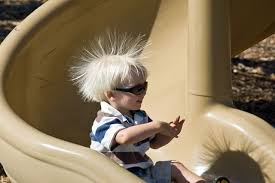
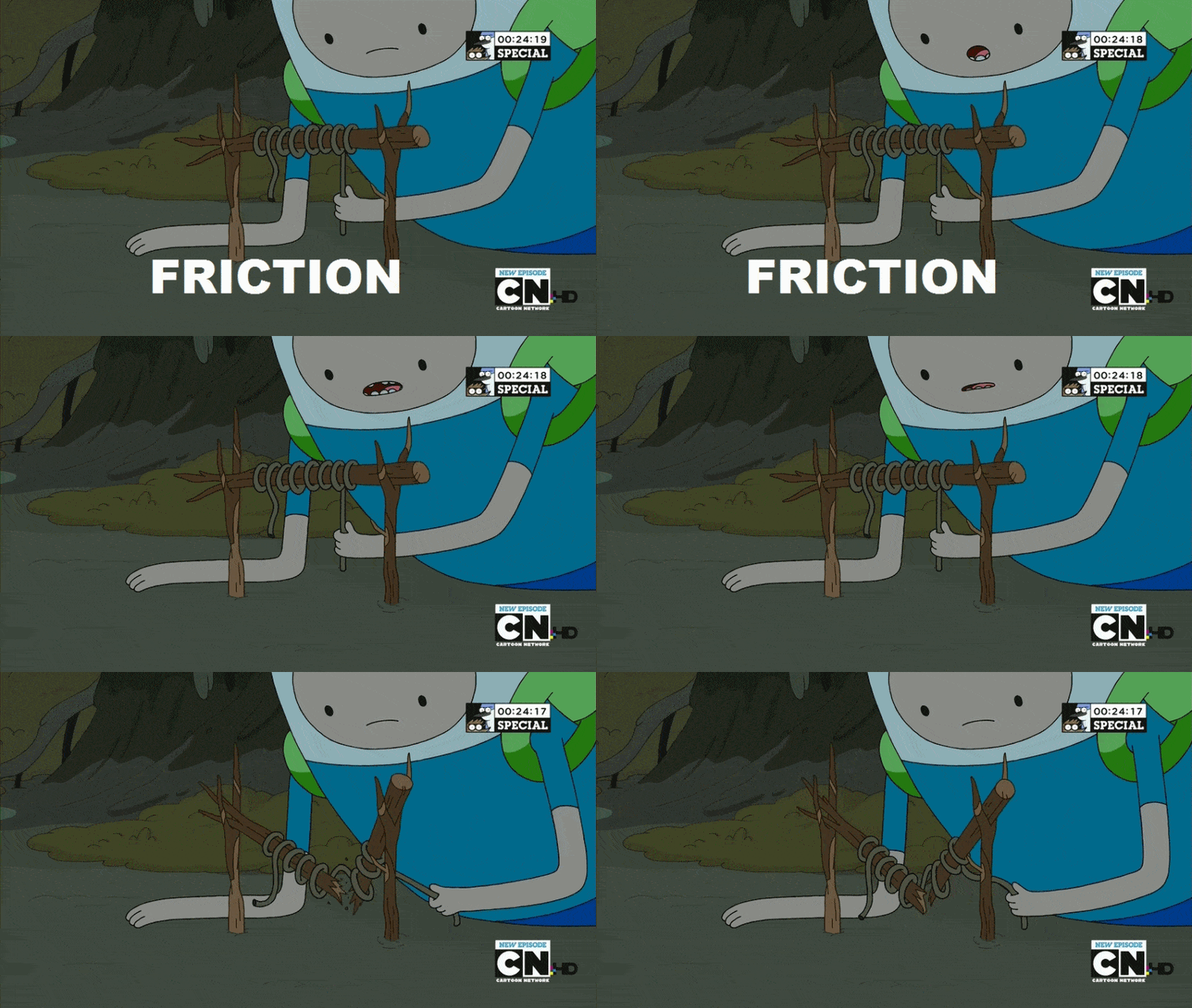
What happens when you touch a metal doorknob after rubbing your shoes on the carpet?
The doorknob sends a burst of electric current into your body
Millions of electrons go from your finger into the doorknob
The doorknob sends millions of electrons into your finger
Your finger becomes negatively charged
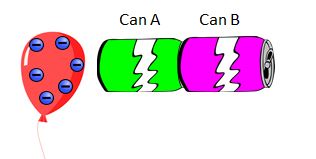
The negatively charged balloon is brought near, not touching, the two cans. What happens?
The negative charges in Can B move towards the balloon
The negative charges in Can A move away from the balloon
The positive charges in Can B move towards the balloon
The positive charges in Can A move away from the balloon

Two neutral conducting pop cans are touching each other. A negatively charged balloon is brought near Can X as shown below. Which of the following occur as the balloon approaches Can X?
The electrons are transferred or move from the balloon to can X to make it negatively charged
Can X becomes positively charged because it loses electrons
Can X becomes positively charged because the electrons are repelled and move to Can Y.
The protons from the balloon move to Can X to make it positively charged.
A neutral metal sphere is touched by a positively charged metal rod. During the process, protons are transferred from the positively charged rod to the sphere and the sphere now has a _________________.
positive charge
negative charge
has no charge; it remains neutral
nonsense! this is not what happens!

Consider the conduction charging shown.
Electrons move from the charge metal bar and into the sphere staying clumped together
Protons move from the bar into the sphere.
Electrons move from the charged metal bar into the sphere and evenly distribute themselves.
Protons move from the sphere into the negatively charged bar.


