
 Worksheets
Water in the Atmosphere
Total questions: 29
Worksheet time: 42mins
Name
Class
Date
1.

What part of the water cycle does this picture show?
a)
condensation
b)
precipitation
c)
evaporation
d)
transpiration
2.
Which of these is an example of precipitation?
a)
snow
b)
air
c)
clouds
d)
vapor
3.

What is it called when plants give off water vapor as a waste product?
a)
condensation
b)
evaporation
c)
sublimation
d)
transpiration
4.
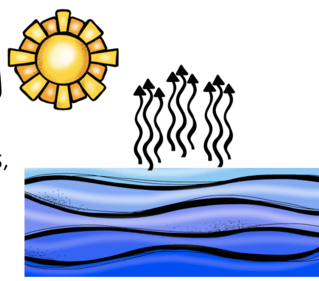
Evaporation happens when the sun ___________ water and turns it into vapor.
a)
cools
b)
heats up
c)
freezes
d)
lights up
5.

When water condenses, the water vapor in the air gets ___________ and changes back into liquid.
a)
cold
b)
hot
c)
warm
d)
solid
6.

What is the water cycle?
a)
the 3 forms of water
b)
the movement of water on, above, or below the surface of the Earth
c)
when water melts
d)
when clouds form
7.
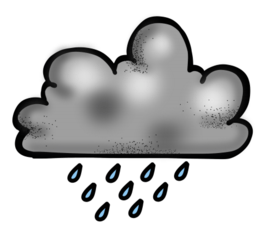
Precipitation happens when clouds of water droplets are too ______________.
a)
cold
b)
light
c)
heavy
d)
hot
8.
Where is most water found on Earth?
a)
glaciers
b)
lakes
c)
rivers
d)
oceans
9.
What source of energy evaporates the most water from Earth’s surface?
a)
volcanoes
b)
the sun
c)
lightning
d)
wind
10.
Snow, sleet, hail, and rain are all examples of ________________.
a)
evaporation
b)
condensation
c)
accumulation
d)
precipitation
11.

What is it called when WATER is FORMED from an LIQUID to a WATER VAPOR Oor an [GAS]?
a)
EVAPORATION
b)
PRECIPITATION
c)
TRANSPIRATION
12.
When water _________, dew forms.
a)
Melts
b)
Evaporates
c)
Condenses
d)
Precipitates
13.

What is A?
a)
Evaporation
b)
Condensation
c)
Precipitation
d)
Runoff
14.

What is B?
a)
Evaporation
b)
Condensation
c)
Precipitation
d)
Runoff
15.
On which kind of day would you expect the most evaporation from the surface of a pond?
a)
cold, rainy
b)
cold, sunny
c)
warm, rainy
d)
warm, sunny
16.
What is water vapor?
a)
Water on the land (geosphere)
b)
Water in the air (atmosphere)
c)
Water in plants
d)
Water in the water (hydrosphere)
17.
The amount of water vapor in the air is known as ___.
a)
dew point
b)
humidty
c)
relative humidity
d)
rain
18.
When the air is full of water and has a relative humidity of 100% it is said to be ___.
a)
full
b)
humid
c)
saturated
d)
warm
19.
The condition of the atmosphere at a certain time and place is referred to as ___.
a)
weather
b)
climate
c)
relative humidity
d)
dew point
20.
Which will hold more water, warm air or cold air?
a)
Warm Air
b)
Cold AIr
21.
Dew is what?
a)
Water that is pushed out by plants
b)
Water that was a gas in the atmosphere, but when it cooled turned into liquid water touching a solid object
c)
Water from the ground
22.
Which weather instrument is useful in measuring relative humidity?
a)
barometer
b)
anemometer
c)
psychrometer
d)
wind vane
23.
The amount of water vapor in the atmosphere compared to how much it could hold.
a)
Saturation
b)
Vaporicity
c)
Absolute Humidity
d)
Relative Humidity
24.
The warmer the air the __________ water vapor it can hold.
a)
less
b)
more
25.

If the air is "saturated", that means:
a)
the air is full of water
b)
the air is partially full of water
c)
it's amount of water vapor in the atmosphere right now
d)
how much liquid water it potentially can hold
26.
What does high humidity mean?
a)
It is cold.
b)
It is hot.
c)
There is a little evaporated water in the air.
d)
There is a lot of evaporated water in the air.
27.
The sun heats up surface water, causing evaporation. The water vapor then rises into the air creating....
a)
rain
b)
ice
c)
fog
d)
humidity
28.
If it's a hot day outside, which statement is true?
a)
The air molecules move slower.
b)
There are more clouds in the sky.
c)
There is little radiation energy in the air.
d)
There is more radiation energy in the air.
29.
How does air temperature affect humidity?
a)
warmer air = lower humidity
colder air = higher humidty
colder air = higher humidty
b)
temperature does not affect humidity
c)
colder air = lower humidity
warmer air = higher humidity
warmer air = higher humidity
d)
warm air and cold air = high humidity
100 %

