
 Worksheets
Cell Transport Test Recovery
Total questions: 20
Worksheet time: 10mins
Name
Class
Date
1.
What term describes the membrane’s ability to allow some, but not all, materials to cross it?
a)
Selective Permeability
b)
Porous
c)
Passable
d)
Descriptive Passage
2.
The cell membrane is made of __________________ that have a hydrophilic head and hydrophobic tail.
a)
Proteins
b)
Phospholipids
c)
Carbohydrates
d)
Fatty Acid Chains
3.
Which of the following types of cell transport is not a form of ‘passive transport’?
a)
Endocytosis
b)
Simple Diffusion
c)
Facilitated Diffusion
d)
Osmosis
4.
In ‘passive transport’, solute always moves in what direction?
a)
High → High
b)
Low→ High
c)
High → Low
d)
Low → Low
5.
‘Active Transport’ requires the use of _________.
a)
Carbohydrates
b)
Glucose
c)
Protein
d)
ATP
6.
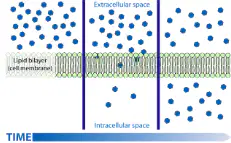
What type of cell transport is shown?
a)
Active Transport
b)
Endocytosis
c)
Simple Diffusion
d)
Facilitated Diffusion
7.
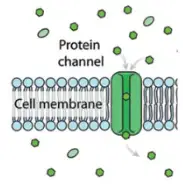
What type of cell transport is shown?
a)
Active Transport
b)
Simple Diffusion
c)
Osmosis
d)
Facilitated Diffusion
8.
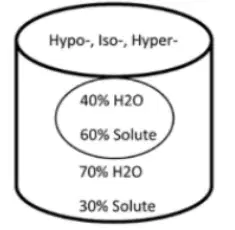
Which direction will the water move in the
image?
a)
Into the cell
b)
Out of the cell
c)
No net movement
9.

Which direction will the solute move in the
image?
a)
Into the cell
b)
Out of the cell
c)
No net movement of solute
10.
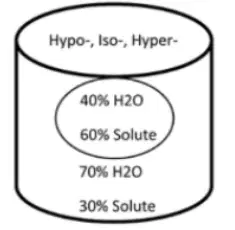
This cell will ____________ and is in a ____________ solution.
a)
Swell ; Hypertonic
b)
Swell ; Hypotonic
c)
Shrink ; Hypertonic
d)
Shrink ; Hypotonic
11.

A researcher claims that glucose is moved into cells by facilitated diffusion through the GLUT4 transporter.
Based on the model, which statement best supports the researcher’s claim?
a)
The movement of glucose across the membrane does not require ATP.
b)
Glucose moves from an area of low concentration to an area of high concentration.
c)
The glucose molecules diffuse freely through the membrane without a protein channel.
d)
Glucose provides energy for the protein channel to transport materials across the membrane.
12.
Other particles consumed by deer mice, such as calcium, have to move into cells by active transport.
Which diagram correctly shows the movement of particles into the cell by active transport?
a)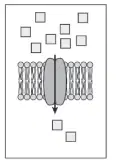
Option 1
b)
Option 2
c)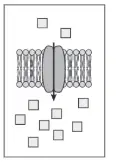
Option 3
d)
Option 4
13.
When glucose is broken down, carbon dioxide is produced, which results in more carbon dioxide inside the cell than outside the cell.The carbon dioxide then diffuses out of the cell.
Which statement best describes the movement of carbon dioxide by diffusion?
a)
The carbon dioxide can move through the plasma membrane by moving down the concentration gradient.
b)
Water molecules are needed to move the carbon dioxide across the plasma membrane.
c)
Peripheral proteins help move the carbon dioxide across the plasma membrane.
d)
The transport of carbon dioxide through the plasma membrane requires energy from ATP.
14.
Students created flowcharts to show select types of transport that occur across the plasma membrane.
Which flowchart correctly shows the types of plasma membrane transport?
a)
Option 1
b)
Option 2
c)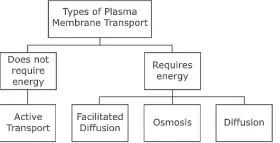
Option 3
d)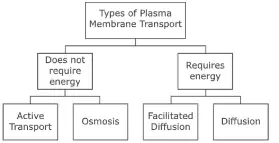
Option 4
15.
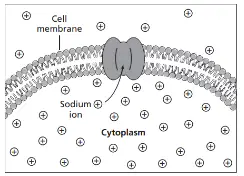
The movement of a sodium ion through a cell membrane is shown.
This sodium ion passes through the cell membrane by which process?
a)
Respiration
b)
Osmosis
c)
Active Transport
d)
Facilitated Diffusion
16.

The diagram below represents a selectively permeable membrane that separates Region A from Region B.
Under which condition will oxygen cross the membrane?
a)
When the membrane has a strong electrical charge
b)
When the membrane uses energy to transport oxygen molecules
c)
When the temperature in Region B is sufficiently higher than in Region A
d)
When the concentration of oxygen in Region A is lower than that in Region B
17.
Students were studying the movement of molecules across selectively permeable membranes. They placed 25 mL each of solutions of varying sugar concentrations in bags of dialysis tubing. Each bag of dialysis tubing was placed in a beaker containing a 10% sugar solution. The dialysis tubing is permeable to water but not to sugar. Which dialysis bag will lose the most volume?
a)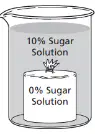
Option 1
b)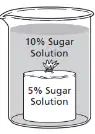
Option 2
c)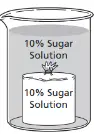
Option 3
d)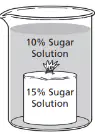
Option 4
18.

Caviar are the eggs of fish. The eggs are stored in brine, or a saltwater solution.
Which statement describes the importance of storing the caviar in brine instead of distilled water?
a)
Distilled water would cause an isotonic environment for the eggs.
b)
Brine keeps the salt levels in the eggs higher than outside of the eggs.
c)
Distilled water would cause water to move outside of the egg membrane.
d)
Brine maintains equilibrium of water movement across the egg membrane.
19.
Cells are able to pump ions across their membranes in opposition to a concentration gradient due to:
a)
The destruction of electrons within the cell.
b)
A drop in temperature outside the cell
c)
An expenditure of energy by the cell.
d)
A vacuole formation within the cell.
20.
The energy necessary to move sodium ions across a cell membrane comes from
a)
The movement of H2O
b)
The use of ATP
c)
The manufacturing of RNA
d)
The replication of DNA
100 %

