
 Worksheets
Ocean Features In
Total questions: 29
Worksheet time: 27mins
Valleys cut deep into the ocean floor
Plankton
Salinity
Surface Current
Ocean Trench
Amount of salt found in water
Photic Zone
Gulf Stream
Photosynthesis
Salinity
Sharp underwater hill connecting the continent to the ocean floor?
Ocean
Coral Reef
Plankton
Continental Slope
the constant movement of ocean water that is caused by the patterns of wind and water density
Ocean Current
Continental Drift
Land Before Time
Zooplankton
Which location is likely to have the greatest water pressure, the coldest temperatures, and the smallest number of living organisms?
Continental Shelf
Continental Slope
Abyssal Plain
Trench
Which of the following would decrease as a diver travels deeper into the ocean? (Choose all of the correct answers!)
Pressure
Light
Temperature
Salinity
High and low tides on the coast are caused mostly by
underwater earthquakes
the gravity from the moon
storms over the ocean
the tilt of Earth
Which of the following are identifying characteristics of the deepest levels of the ocean. (Choose all that apply)
Some light
No light
90 percent of all ocean life
Greater water pressure
Which of the following cause ocean waves.
changes in salinity
ships navigating
temperature decreasing
friction from the wind
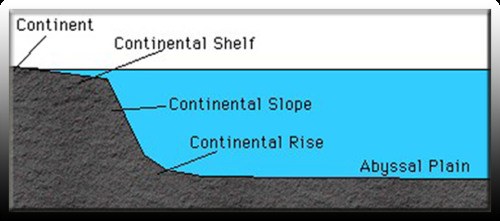
Which ocean floor feature is the steep cliff-like drop beyond the continental shelf?
Continental Shelf
Continental Slope
Abyssal Plain
Ocean Trench

As the depth of the ocean water increases, the amount of light...
Increases (more light)
Decreases (less light)
The deepest parts of the ocean are called
trenches
abyss
deep sea plain
guyot
Shorelines made up of sand are called ____________.
beaches
rock ports
currents
tides
What is the flat land located on either side of the mid-ocean ridge?
continental slope
abyssal plain
continental shelf
mid-ocean ridge
What causes surface waves?
underwater volcanoes
earthquakes
wind
landslides
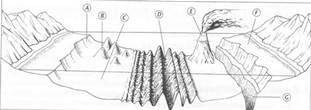
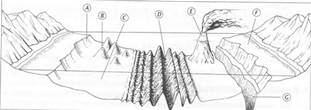
The Mariana __________ is the deepest known place on Earth
Volcanoe
Seamount
Ridge
Trench

Ocean basins are mainly responsible for the movements of Earth's ---------- plates.
(a)
What did scientists use to map the ocean floor?
Echo-location
Animals
Sonar
space shutters
What are mid-ocean ridges?
A chain of underwater waterfalls
A chain of underwater volcanos
A chain of underwater mountains
A chain of underwater rocks
How are salts added to the ocean?
Precipitation
Land erosion
Evaporation

