wayground logo

Free Printable Worksheets

NEW

Font size

S
M
L
XL
Worksheets

Newton's Law

Total questions: 26

Worksheet time: 18mins

Name
Class
Date
1.

An object's tendency to resist change, whether it is in motion or remaining still is called -

a)

Friction

b)

Inertia

c)

Force

d)

Gravity

2.

Push or Pull

a)

Friction

b)

Inertia

c)

Force

d)

Gravity

3.
"For every action, there is an equal and opposite reaction."
a)
Newton's 1st Law
b)
Newton's 2nd Law
c)
Newton's 3rd Law
d)
Newton's 4th Law
4.
Force = Mass x Acceleration
a)
Newton's 1st Law
b)
Newton's 2nd Law
c)
Newton's 3rd Law
d)
Newton's 4th Law
5.
"An object in motion (or at rest) will to stay in motion (or at rest) until an outside force acts upon it."
a)
Newton's 1st Law
b)
Newton's 2nd Law
c)
Newton's 3rd Law
d)
Newton's 4th Law
6.
Any push or pull on an object.
a)
force
b)
velocity 
c)
inertia
d)
momentum
7.
A Newton is a unit of...
a)
force
b)
inertia
c)
acceleration
d)
velocity
8.

When all the forces on an object are equal and opposite, & the net force is zero, those are -

a)

balanced forces

b)

unbalanced forces

c)

terminal velocity

d)

reaction forces

9.

A cannonball with a MASS of 0.5 kg is flying at an ACCELERATION of 10 m/sec/sec. What is it's force? (REMEMBER! Force=Mass x Acceleration)

a)

50 Newtons

b)

5 Newtons

c)

20 Newtons

d)

9.5 Newtons

10.

Mass x acceleration = ?

a)

force

b)

inertia

c)

momentum

d)

velocity

11.
In the picture, the blocks are flying out of the truck based on which of Newton's laws?
a)
Newton's 1st Law
b)
Newton's 2nd Law
c)
Newton's 3rd Law
d)
Newton's 6th Law
12.
In the picture, the vehicle will move because of...
a)
Newton's 1st Law
b)
Newton's 2nd Law
c)
Newton's 3rd Law
d)
Newton's 9th Law
13.

A person not paying attention while skateboarding hits a rock. The skateboard stops...they don't.

a)

The Law of Inertia (Newton's First Law)

b)

The Law of Acceleration (Newton's Second Law)

c)

The Law of Conservation of Momentum (Newton's Third Law)

14.
This person bought coffee and put it on the seat next to them. If they stopped quickly and the coffee spilled which law would that represent?
a)
Newton's 1st Law
b)
Newton's 2nd Law
c)
Newton's 3rd Law
15.
The combination of all the forces acting on an object is the...
a)
net force
b)
action force
c)
reaction force
d)
balance force
16.

The Law of Inertia

a)

Newton's

1st

Law of Motion

b)

Newton's

2nd

Law of Motion

c)

Newton's

3rd

Law of Motion

17.

F=ma

a)

Newton's

1st

Law of Motion

b)

Newton's

2nd

Law of Motion

c)

Newton's

3rd

Law of Motion

18.

For every action, there is an equal and opposite reaction.

a)

Newton's

1st

Law of Motion

b)

Newton's

2nd

Law of Motion

c)

Newton's

3rd

Law of Motion

19.

An asteroid in outer space continues to move.

a)

Newton's

1st

Law of Motion

b)

Newton's

2nd

Law of Motion

c)

Newton's

3rd

Law of Motion

20.
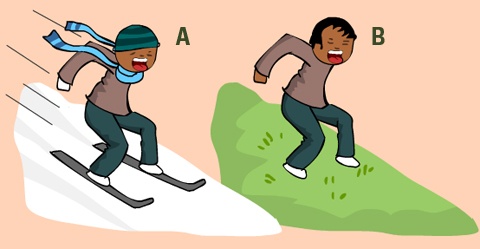
Why is it harder for the boy in Image B to get down the hill?
a)
Motion
b)
Friction
c)
Work
d)
Displacement
21.

Why does a rolling ball stop?

a)

Gravity

b)

Friction

c)

Waterfalls

d)

Sand

22.
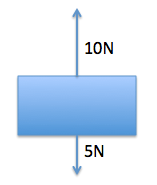
What is the net force on the block? (click on the words to view the picture)
a)
5 Newtons up
b)
5 Newtons down
c)
15 Newtons up
d)
15 Newtons down
23.
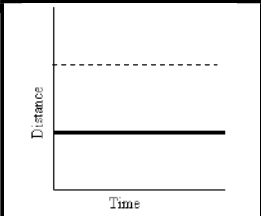
What does this graph represent?
a)
Constant speed
b)
Acceleration
c)
Not moving
24.
Angela blows air into a balloon and holds the end of it closed with her fingers. When she lets go of the end of the balloon, Angela observes that the release of the air propels the balloon.  The propelling of the balloon from the release of the air is an example of which of Newton’s laws? 
a)
The force of an object is the product of its mass multiplied by its acceleration. 
b)
 A force of attraction exists between any two objects with mass. 
c)
 For every action, there is an equal and opposite reaction.
d)
An object in motion tends to stay in motion unless an unbalanced force acts upon it. 
25.
If you pull the cord, what direction will the box move?
a)
Up
b)
Down
c)
Left
d)
Right
26.
Which scientist gave us the laws of motion?
a)
George Washington
b)
John Adams
c)
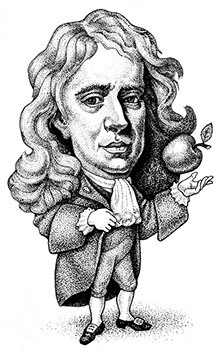
Sir Isaac Newton