
NEW
Font size
 Worksheets
Cosmology Model
Total questions: 51
Worksheet time: 38mins
How long ago did the Universe begin according to the Big Bang Theory?
4 billion years ago
14 million years ago
14 billion years ago
40 billion years ago
What was the Universe like at the very beginning, as described by the Big Bang Theory?
A very small region that was extremely cold and dense
A very large region that was extremely hot and dense
A very small region that was extremely hot and dense
A very large region that was extremely cold and sparse
What is the evidence that supports the idea that the Universe is expanding?
Galaxies are moving towards each other
Galaxies are stationary relative to each other
Galaxies are moving away from each other
Galaxies are randomly distributed in space
What is the result of the initial explosion of the Big Bang?
The Universe has stopped expanding
The Universe began to contract
The Universe continues to expand
The Universe has become completely static

What does the balloon represent in the analogy used to explain the expansion of the universe?
The balloon represents the galaxies.
The balloon represents the space between galaxies.
The balloon represents the density of galaxies.
The balloon represents the amount of expansion.

What happens to the points on the balloon as it deflates?
The points move closer together and are an equal distance apart.
The points move further apart and are an unequal distance apart.
The points disappear as the balloon deflates.
The points move closer together but are an unequal distance apart.

As the balloon expands, how do the points on the balloon move relative to each other?
They move closer together by the same amount.
They move further apart by different amounts.
They move further apart by the same amount.
They stay at the same distance from each other.
What is the effect on the density of galaxies as the universe expands?
The density of galaxies increases.
The density of galaxies remains the same.
The density of galaxies falls.
The density of galaxies is not affected by the expansion of the universe.
What is the currently accepted model for the origin of the Universe?
Steady State theory
Big Crunch
Big Bang
Oscillating Universe model

What piece of evidence from light spectra of distant galaxies supports the Big Bang theory?
The light spectra show a blueshift indicating galaxies are moving towards each other
The light spectra show no significant shift indicating galaxies are stationary
The light spectra show a redshift indicating the universe is expanding
The light spectra show a random shift indicating chaotic movement of galaxies
What was concluded from the observation that all galaxies are moving away from the Earth?
The universe is contracting
The universe is in a steady state
The universe is oscillating
The universe is expanding

According to the Big Bang theory, how do galaxies move relative to their distance from the source of the explosion?
Galaxies closer to the source move faster
Galaxies farther from the source move slower
Galaxies farther from the source move faster
All galaxies move at the same speed
What would be observed if someone were to travel back in time and compare the separation distance of the galaxies?
Galaxies would appear to be in a random arrangement
Galaxies would become more separated and scattered
Galaxies would become closer and closer together
Galaxies would appear the same as they are now

What led to the Big Bang theory becoming the currently accepted model?
The discovery of the CMB (Cosmic Microwave Background)
The invention of the telescope
The discovery of dark matter
The observation of redshift in distant galaxies

What is the CMBR?
A type of dark energy
A type of electromagnetic radiation from the early stages of the Universe
A type of radiation only found in black holes
A type of radiation emitted by stars

What is the wavelength of the CMB?
Around 1mm
Around 1cm
Around 1m
Around 1km
Why were astronomers unable to detect microwaves from the CMB earlier?
Because microwaves do not exist outside the Earth's atmosphere
Because microwaves are absorbed by the Earth's atmosphere
Because the technology to detect microwaves did not exist
Because microwaves were not believed to be significant

What development enabled astronomers to detect CMB radiation more effectively?
The creation of more powerful ground-based telescopes
The development of space flight allowing telescopes to be sent into orbit
The discovery of a new type of radiation
The invention of the radio
According to the Big Bang theory, what must the early Universe have emitted as a result of being extremely hot and dense?
Sound waves
Thermal radiation
Visible light
Ultraviolet radiation
In which region of the spectrum is the radiation from the Big Bang now found?
Gamma rays
X-rays
Microwave
Radio waves
What has happened to the wavelength of the radiation from the Big Bang as the Universe has expanded?
It has decreased
It has stayed the same
It has increased
It has disappeared
What is the temperature associated with the Cosmic Microwave Background (CMB) radiation?
3000 Kelvin
3 Kelvin
300 Kelvin
30 Kelvin
What phenomenon does the Cosmic Microwave Background (CMB) radiation's uniformity and profile challenge?
The Big Bang Theory
The Steady State Theory
The Theory of Relativity
The Quantum Theory
What is the term used to describe the shift to longer wavelengths of the radiation from the Big Bang due to the expansion of the Universe?
Blueshift
Redshift
Greenshift
Purpleshift
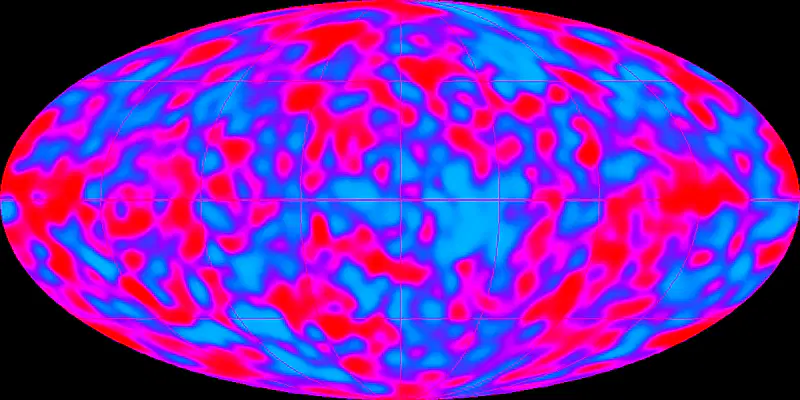
What do the blue regions on the CMB map represent?
Warmer temperature indicating a higher density of galaxies
Cooler temperature indicating a higher density of galaxies
Cooler temperature indicating a lower density of galaxies
Warmer temperature indicating a lower density of galaxies
What happens to wavefronts when an object emits waves while being stationary?
The wavefronts spread out asymmetrically.
The wavefronts do not spread out at all.
The wavefronts spread out symmetrically.
The wavefronts only spread out in one direction.
What is the effect called when a wave source moves relative to an observer, causing a change in the observed frequency and wavelength?
Wavefront effect
Doppler effect
Frequency shift
Wavelength variation
When a wave source is moving, how does the wavelength in front of the source change?
It increases.
It decreases.
It remains constant.
It becomes infinite.
As a wave source moves, what happens to the frequency of the waves behind the source?
It increases.
It decreases.
It remains constant.
It becomes zero.
What does the symbol λ represent in the Doppler shift equation for light?
Change in wavelength
Reference wavelength
Velocity of a galaxy
Observed wavelength of the source
What is the value of c in the Doppler shift equation?
Change in wavelength
Reference wavelength
Velocity of a galaxy
Speed of light in meters per second
What does Δλ represent in the Doppler shift equation?
Observed wavelength of the source
Reference wavelength
Change in wavelength
Speed of light in meters per second
How can the velocity of a galaxy be calculated using the Doppler shift equation?
By measuring the change in wavelength and comparing it to the speed of light
By measuring the observed wavelength and comparing it to the reference wavelength
By measuring the change in wavelength and comparing it to the reference wavelength
By measuring the reference wavelength and comparing it to the speed of light
What effect describes the change in wavelength of light as objects in space move towards or away from an observer?
Gravitational lensing
Doppler effect
Cosmic microwave background radiation
Hubble's law
What is known as redshift in the context of galactic movement?
The movement of a galaxy away from an observer, causing the light to shift towards the red end of the spectrum
The movement of a galaxy towards an observer, causing the light to shift towards the blue end of the spectrum
The movement of a galaxy in a circular orbit, causing the light to shift towards the green end of the spectrum
The movement of a galaxy perpendicular to the observer, causing no shift in the light spectrum
What is the term for the shift in light towards the blue end of the spectrum as an object moves towards an observer?
Redshift
Orangeshift
Greenshift
Blueshift
What happens to the wavelength and frequency of light from a star moving towards an observer?
The wavelength increases and the frequency decreases
The wavelength decreases and the frequency increases
Both the wavelength and frequency increase
Both the wavelength and frequency decrease
What happens to the light from a star that is moving away from an observer?
It will be blueshifted
It will be redshifted
It will be greenshifted
There will be no shift in the light
What happens to the observed frequency of waves when the source is moving towards the observer?
The frequency remains unchanged.
The frequency decreases, resulting in a redshift.
The frequency increases, resulting in a blueshift.
The frequency increases, resulting in a redshift.
What is observed when the source of waves is moving away from the observer?
The frequency increases, resulting in a blueshift.
The frequency remains unchanged.
The frequency decreases, resulting in a blueshift.
The frequency decreases, resulting in a redshift.
When the source of waves is not moving relative to the observer, what is observed?
A redshift is observed.
A blueshift is observed.
No shift in frequency is observed.
The frequency increases.
Which color in the visible light spectrum has the longest wavelength?
Blue
Green
Red
Violet
As an object moves further away, what happens to the frequency and wavelength of the waves it emits?
The frequency increases and the wavelength decreases.
The frequency and wavelength both increase.
The frequency decreases and the wavelength increases.
The frequency and wavelength both decrease.
What does galactic redshift provide evidence for?
The steady state theory of the universe
The Big Bang Theory and the expansion of the universe
The contraction of the universe
The oscillating universe theory
What is observed when the spectral lines from a distant galaxy move closer to the red end of the spectrum?
Blue-shift
Red-shift
No shift
Green-shift
Why are light waves from distant galaxies red-shifted more than those from nearby galaxies?
Because distant galaxies are moving towards us
Because the light waves are stretched by the expansion of the universe
Because distant galaxies have a stronger gravitational pull
Because nearby galaxies are moving away faster
What does the redshift of light from distant galaxies indicate about their movement relative to us?
They are moving in random directions
They are stationary relative to us
They are moving towards us
They are moving away from us

What can be inferred about the speed of a galaxy's movement relative to its distance from Earth?
The closer a galaxy is, the faster it is moving away from the Earth
The speed of a galaxy's movement is not related to its distance from Earth
The further away a galaxy is, the faster it is moving away from the Earth
All galaxies move away from the Earth at the same speed
What do the observations about the light spectrum from distant galaxies imply about the universe?
The universe is contracting
The universe is in a steady state
The universe is expanding
The universe is oscillating

What is the relationship between the distance to a galaxy and its redshift?
The greater the distance to a galaxy, the smaller the redshift.
The distance to a galaxy has no effect on the redshift.
The greater the distance to a galaxy, the greater the redshift.
The distance to a galaxy is inversely proportional to the redshift.
Light emitted from a star has a wavelength of 435 x 10-9m. A distance galaxy emits the same light but has a wavelength of 485 x 10-9m. Calculate the speed at which the galaxy is moving relative to Earth. The speed of light = 3 x 10⁸ m/s.
2.61 x 10⁹ m/s
5 x 10⁻⁸ m/s
3.4 x 10⁷ m/s
3.4 x 10⁻⁷ m/s

