wayground logo

Free Printable Worksheets

NEW

Font size

S
M
L
XL
Worksheets

Hbs Unit

Total questions: 26

Worksheet time: 18mins

Name
Class
Date
1.

What number on the graph represents when the sodium potassium pump has reset the axon?

a)

1

b)

2

c)

3

d)

4

2.

What number on the graph represents when sodium enters the inside of the axon?

a)

1

b)

2

c)

3

d)

4

3.

A momentary reversal in electrical potential across the cell membrane that occurs when a cell has been activated by a stimulus.

a)
Electric Potential
b)
Potential Energy
c)
Action Potential
d)
Kinetic Potential
4.

A substance contained in a vesicle that transmits nerve impulses across a synapse.

a)

Norotransmitter

b)

Neurotransmitter

c)

Electrotransmitter

d)

Synoptictransmitter

5.
An automatic and often inborn response to a stimulus that involves a nerve impulse passing inward from a receptor to the spinal cord and thence outward to an effector (as a muscle or gland) without reaching the level of consciousness and often without passing to the brain.
a)
Reaction
b)
Reflex
c)
Reflection
d)
Reflects
6.
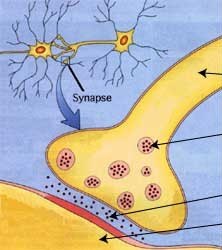
The place at which a nervous impulse passes from one neuron to another.
a)
Synaptic gap
b)
Neural gap
c)
Synapse
d)
Neuraltransmitter
7.
Hydrophilic portion of cell membrane?
a)
A
b)
B
c)
C
d)
E
D
8.
When a neuron is resting, the inside of the axon has a ____________ charge.
a)
positive
b)
negative
9.
When a neuron is not engaged in an impulse.
a)
Resting potential
b)
Action potential
c)
Neural potential
d)
Synaptic potential
10.
Which ions are involved in the electrical nerve impulse?
a)
Iodine and Sodium
b)
Potassium and Sodium
c)
Iron and Sodium
d)
Calcium and Iodine
11.
The sodium-potassium pump usually pumps
a)
potassium out of the cell 
b)
sodium out of the cell 
c)
sodium into the cell 
d)
both potassium and sodium into the cell 
12.
Name the ion that is pumped into the axon to maintain resting potential. 
a)
Calcium
b)
Hydrogen
c)
Potassium 
d)
Sodium 
13.
What maintains the resting membrane potential?
a)
Na/K pump
b)
Ion Channels
c)
Depolarization
d)
Hyperpolarization
14.
In resting potential, neurons have more _________ on the outside of the cell membrane.
a)
K+
b)
NaCl
c)
Na+
d)
Cl-
15.
Active transport requires ___ to provide energy that cells need to move against the gradient.
a)
ATP
b)
Water
c)
Oxygen
d)
Carbon dioxide
16.
What neuron is this?
a)
Relay
b)
Motor
c)
Reflex
d)
Sensory
17.
What neuron is this?
a)
motor
b)
sensory
c)
relay
d)
reflex
18.
In this picture, the red line represents a(n)
a)
motor neuron
b)
sensory neuron
c)
receptor
d)
interneuron
19.
In this picture, the blue line represents a(n)
a)
interneuron
b)
motor neuron
c)
sensory neuron
d)
effector
20.
This picture is an example of a
a)
Nerve Impulse
b)
Reflex Arc
c)
Neural Arc
d)
Cerebral Processing
21.

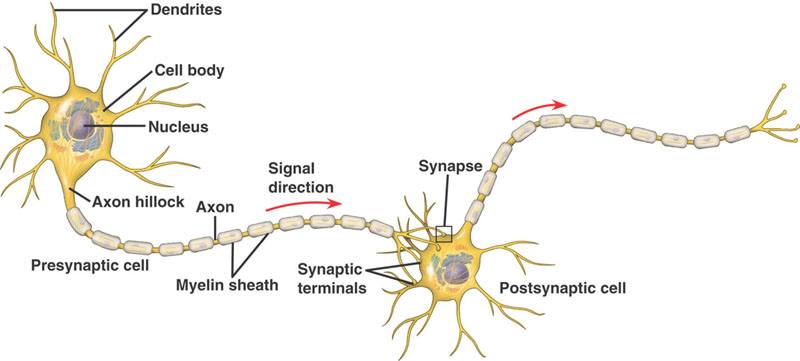
What do Axon Terminals do?

a)

Receives information from other neurons

b)

Produces fatty tissue for the Myelin Sheath

c)

Sends information to the next cell

d)

Controls the speed of electrical signal through the axon

22.
Which is the correct sequence in the transmission of a neural impulse?
a)
axon, dendrite, cell body, synapse
b)
dendrite, axon, cell body, synapse
c)
synapse, axon, dendrite, cell body
d)
dendrite, cell body, axon, synapse
23.
Nerve impulses within the neuron are sent in _____ form
a)
Electrical
b)
Chemical
c)
Electro-chemical
d)
Petrochemical
24.

The proper name for brain chemicals

a)

Hormones

b)

Neurons

c)

Neurotransmitters

d)

Synapse

25.

The part of the neuron that receives messages from other neurons

a)

axon

b)

dendrite

c)

cell body

d)

Schwann cell

26.

The location of neurotransmitters

a)

axon terminals

b)

dendrites

c)

Schwann cells

d)

cell body