
NEW
Font size
 Worksheets
AP Chemistry Electrochemistry
Total questions: 25
Worksheet time: 2hrs 2mins

Given their standard reduction potentials, which of the species is going to be oxidized?
Cu2+/Cu = 0.34V
Zn2+/Zn = -0.76V
Cu
Zn
CuSO4
ZnSO4
What occurs to the mass of copper electrode in the following reaction?
Zn/Zn2+ // Cu2+/Cu
increases
decreases
remains the same
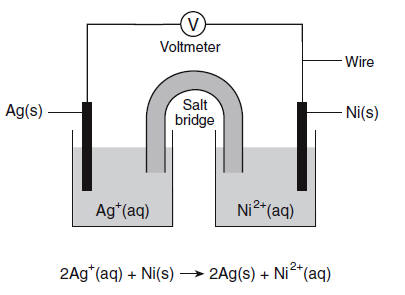
What reaction occurs at the anode?
Ag+/Ag = 0.80V
Ni2+/Ni = -0.25V
Ag+ + e- →Ag
Ag → Ag+ + e-
Ni2+ + 2e- → Ni
Ni → Ni2+ + 2e-
What would be the theoretical cell potential of the electrochemical cell with the following species?
Ag+/Ag = 0.80V
Ni2+/Ni = -0.25V
+1.05V
-1.05V
+0.55V
-0.55V

An oxidizing agent will
increase in mass
lose electrons
be reduced
increase in oxidation number

As an element is oxidized, its oxidation number
decreases as electrons are lost
increases as electrons are lost
decreases as electrons are gained
increases as electrons are gained

In the following reaction
Sn+2 + 2Fe+3 --> Sn+4 + 2Fe+2,
the reducing agent is...
Fe+3
Sn+2
Sn+4
Fe+2

In the following reaction
Sn+2 + 2Fe+3 → Sn+4 + 2Fe+2
the oxidizing agent is....
Sn+4
Sn+2
Fe+3
Fe+2

Galvanic cells convert
mechanical energy in to electrical energy
potential energy in to electrical energy
electrical energy in to chemical energy
chemical energy in to electrical energy

When water is electrolyzed, gas collected at cathode, is
sulphur
oxygen
hydrogen
sulphur dioxide
Conductivity always ____________ with a decrease in concentration
decreases
increases
remain same
irregular for weak and strong
What is oxidation number of Cr in Cr2O72-?
-2
+2
+6
+12
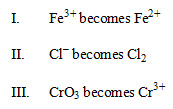

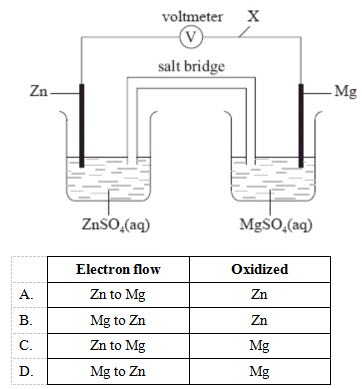
Which statement best describes how a salt bridge maintains electrical neutrality in the half-cells of an electrochemical cell?
It prevents the migration of electrons.
It prevents the reaction from occurring spontaneously.
It permits the migration of ions.
It allows for the reaction from occurring spontaneously.
When an electrochemical cell is operating, it is
approaching equilibrium
using external energy
undergoing oxidation, only
undergoing reduction, only
Fe2+ + 2e– → Fe(s) E° = –0.44 volt
Ni2+ + 2e– → Ni(s) E° = –0.23 volt
The standard reduction potentials for two half reactions are given above. The Nernst equation for a galvanic cell at 25°C in which Fe(s) reduces Ni2+ is the following.
E = E° – 0.03 log [Fe2+]/[Ni2+]
What is the equilibrium constant for the reaction below?
Fe(s) + Ni2+ → Fe2+ + Ni(s)
1.9 × 10⁻²³
7.6 × 10⁻⁸
3.6 × 10³
1.3 × 10⁷

Which of the following statements applies to the change in mass of the electrodes involved in this electrochemical cell?
Electrode A is the anode and it gains mass
since metal ions are being converted to metal
atoms which often adhere to the electrode.
Electrode C is the anode and it gains mass
since metal ions are being converted to metal
atoms which often adhere to the electrode.
Electrode A is the cathode and it gains mass since metal ions are being converted to metal atoms which often adhere to the electrode.
Electrode C is the cathode and it gains mass since metal ions are
being converted to metal atoms which often adhere to the electrode.

In electrolytic cell which its electrolyte is copper(II) sulphate, copper are used as electrodes. What is the product at the anode?
The OEcell of an electrolytic cell is
greater than one.
less than zero.
equal to one.
zero.

An experiment is set up as shown in the diagram where the external battery's anode is illustrated by the left "short" vertical line. Both electrodes P and Q are made of graphite. Which of the following gives the correct results as electrolysis proceeds?
Electrolyte: Aqueous sodium chloride; Mass of P: Remains unchanged; Mass of Q: Increase
Electrolyte: Aqueous sodium chloride; Mass of P: Increase; Mass of Q: Remains unchanged
Electrolyte: Aqueous copper(II) sulfate; Mass of P: Remains unchanged; Mass of Q: Increase
Electrolyte: Aqueous copper(II) sulfate; Mass of P: Increase;
Mass of Q: Remains unchanged
Which statement correctly describes the 2 electrodes in an electrolytic cell?
The anode is negative and the cathode is positive
The anode and cathode are both positive
The anode is positive and the cathode is negative
The anode and cathode are both negative.

