
 Worksheets
Air Masses Fronts
Total questions: 20
Worksheet time: 18mins
Name
Class
Date
1.
A cold, dry air mass would be called -
a)
continental tropic
b)
continental polar
c)
maritime polar
d)
continental maritime
2.
When a warm air mass and a cold air mass meet, but they push at each other and neither one can move, it is called a/an -
a)
warm front
b)
cold front
c)
occluded front
d)
stationary front
3.
The boundary between two air masses is called a/an -
a)
flood
b)
front
c)
climate
d)
storm
4.
When a fast moving cold air mass moves into a slower moving warm air mass, we may experience severe storms and we will have cooler weather. What type of front is this?
a)
warm front
b)
cold front
c)
occluded front
d)
stationary front
5.
When a warm air mass slides on top of a cold air mass, and you have drizzly rain and then warmer weather, what type of front is it?
a)
warm front
b)
cold front
c)
occluded front
d)
stationary front
6.
A/An ____ is a large body of air that has the same properties as the Earth's surface over which it develops.
a)
front
b)
air mass
c)
cloud
d)
tornado
7.
What type of weather would a continental tropical air mass bring?
a)
dry and cold weather
b)
wet and cold weather
c)
dry and warm weather
d)
wet and warm weather
8.
An air mass that formed over the ocean near the equator would probably be -
a)
maritime polar
b)
maritime tropical
c)
continental polar
d)
continental tropical
9.
A wet, cold air mass would be -
a)
maritime tropical
b)
maritime polar
c)
continental tropical
d)
continental polar
10.
Where would you find a tropical maritime air mass?
a)
over the ocean, near the equator
b)
over the ocean, near the poles
c)
over a continent, near the equator
d)
over a continent, near the poles
11.

What type of front is this?
a)
warm front
b)
cold front
c)
stationary front
d)
occluded front
12.

What type of storm front is this?
a)
warm front
b)
cold front
c)
stationary front
d)
occluded front
13.

What does symbol # 3 mean?
a)
stationary front
b)
occluded front
c)
warm front
d)
cold front
14.

What does symbol # 1 mean?
a)
stationary front
b)
occluded front
c)
warm front
d)
cold front
15.

What does symbol # 2 mean?
a)
stationary front
b)
occluded front
c)
warm front
d)
cold front
16.
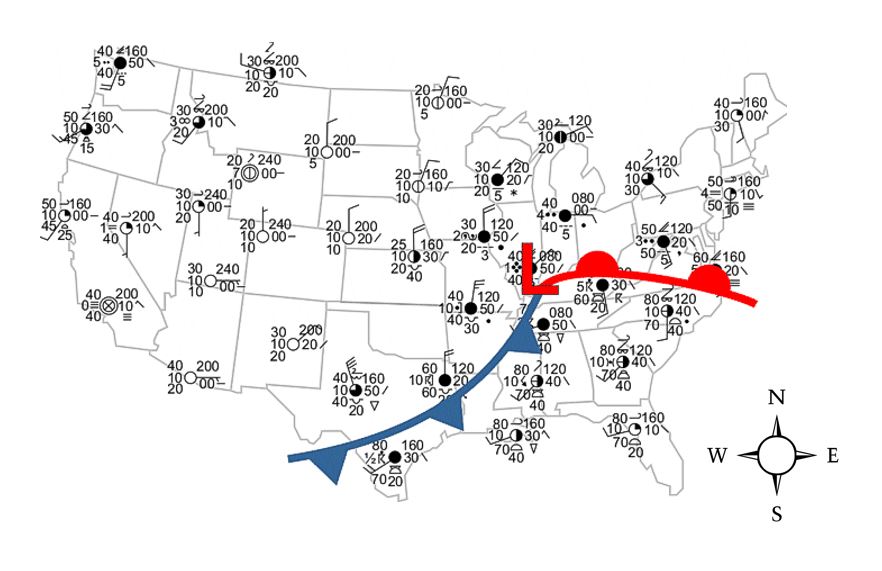
What direction is the cold front moving on the map?
a)
Southwest
b)
Northwest
c)
Southeast
d)
Northeast
17.
What direction is the warm front moving on the map?
a)
North
b)
South
c)
East
d)
West
18.
What type of weather would you expect to see after a warm front has passed through an area?
a)
cool and clear skies
b)
warm and humid
c)
thunderstorms
d)
foggy
19.
What type of weather would you expect to see after a cold front has passed through an area?
a)
cool and clear skies
b)
warm and humid
c)
thunderstorms
d)
foggy
20.
What characteristics are used to classify air masses?
a)
temperature and humidity
b)
pressure and temperature
c)
latitude and longitude
d)
wind speed and location
100 %

