
 Worksheets
Conservation of Energy AP Physics
Total questions: 26
Worksheet time: 24mins
Potential energy is defined as
Energy stored in the object
Energy of motion
Energy stored in the bonds of molecules
Heat energy

A 4 kg block is pushed up an incline that makes a 300 angle with the horizontal, as shown in the figure. Once the block is pushed a distance of d=5.0 m up the incline, the block remains at rest. What is the approximate change in the gravitational potential energy of the block-Earth system when the block is held at rest compared to its original location at the bottom of the incline?
0 J
100 J
100 square root of 3
200J
The unit for energy and work is
J
N
m/s
m/s/s

An object of mass M is attached to a string of negligible mass and spun in a vertical circle of radius R, as shown in the figure above. As the object’s height increases, its speed decreases such that the object-Earth system’s total mechanical energy remains constant. By how much does the object’s kinetic energy decrease in moving from point O, the lowest point on the circle, to point P, the highest point on the circle?


The surface of an incline is coated with an experimental substance that is intended to reduce the frictional force between a block and the surface of the incline. A 2 kg
block is placed at the top of the incline at a height of 1.8 m
, as shown in the figure. After the block is released from rest, the block slides down the incline and a motion detector at the bottom of the incline measures the block’s speed as 5.8m/s after the block is no longer on the incline. Which of the following claims is correct about the experimental substance?
The experimental substance reduced all the frictional force because all the gravitational potential energy of the Earth-block system at the top of the incline was converted into the kinetic energy of the block at the bottom of the incline.
The experimental substance did not reduce all the frictional force because some of the gravitational potential energy of the Earth-block system at the top of the incline was converted into nonmechanical energy.
The effectiveness of the experimental substance cannot be determined because the speed of the block at the bottom of the inline, as measured by the motion detector, indicates that the block has more energy at this location than the Earth-block system had at the top of the incline.The effectiveness of the experimental substance cannot be determined because the speed of the block at the bottom of the inline, as measured by the motion detector, indicates that the block has more energy at this location than the Earth-block system had at the top of the incline.
The effectiveness of the experimental substance cannot be determined without knowing the magnitude of the frictional force between the block and the incline before and after the experimental substance was applied to the incline.

A student is conducting an experiment to analyze the mechanical energy of a block-spring system. The student places a block of mass 2kg on a horizontal surface and attaches the block to a horizontal spring of negligible mass and spring constant 100N/m, as shown in the figure. There is negligible friction between the block and the horizontal surface. The other end of the spring is attached to a wall. The block-spring system is initially at the spring’s equilibrium position.
The student wants to collect data of the block-spring system that can be used to determine the work done on the spring by the block when the spring is compressed. Which of the following includes only the measuring devices that the student will need in order to collect the data?
Force probe and meterstick
Stopwatch and meterstick
Stopwatch and force probe
Force probe, stopwatch, and meterstick

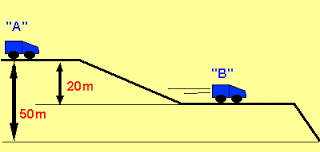
In diagram 2, if the mass of the car is 600 kg, what is the change in potential energy from point A to point B?
411,600 J
294,000
176,400 J
117,600 J
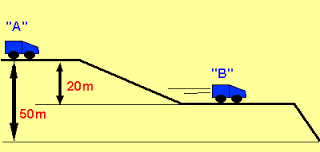
1. A ball has a 17 J of kinetic energy and its mechanical energy is 25 J. If the ball has a mass of 3.2 kg, what is its height above the ground?
0.26 m
0.52 m
5.2 m
25 m
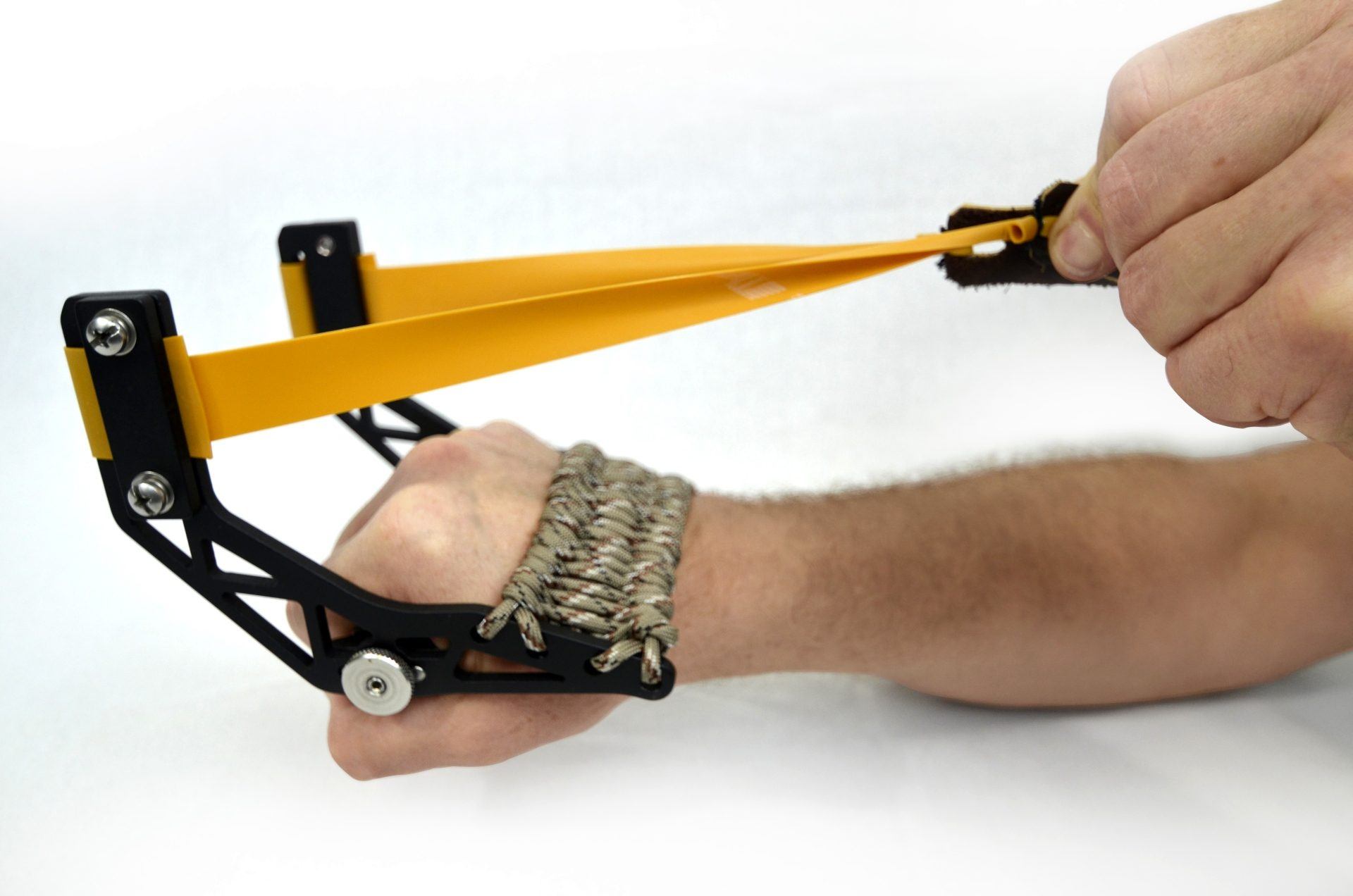
A man is pulling on a stubborn mule but the mule doesn't move. What is the work being done?
positive
negative
zero
A car accelerates from a stop sign to reach the speed limit. What is the work being done on the car by the engine?
positive
negative
zero
A truck runner is running a race on a level ground. Identify what form of mechanical energy the object or system possesses. It is possible to have more than one form of mechanical energy:
Elastic potential energy and Kinetic energy
Gravitational potential energy only
Elastic potential and gravitational potential energy
Kinetic energy only
A mass is sitting on top of a compressed spring that is resting on a lab table . Identify what form of mechanical energy the object or system possesses. It is possible to have more than one form of mechanical energy:
Elastic potential energy and Kinetic energy
Gravitational potential energy only
Elastic potential and gravitational potential energy
Kinetic energy only
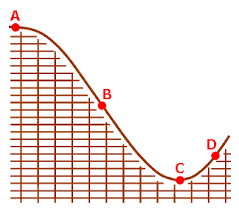
At which point(s) on the roller coaster is the kinetic energy at its maximum?
A
B
C
D
A satellite in orbit around the Earth . Identify what form of mechanical energy the object or system possesses. It is possible to have more than one form of mechanical energy:
Elastic potential energy and Kinetic energy
Gravitational potential energy only
Elastic potential and gravitational potential energy
Kinetic energy and gravitational potential energy

