wayground logo

Free Printable Worksheets

NEW

Font size

S
M
L
XL
Worksheets

Physics and Thermodynamics

Total questions: 27

Worksheet time: 54mins

Name
Class
Date
1.
Temperature is a measure of the...
a)
total energy in a substance
b)
total kinetic energy in a substance
c)
average potential energy in a substance
d)
average kinetic energy of molecules in a substance
2.
A(n) _____________ is a device for measuring temperature.
a)
thermometer
b)
barometer
c)
anemometer
d)
psychrometer 
3.

When thermal energy is added to a substance, the substance's particles move:

a)

More rapidly at an increased distance from each other.

b)

More rapidly with less distance between each other.

c)

More slowly with a greater distance between each other.

d)

More slowly with a reduced distance between each other.

4.
Heat transfer by conduction occurs when...
a)
particles bump into each other
b)
large numbers of atoms move from place to place
c)
atoms give off heat in the form of electromagnetic waves
d)
electromagnetic waves travel from place to place through a vacuum
5.
Heat transfer by convection occurs when...
a)
electrons bump into other electrons
b)
large numbers of atoms move from place to place
c)
atoms give off heat in the form of electromagnetic waves
d)
electromagnetic waves travel from place to place through a vacuum
6.
Heat travels from the sun to the earth by the process of...
a)
conduction
b)
convection
c)
radiation
d)
insulation
7.
Thermal energy always moves:
a)
From a high temperature object to a lower temperature object.
b)
From a lower temperature object to a higher temperature object.
c)
From an object with lower kinetic energy to an object with higher kinetic energy.
d)
From an object of higher mass to an object of lower mass.
8.
The temperature of a glass of cold water will eventually...
a)
Match the temperature of the surrounding environment.
b)
Always be colder than the surrounding environment.
c)
Become warmer than the surrounding environment.
d)
Never change temperature.
9.

Transfer of heat by means of electromagnetic waves

a)

conduction

b)

convection

c)

radiation

10.

Transfer of heat by contact and collisions between the molecules in a substance.

a)

conduction

b)

radiation

c)

convection

11.
Warm air rises and cold air sinks demonstrates what?
a)
conduction
b)
convection
c)
radiation
d)
refrigeration
12.

The average kinetic energy of the atoms or molecules in a substance is directly related to

a)

heat

b)

specific heat capacity

c)

temperature

d)

Brownian Motion

13.
In this method of heat transfer heat is carried by a moving medium, like water or air.
a)
Conduction
b)
Convection
c)
Radiation
d)
this is impossible
14.

What happens on a molecular level when heat is removed from an object?

a)

the temperature decreases and the molecules move faster

b)

the temperature increases and the molecules move slower

c)

the temperature increases and the molecules molecules move faster

d)

the temperature decreases and the molecules move slower

15.
In convection, WARM air
a)
Rises
b)
Sinks
16.
Warm air is __________ dense than cold air and rises creating convection currents.
a)
more
b)
less
17.

Why does ice float?

a)

Due to convection currents

b)

It is more dense than water.

c)

It is less dense than water.

18.

Which of the following is one reason Earth's tectonic plates to move?

a)

energy from the Sun

b)

magnetic Pole Reversal

c)

convection currents in the mantle

d)

faults in Mountain Ranges

19.

Name the type of heat transfer shown in the picture.

a)

convection

b)

conduction

c)

radiation

20.
Which of the following properties cannot be explained by the kinetic theory of particle?
a)
Density
b)
Compressibility 
c)
Shape
d)
Colour
21.

In which state of matter will there be the LARGEST space between molecules?

a)

Solid

b)

Liquid

c)

Gas

22.

How do gases behave in a sealed container?

a)

Cluster together

b)

form a solid

c)

They take the shape of their container

d)

leak out

23.
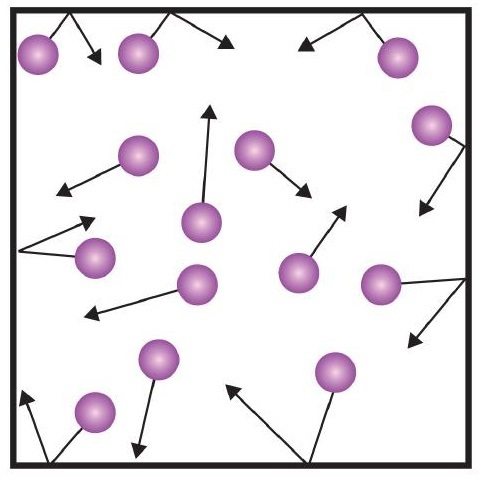
Which description best matches this particle model?
a)
Closely packed and can't move a lot. 
b)
Particles are close together but can move a little. 
c)
Particles have lots of energy and can move around. 
24.
What happens to particles as they heat up?
a)
They slow down
b)
Nothing
c)
They don't move
d)
They speed up
25.

Which state of matter has particles that move the least/slowest?

a)

solid

b)

water

c)

gas

26.
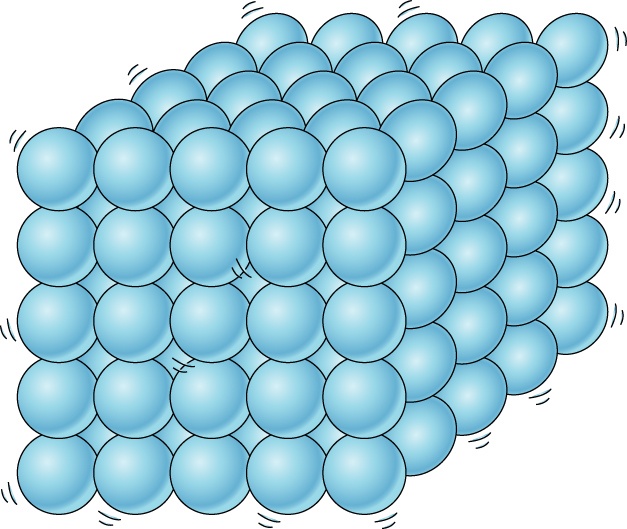
Which description best matches this particle model?
a)
Particles are closely packed, vibrate fixed position, strong intermolecular forces.
b)
Particles are closely packed, no movement, strong intermolecular forces
c)
Particles are closely packed, move around each other, medium intermolecular forces
27.
If a balloon is cooled what will happen to the volume?
a)
Volume will increase
b)
Volume will decrease
c)
Volume will not change