wayground logo

Free Printable Worksheets

Font size

S
M
L
XL
Worksheets

Atomic Structure, Electron Configurations, Orbital Notation, Noble Gas Configurations, Electron-Dot Diagrams

Total questions: 199

Worksheet time: 2hrs 22mins

Name
Class
Date
1.
What atom matches this electron configuration?
1s22s22p63s23p64s23d10
a)
Zinc
b)
Copper
c)
Nickel
d)
Germanium
2.
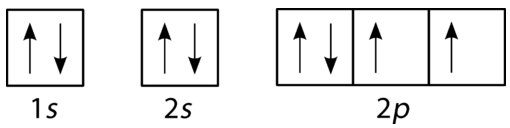
What electron configuration matches an oxygen atom?
a)
1s22s22p63s2, 3p64s23d104p5
b)
1s22s22p4
c)
1s22s22p6
d)
1s22s22p63s23p64s23d1
3.
How many electrons can the first energy level hold?
a)
1
b)
2
c)
8
d)
0
4.
The electron configuration of an atom is 1s22s22p6.  The number of electrons in the atom is 
a)
3
b)
6
c)
8
d)
10
5.
Which electron configuration belongs to Chlorine (Cl)?
a)
1s2s2p3s3p5
b)
1s2s2p3s3p6
c)
1s2s2p3s3p7
6.
This orbital diagram represents:  
a)
C
b)
B
c)
N
d)
O
7.
This orbital diagram represents:  
a)
C
b)
B
c)
N
d)
O
8.
What is incorrect about this orbital diagram?
a)
Both arrows in the 2p box should be pointing up
b)
There is nothing incorrect with this diagram
c)
In the there should only be 1 orbital in the first 2p box and one in the 2nd 2p box
d)
All the arrows should be pointing up.
9.
Which element is pictured?
a)
neon
b)
fluorine
c)
magnesium
d)
argon
10.
Which is associated with more energy? 
a)
2p
b)
2s
c)
3p
d)
1s
11.
How many electrons can the d sublevel hold?
a)
14
b)
10
c)
2
d)
6
12.
How many electrons can the s sublevel hold?
a)
14
b)
10
c)
2
d)
6
13.
How many electrons can the p sublevel hold?
a)
14
b)
10
c)
2
d)
6
14.
Which element is pictured?
a)
neon
b)
fluorine
c)
magnesium
d)
argon
15.

What element has this electron configuration?

a)

hydrogen

b)

helium

c)

lithium

d)

beryllium

16.

What element has this orbital notation?

a)

lithium

b)

beryllium

c)

boron

d)

carbon

17.

What element has this electron configuration?

a)

helium

b)

lithium

c)

beryllium

d)

boron

18.

What element has this electron configuration?

a)

boron

b)

carbon

c)

nitrogen

d)

oxygen

19.

Which element is represented by this orbital notation?

a)

carbon

b)

nitrogen

c)

oxygen

d)

fluorine

20.

Which element is represented by this electron configuration?

a)

neon

b)

sodium

c)

magnesium

d)

aluminum

21.

Which element is represented by this orbital notation?

a)

neon

b)

sodium

c)

magnesium

d)

aluminum

22.

Which of the following is the electron configuration for Fluorine

a)
b)
c)
d)
23.

Which of the following is the electron configuration for neon?

a)
b)
c)
d)
24.

Which of the following is the electron configuration for silicon?

a)
b)
c)
d)
25.

Which of the following is the orbital notation for oxygen?

a)
b)
c)
d)
26.
An electron occupies the lowest energy orbital that can receive it.
a)
Hund’s rule
b)
Pauli exclusion principle
c)
Bohr model of the atom
d)
Aufbau principle
27.
All orbitals of equal energy are occupied by one electron before any single orbital is occupied by a second electron.
a)
Aufbau principle
b)
Pauli exclusion principle
c)
Hund’s rule
d)
Core Notation
28.
No two electrons in the same atom can have the same four quantum numbers.
a)
Aufbau principle
b)
Pauli exclusion principle
c)
Hund’s rule
d)
Noble gas notation
29.
Which guideline, Hund’s rule or the Pauli exclusion principle, is violated in the following orbital diagrams?
a)
Hund's
b)
Aufbau's
c)
Pauli's Exclusive
30.
Which guideline, Hund’s rule or the Pauli exclusion principle, is violated in the following orbital diagrams?
a)
Aufbau's
b)
Hund's
c)
Pauli exclusive
31.
Electrons are paired based on their spin directions, clockwise and counterclockwise, is what electron configuration rule?
a)
Hund’s Rule
b)
Aufbau Principle
c)
Pauli Exclusion Principle
32.

What is the element?

a)

Neon

b)

Chlorine

c)

Aluminum

d)

Argon

33.

What is the element?

a)

sulfur

b)

chlorine

c)

phosphorus

d)

silicon

34.

Which is the electron configuration for beryllium?

a)
b)
c)
d)
35.
What electron configuration matches an oxygen atom?
a)
1s22s22p63s2, 3p64s23d104p5
b)
1s22s22p4
c)
1s22s22p6
d)
1s22s22p63s23p64s23d1
36.
How many electrons can the first energy level hold?
a)
1
b)
2
c)
8
d)
0
37.
This orbital diagram represents:  
a)
C
b)
B
c)
N
d)
O
38.

What is incorrect about this orbital diagram?

a)

Both arrows in the 2p box should be pointing up.

b)

There is nothing incorrect with this diagram.

c)

There should only be 1 arrow in the first 2p box and one in the 2nd 2p box.

d)

All the arrows should be pointing up.

39.

This shape is that of a/n:

a)

s orbital

b)

p orbital

c)

d orbital

d)

f orbital

40.
Which type of orbital is shaped like a sphere?
a)
s orbital
b)
p orbital
c)
d orbital
d)
f orbital
41.
What is the electron configuration for F?
a)
1s2 2s2 3p5
b)
1s2 2s2 3d5
c)
1s2 2s2 2p5
d)
1s2 2p5
42.
How many electrons can the first energy level hold?
a)
1
b)
2
c)
8
d)
0
43.
What is the maximum number of electrons that can be on the p sublevel?
a)
6
b)
3
c)
2
d)
4
44.
What shape are d orbitals?
a)
Peanut shaped
b)
Spherical shaped
c)
Dumbbell shaped
d)
Flower shaped
45.
Electrons occupy orbitals of lowest energy first is part of what electron configuration rule?
a)
Hund’s Rule
b)
Aufbau Principle
c)
Pauli Exclusion Principle
46.
There are 4 different types of sublevels: s,p,d,f
a)
true
b)
false
47.
How many orbitals are there in the "d" sublevel?
a)
1
b)
3
c)
5
d)
7
48.
How many orbitals are there in the "s" sublevel?
a)
1
b)
3
c)
5
d)
7
49.
How many orbitals are there in the "p" sublevel?
a)
1
b)
3
c)
5
d)
7
50.
How many orbitals are there in the "f" sublevel?
a)
1
b)
3
c)
5
d)
7
51.
How many electrons can the f sublevel hold?
a)
14
b)
10
c)
6
d)
4
52.
Which main energy level is furthest from the nucleus ?
a)
1
b)
2
c)
3
53.
The Quantum Mechanical Model is the most recent/modern atomic model.
a)
True
b)
False
54.
The quantum number "n" represents:
a)
electron spin
b)
orbital
c)
sublevel
d)
main energy level
55.
Which scientist developed the Quantum Mechanical
a)
E. Schroedinger
b)
W. Heisenberg
c)
J. Dalton
d)
N. Bohr
56.
What is the Pauli Exclusion Principle?
a)
An atomic orbital can only hold a maximum of 2 electrons, each with opposite spins
b)
An atomic orbital can hold a minimum of 6 electrons, each with opposite spins
c)
An atomic orbital can hold a maximum of 6 electrons, each with the same spin
d)
An atomic orbital can hold a minimum of 2 electrons, each with opposite spins
57.
According to the Bohr model of the atom, the single electron of a hydrogen atom circles the nucleus
a)
in specific, allowed orbits.
b)
in one fixed orbit at all times.
c)
at any of an infinite number of distances, depending on its energy.
d)
counterclockwise.
58.
A line spectrum is produced when an electron moves from one energy level
a)
into the nucleus.
b)
to another position in the same sublevel.
c)
to a higher energy level.
d)
to a lower energy level.
59.
If an electron moves from n=2 to n=4 ...
a)
it absorbs energy
b)
it releases energy
60.
If an electron moves from n=5 to n=2 ...
a)
it absorbs energy
b)
it releases energy
61.
Based on the picture, choose the best description of how wavelength and frequency are related
a)
As wavelength increases, frequency increases
b)
As frequency increases, wavelength remains the same
c)
As frequency increases, wavelength decreases
d)
frequency and wavelength mean the same thing
62.
Which kind of wave has the greatest frequency?
a)
gamma rays
b)
infrared
c)
ultraviolet
d)
microwaves
63.
The higher the frequency the ______ the energy. 
a)
higher
b)
lower
c)
neither, stays the same
64.
Einstein's Photoelectric Effect proved that light had a ____ nature.
a)
particle
b)
wave
c)
wave-particle
d)
particle-wave
65.
De Broglie provided a mathematical model of the electron as a ____.
a)
wave
b)
particle
c)
tsunami
d)
energy
66.
Heisenberg's uncertainty principle states that ___ and ___ cannot BOTH be known simultaneously?
a)
wavelength and distance
b)
position and momentum
c)
charge and displacement
d)
atomic radius and frequency
67.
The Quantum Mechanical Model of the Atom describes the electron's probable location around the nucleus in a 3-D cloud called a(n) ___.
a)
sphere
b)
it's just too complex to thing to answer
c)
orbit
d)
orbital
68.
The major difference between a 1s orbital and a 2 s orbital is that
a)
the 2 s orbital is at a higher energy level.
b)
the 2s orbital has a slightly different shape.
c)
the 1 s orbital can have only one electron.
d)
the 2s orbital can hold more electrons.
69.

The element with electron configuration 1s22s22p63s23p2

a)

Si

b)

Mg

c)

S

d)

C

70.
The electron configuration for the carbon atom (C)is 1s22s22p2. The atomic number of carbon is 
a)
3.
b)
11.
c)
12.
d)
6.
71.
The atomic sublevel with the next hightest energy after 4p is
a)
5s
b)
4f
c)
5p
d)
4d
72.
The part of the atom where the electrons CANNOT be fond is the 
a)
orbitals.
b)
nucleus.
c)
electron cloud.
d)
area surrounding the nucleus
73.
With the quantum model of the atom, scientists have come to believe that determining an electron's exact location around the nucleus.
a)
can be done before 2005.
b)
can be done only with specialized equipment.
c)
is impossible.
d)
can be done easily.
74.
The statement that an electron occupies the lowest available energy orbital is 
a)
the Pauli exclusion principle.
b)
Hund's rule.
c)
the Aufbau principle.
d)
Bohr's law.
75.
What is the electron configuration for nitrogen?
a)
1s22s22p23s1
b)
1s22s32p1
c)
1s22s32p2
d)
1s22s22p3
76.
The electron notation for aluminum is 
a)
1s22s22p63s22d1
b)
1s22s22p33s23d1
c)
1s22s22p63s23p1
d)
1s22s22p9
77.
For the f sublevel, the number of orbitals is
a)
18.
b)
9.
c)
5.
d)
7.
78.
Which of the following rules requires that each of the p orbitals at a particular energy level receive one electron before any of them can have two electrons?
a)
the Pauli exclusion principle
b)
Hund's rule.
c)
the Aufbau principle.
d)
the quantum rule.
79.
The region outside the nucleus where an electron can most probably be found is the
a)
s sublevel.
b)
electron cloud.
c)
quantum.
d)
electron configuration
80.
What element's orbital diagram is shown in the figure?
a)
stontium
b)
chromium
c)
antimony
d)
fluorine
81.
Which element has the following noble gas notation [Ar]4s23d104p5?
a)
bromine
b)
calcium
c)
helium
d)
boron
82.
Who developed the Quantum Mechanical Model?
a)
Erwin Schrodinger
b)
Joseph Thomson
c)
James Chadwick
d)
Ernest Rutherford
83.

Proposed that electrons move around the nucleus in specific layers, or shells.

a)

Bohr

b)

Rutherford

c)

Chadwick

d)

Thomson

84.

Which of the following sub-levels is correctly designated?

a)

1p5

b)

3f9

c)

2p6

d)

3d11

85.

Which of the following main energy levels of an atom can accommodate a maximum of 18 electrons?

a)

1st energy level

b)

2nd energy level

c)

3rd energy level

d)

4th energy level

86.

If the 1st energy level is already filled up with 2 electrons, what level should be filled up next?

a)

Second

b)

Third

c)

Fourth

d)

Fifth

87.

“An electron should occupy the lowest energy level first before the higher energy level” is stated in what rule?

a)

Hund's rule

b)

Pauli Exclusion Principle

c)

Aufbau Principle

d)

All of the above.

88.

What rule states that single electrons must occupy each equal-energy orbital before additional electrons can occupy the same orbitals.

a)

Hund's rule

b)

Pauli Exclusion Principle

c)

Aufbau Principle

d)

None of the choices.

89.

What is the electron configuration of Argon?

a)

1s2 2s2 2p6

b)

1s2 2s2 2p6 3s1

c)

1s2 2s2 2p6 3s2

d)

1s2 2s2 2p6 3s2 3p6

90.

Which atom has an electron configuration of 1s2 2s2 2p6?

a)

He

b)

Ne

c)

Ar

d)

Xe

91.

What is the electron configuration of Gallium, 31Ga?

a)

1s2 2s2 2p6 3s2 3p5 4s2 3d10 4p1

b)

1s2 2s2 2p6 3s2 3p6 4s2 3d10 4p1

c)

1s2 2s2 2p6 3s2 3p6 4s2 3d9 4p2

d)

1s2 2s2 2p6 3s2 3p5 4s2 3d10 4p2

92.

Which one of the following electron configurations is INCORRECT?

a)

1s2 2s2 2p6 3s2 3p6

b)

1s2 2s2 2p6 3s2 3p6 4s2 3d10 4p3

c)

1s2 2s2 2p6 3s2 3p6 4s2 3d10 4p5

d)

1s2 2s2 2p6 3s2 3p6 4s2 3d9 4p2

93.

Which of the following electron configurations is CORRECT?

a)

1s2 2s3

b)

1s2 2s2 2p6

c)

1s2 2s2 3s2

d)

1s2 2s2 2p6 3s2 4s2

94.

Who used theoretical calculations and experimental results to devise and solve a mathematical equation describing the behavior of the electron in a hydrogen atom?

a)

JJ Thomson

b)

Niels Bohr

c)

Erwin Schrodinger

d)

James Chadwick

95.

What orbital is shown in the picture?

a)

s orbital

b)

p orbital

c)

d orbital

d)

f orbital

96.

What is the difference in a 1s orbital and a 2s orbital?

a)

The shape of the orbital

b)

The size of the orbital

c)

The number of electrons it can hold

d)

None of the above

97.

Which quantum number represents the shape of the orbital?

a)

principal quantum number

b)

azimuthal (angular momentum) quantum number

c)

magnetic quantum number

d)

spin quantum number

98.

Which of the following values does NOT represent a valid electron?

a)

n=(2), l=(1), ml=(1), ms=(+1/2)

b)

n=(4), l=(2), ml=(-1), ms=(-1/2)

c)

n=(2), l=(0), ml=(0), m=(-1/2)

d)

n=(4), l=(2), ml=(-3), ms=(+1/2)

99.

Which quantum number represents the orientation of the orbital?

a)

principal quantum number

b)

azimuthal (angular momentum) quantum number

c)

magnetic quantum number

d)

spin quantum number

100.

When atoms _____________ energy, their electrons move to higher energy levels. These electrons _____________ energy by emitting light when they return to lower energy levels.

a)

lose, absorb

b)

absorb, lose

c)

lose, lose

d)

absorb, absorb

101.

Which form of radiation has the highest frequency?

a)

radio waves

b)

ultraviolet

c)

x-ray

d)

gamma

102.

Heisenberg's Uncertainty Principle states that it is impossible to know both the ___________ and the __________ of a particle at the same time.

a)

velocity, position

b)

velocity, energy

c)

position, energy

d)

velocity, speed

103.

In a wave, the distance between two crests is called

a)

amplitude

b)

wavelength

c)

frequency

104.

The number of wave cycles to pass a given point per unit of time is called the __________.

a)

amplitude

b)

wavelength

c)

frequency

105.

The SI unit of frequency is the __________.

a)

meter

b)

second

c)

hertz

d)

meter per second

106.

Which of the following colors of visible light has the highest frequency?

a)

Blue

b)

Green

c)

Orange

d)

Red

e)

Violet

107.

Which of the following colors of visible light has the lowest frequency?

a)

blue

b)

green

c)

yellow

d)

red

e)

violet

108.

Which of the following colors of visible light has the longest wavelength?

a)

Blue

b)

Green

c)

Yellow

d)

Red

e)

Violet

109.

Which of the following colors of light is associated with the greatest amount of energy?

a)

blue

b)

green

c)

yellow

d)

red

e)

violet

110.

Which color of light moves at the fastest speed?

a)

blue

b)

green

c)

yellow

d)

red

e)

All light travels at the same speed.

111.

On the electromagnetic spectrum, what type of radiation has the longest wavelengths?

a)

radio waves

b)

visible light

c)

gamma rays

d)

microwaves

e)

x-rays

112.

When an electron absorbs energy, it moves ________.

a)

from a higher energy level to a lower energy level

b)

from a lower energy level to a higher energy level

c)

in a circle

d)

toward the nucleus

113.

When an electron moves from a higher energy level to a lower energy level, it ____________.

a)

it releases energy in the form of light

b)

it absorbs energy in the form of light

c)

it breaks in half

d)

it releases a sonic boon

114.

In the speed of light equation, c stands for

a)

frequency

b)

wavelength

c)

the speed of light

d)

Carbon

115.

The Lyman series contains the ultraviolet portion of hydrogen's emission spectrum which corresponds to an electron falling to ________.

a)

the first energy level

b)

the second energy level

c)

the third energy level

d)

the nucleus

116.

In the Balmer series, when an excited electron falls to the second energy level, it emits _______ light.

a)

infrared

b)

visible

c)

ultraviolet

117.

Neils Bohr's atomic theory is similar to the concept of the

a)

solar system

b)

circles with dots

c)

spinning wheel

d)

None of the above

118.

'Quantum numbers' are...

a)

used to describe amount of things an atom can react with.

b)

used when describing number of electrons.

c)

used when describing the energy levels available to atoms and molecules.

d)

used when labelling parts of a wave.

119.

Select the Quantum number with the highest energy...

a)

n=1

b)

n=3

c)

n=5

d)

n=7

120.
How are electrons arranged in an atom?
a)
In groups of five
b)
In energy levels
c)
By color
d)
By shape
121.

___________ __________ is the lowest energy level an electron will occupy in an atom at an ordinary condition

a)

ground state

b)

excited state

c)

highest state

d)

none of the above

122.

Soon after the electron absorbs energy, this energy is released in a form of light or photon. True or False?

a)

True

b)

False

123.
Which portion of the electromagnetic spectrum includes the entire range of light that can be detected by the human eye? 
a)
ultraviolet light
b)
visible light
c)
infrared light
d)
x-rays
124.
If the wavelength of an electromagnetic wave is longer, what is true about the energy? 
a)
Energy is higher.
b)
Energy is lower. 
c)
Energy is not dependent on wavelength. 
125.
If the wavelength of an electromagnetic wave is longer, what is true about the energy? 
a)
Energy is higher.
b)
Energy is lower. 
c)
Energy is not dependent on wavelength. 
126.
Which part of the electromagnetic spectrum has high enough energy to cause damage to eyes and skin, and sometimes even cancer? 
a)
infrared light
b)
visible light
c)
ultraviolet light
d)
microwaves
127.
Which is the correct order of waves of the electromagnetic spectrum, from lowest energy to highest energy? 
a)
radio waves, microwaves, infrared waves, visible light, ultraviolet light, x-rays, gamma rays
b)
gamma rays, x-rays, ultraviolet light, visible light, infrared light, microwaves, radio waves
128.
Cancer can be treated with_______________waves.
a)
Penicillin
b)
Radio
c)
Infrared
d)
Gamma
129.
_____ have the longest wavelengths and lowest frequencies of all electromagnetic waves.
a)
microwaves
b)
radio waves
c)
gamma rays
d)
ultraviolet
130.
Nuclear weapons are examples of __________. 
a)
x-rays
b)
ultraviolet rays
c)
gamma rays
d)
infrared rays
131.
This type of EM wave shows a break in bones.
a)
gamma ray
b)
x-ray
c)
brokenometer
d)
radio wave
132.
The entire electromagnetic spectrum is divided into regions by
a)
color
b)
speed
c)
wavelength
d)
the way they are used
133.
White light is the entire range of
a)
colors of visible light combined.
b)
ultraviolet light.
c)
gamma rays and X rays.
d)
EM waves.
134.

Which of the following sub levels does not exist

a)

2p

b)

3d

c)

2d

d)

5f

e)

4f

135.

There may be a maximum of ____ p orbitals at a given energy level.

a)

2

b)

6

c)

3

d)

8

136.

This shape is that of a...

a)

s orbital

b)

d orbital

c)

p orbital

d)

f orbital

137.

The spin of an electron is represented by this variable:

a)

n

b)

m

c)

L

d)

s, ms

138.

This is a ____ orbital

a)

s

b)

d

c)

p

d)

d

139.

Orbital sublevels, or L, represents:

a)

orbital color

b)

orbital shape

c)

electron spin

d)

energy level

140.

How many electrons total are found in the f orbital?

a)

2

b)

6

c)

10

d)

14

141.

With each higher energy level, the electrons are

a)

lower in energy

b)

more stable

c)

weaker

d)

farther from the nucleus

142.
Which element is pictured?
a)
neon
b)
fluorine
c)
magnesium
d)
argon
143.
What is incorrect about this orbital diagram?
a)
Both arrows in the 2p box should be pointing up
b)
There is nothing incorrect with this diagram
c)
In the 2p box there should only be 1 electron in the first 2p box and one in the 2nd 2p box
d)
All the arrows should be pointing up.
144.
An orbital can at most hold how many electrons?
a)
1 electron
b)
2 electrons
c)
3 electrons
d)
4 electrons
145.

What is the noble gas configuration for Neon?

a)

[Ne]

b)

[He]2s22p6

c)

[F]2p1

d)

[Ne]2s21p6

146.
What is the noble gas configuration for beryllium?
a)
[He]1s2
b)
[He]2s2
c)
[Li]2s1
d)
[Li]2s2
147.
What is the noble gas configuration for boron?
a)
[He]1s22s2
b)
[He]2s22p2
c)
[He]2s22p1
d)
[Li]2s22p1
148.
[He]2s22p4 is the noble gas configuration for which element?
a)
oxygen
b)
sulfur
c)
phosphorus
d)
fluorine
149.
There are 4 different types of subshells s,p,d,f
a)
true
b)
false
150.
Which element is depicted from this orbital diagram
a)
Fluorine
b)
Neon
c)
Chlorine
d)
Argon
151.
 The diagram above represents two electrons with 
a)
a. opposite spins.
b)
 b. the same spin.
c)
c. different energies.
d)
d. different energy levels.
152.

What element's orbital notation is pictured here?

a)

Ar

b)

Br

c)

Cu

d)

Cl

153.
Which orbital shows a violation of the Pauli Exclusion Principle?
a)
A
b)
B
c)
C
d)
D
154.

Energy levels are denoted by:

a)

letters

b)

numbers

c)

a combination of letters and numbers

d)

subscripts

155.
What configuration do you start electron configurations with?
a)
1s2
b)
1d10
c)
1f14
d)
1p6
156.
Which guideline, Hund’s rule or the Pauli exclusion principle, is violated in the following orbital diagrams?
a)
Aufbau's
b)
Hund's
c)
Pauli exclusive
157.

Which rule is violated in the following orbital diagrams?

a)

Hund's Rule

b)

Aufbau Principle

c)

Pauli's Exclusion Principle

158.

X has 10 electrons. What is the the possible set of quantum number of the 10th electron?

a)

(n=2, l= 1, m=0, s=+1/2)

b)

(n=2, l= 0, m=0, s=+1/2)

c)

(n=1, l= 0, m=0, s=-1/2)

d)

(n=2, l= 1, m=+2, s=+1/2)

159.

p3, p6 configurations are more stable than p4, p5 configurations.

a)

True

b)

False

160.

Which one of the following atoms have three unpaired electrons?

a)

B

b)

C

c)

N

d)

O

161.

According to Bohr’s theory, electrons can be found in:

a)

orbit around the nucleus at varying distances

b)

a cloud around the nucleus with higher energy electrons further away

c)

hanging out on the corner

d)

orbit the nucleus at constant distances related to their energy level

162.

The biggest problem with the Bohr's model of the atom is that:

a)

it doesn't work for anything but hydrogen

b)

nothing, it's perfect

c)

it doesn't accurately explain any photons emitted by atoms

d)

it doesn't explain why the electrons orbit in circles

163.

Electrons in energy levels farther from the nucleus have ________ energy than/as electrons in energy levels closer to the nucleus.

a)

less

b)

depends on the element

c)

greater

d)

the same

164.

What was Louis de Broglie's contribution to solving the problems in the Bohr model?

a)

discovering that electrons go into the lowest energy state available

b)

applying probability wave theory to electrons

c)

defining the four quantum numbers

d)

treating the electrons as wave particles

165.

Schrodinger improved on Bohr's work by:

a)

applying probability wave functions to the electron energy levels and discovering orbitals in the electron cloud

b)

theorizing that electrons have wave-particle duality just like photons

c)

determining that it was impossible to know both the position and location of an electron

d)

showing that each electron in an atom must have a unique set of quantum numbers

166.

The magnetic quantum number, or orbital number, tells us:

a)

the orientation of the orbital

b)

the shape of the orbital

c)

the size of the orbital

d)

the direction of electron spin

167.

There are ___ orbitals in the f sublevel, so the f sublevel can hold ___ electrons.

a)

1, 2

b)

3, 6

c)

5, 10

d)

7, 14

168.

Which area on the periodic table represents the electrons in the "d" sublevel (d orbitals)?

a)

representative elements

b)

columns 3-8

c)

rare earth elements

d)

transition elements

169.
How many half-filled orbitals would silicon contain?
a)
0
b)
2
c)
1
d)
3
170.
What is the abbreviated electron configuration for silver?
a)
1s2 2s2 2p3s2 3p6 4s2 3d10 4p6 5s2 4d9
b)
[Kr] 5s2 4d9
c)
[Ar] 4s2 3d9
d)
[Ag]
171.
Which of the following is a p block element?
a)
Ca
b)
Ar
c)
Re
d)
Au
172.
Anions are _______ that form ____________ ions and __________ electrons.
a)
nonmetals, positive, lose
b)
nonmetals, negative, gain
c)
metals, positive, gain
d)
metals, positive, lose
173.
How many electrons can the first energy level hold?
a)
1
b)
2
c)
8
d)
0
174.
What element in Period 4 has 5 valence electrons?
a)
Zr
b)
As
c)
V
d)
Sb
175.
Electron arrangement that uses arrows
a)
Electron configuration
b)
Shorthand configuration
c)
Lewis dot structure
d)
Orbital diagram
176.

How many sublevels are in this atom?

a)

4

b)

6

c)

12

d)

Impossible to determine

177.

Which sublevel has the most energy in this diagram?

a)

1s

b)

4p

c)

3d

d)

they are all the same

178.

According to Bohr's model of the atom:

a)

electrons excite from a lower energy level to a higher energy level when they absorb a photon of the correct energy

b)

electrons release photons when they are excited from one energy level to a higher one

c)

electrons can switch from one energy level to another by trading energy with other electrons

d)

energy is continuous in an atom

179.

Electrons in energy levels farther from the nucleus have ________ energy than/as electrons in energy levels closer to the nucleus.

a)

less

b)

depends on the element

c)

greater

d)

the same

180.

What was Louis de Broglie's contribution to solving the problems in the Bohr model?

a)

discovering that electrons go into the lowest energy state available

b)

applying probability wave theory to electrons

c)

defining the four quantum numbers

d)

treating the electrons as wave particles

181.

Schrodinger improved on Bohr's work by:

a)

applying probability wave functions to the electron energy levels and discovering orbitals in the electron cloud

b)

theorizing that electrons have wave-particle duality just like photons

c)

determining that it was impossible to know both the position and location of an electron

d)

showing that each electron in an atom must have a unique set of quantum numbers

182.

The second quantum number is known as the ____________ number.

a)

sublevel

b)

spin

c)

orbital

d)

energy level

183.

The magnetic quantum number, or orbital number, tells us:

a)

the orientation of the orbital

b)

the shape of the orbital

c)

the size of the orbital

d)

the direction of electron spin

184.
What is the shorthand electron configuration for Sulfur atom?
a)
[Ar] 3p4
b)
[He] 3s23p4
c)
[Ne] 3s23p4
d)
[Na] 3s23p3
185.
Electron arrangement that uses arrows
a)
Electron configuration
b)
Shorthand configuration
c)
Lewis dot structure
d)
Orbital diagram
186.
Which orbital shows a violation of Hund's Rule?
a)
A
b)
B
c)
C
d)
D
187.
Which orbital shows a violation of the Aufbau Principle?
a)
A
b)
B
c)
C
d)
D
188.
Which orbital shows a violation of the Pauli Exclusion Principle?
a)
A
b)
B
c)
C
d)
D
189.
Rows on the period table are called _____ while columns are called _____.
a)
groups, families
b)
groups, periods
c)
periods, groups
d)
families, groups
190.

Which shows the correct orbital diagram for Cobalt?

a)
b)
c)
d)
191.

Which area on the periodic table represents the electrons in the "d" sublevel?

a)

representative elements

b)

columns 3-8

c)

rare earth elements

d)

transition elements

192.

Each row on the periodic table represents:

a)

an energy level

b)

a sublevel

c)

an electron

d)

an orbital

193.

Choose the correct shortcut configuration for iodine.

a)

[Ar]4s24d104p5

b)

[Kr]5s24d105p5

c)

[Xe]5s25d105p5

d)

none of the above

194.

Choose the Noble Gas that you would use to begin the shorthand configuration of the following element.

Iron

a)

[He]

b)

[Ne]

c)

[Ar]

d)

[Kr]

195.

Choose the Noble Gas that you would use to begin the shorthand configuration of the following element.

Plutonium (Pu)

a)

[Xe]

b)

[Ne]

c)

[Rn]

d)

[Kr]

196.

What is the shorthand configuration for Tin?

a)

[Xe]5s24d105p2

b)

[Xe]5s24d105p2

c)

[Kr]5p2

d)

[Kr]5s24d105p2

197.

What is the shorthand configuration for Lead?

a)

[Xe]6s24f145d106p2

b)

[Xe]6s25d106p2

c)

[Rn]6s25d106p2

d)

[Rn]6s24f145d106p2

198.
Which group of the periodic table has an electron configuration of ns2?
a)
Metalloids
b)
Nobel Gases
c)
Halogens
d)
Alkaline Earth Metals
199.
Which group of the periodic table has an electron configuration of ns2 np5?
a)
Metalloids
b)
Nobel Gases
c)
Halogens
d)
Alkaline Metals