wayground logo

Free Printable Worksheets

Font size

S
M
L
XL
Worksheets

Periodic Trends

Total questions: 203

Worksheet time: 4hrs 43mins

Name
Class
Date
1.
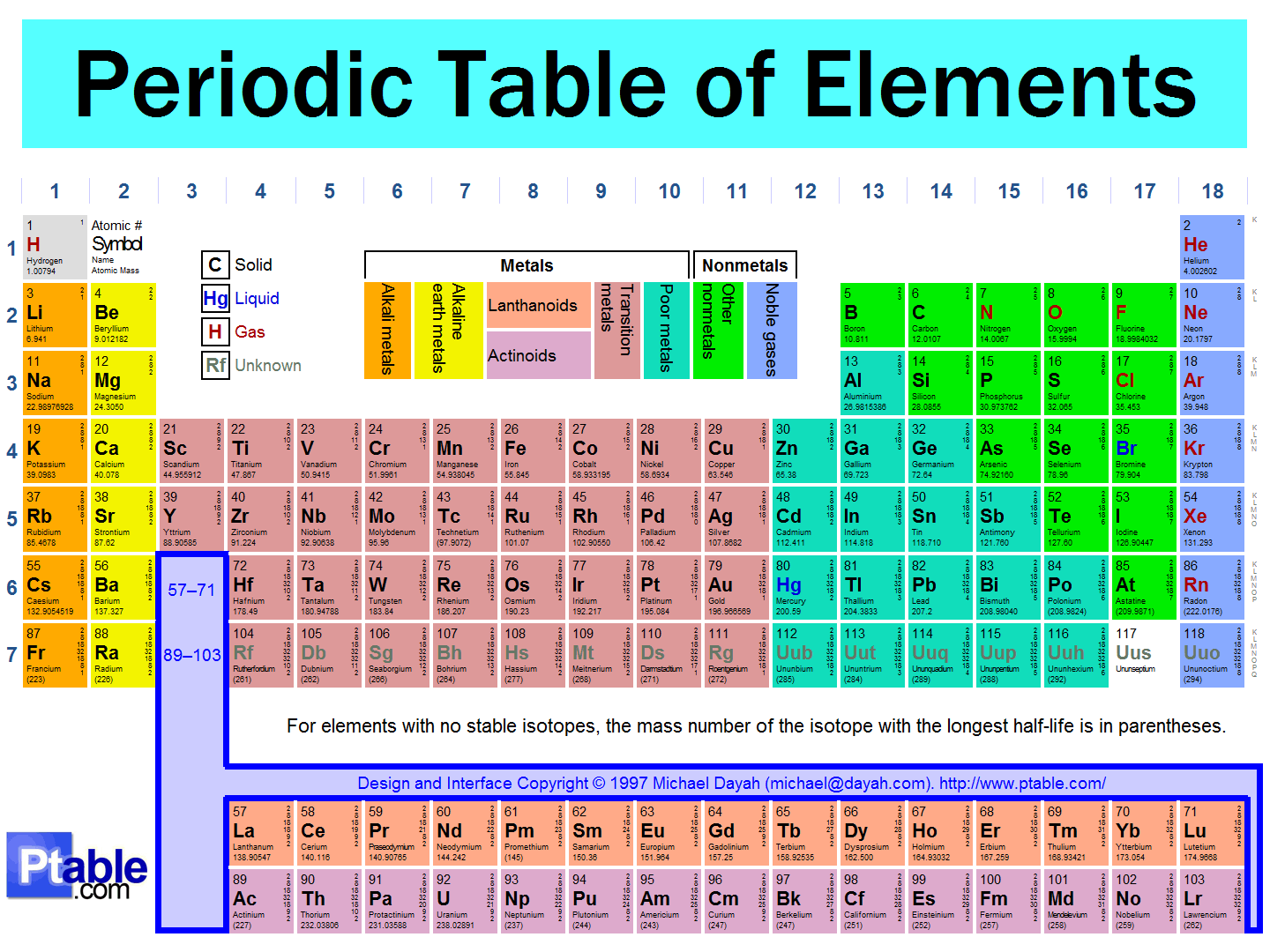
The atom with the largest atomic radius in Group 18 is - 
a)
Ar
b)
He
c)
Kr
d)
Rn
2.
As you move down a group, atomic radius increases because - 
a)
you add more and more neutrons
b)
you add more and more protons
c)
you add more and more shells (energy levels)
d)
you add more atomic mass
3.
The atom with the largest atomic radius in Period 4 (row 4) is - 
a)
K
b)
Kr
c)
Fe
d)
Fe
4.
Francium (Fr) has the lowest ionization energy in Group 1 because - 
a)
it has the smallest number of valence electrons
b)
it has the greatest atomic mass
c)
it has the greatest number of protons, so it attracts its electrons the strongest
d)
its 1 valence electron is very far from the nucleus, so little energy is needed to remove it
5.
The element with the smallest ionization energy in Period 6 is - 
a)
Rn
b)
Cs
c)
Os
d)
Tm
6.

Of the halogens, which has the smallest radius?

a)

F

b)

Br

c)

He

d)

At

7.

Which of the following will have a lower ionization energy than Scandium (Sc)?

a)

Helium (He)

b)

Titanium (Ti)

c)

Calcium (Ca)

d)

Magnesium (Mg)

8.

Which of the following will have a higher electronegativity than arsenic (As)?

a)

Carbon (C)

b)

Neon (Ne)

c)

Antimony (Sb)

d)

Germanium (Ge)

9.

Which of the following halogens has the greatest electronegativity?

a)

Chlorine (Cl)

b)

Bromine (Br)

c)

Iodine (I)

d)

Astatine (At)

10.

Which group of elements has the lowest ionization energies?

a)

Alkali Metals (Group 1)

b)

Alkaline Earth Metals (Group 2)

c)

Halogens (Group 17)

d)

Noble Gases (Group 18)

11.

What is the amount of energy required to remove an electron from an atom?

a)

atomic energy

b)

ionization energy

c)

ionic energy

d)

electron energy

12.

What is one-half the distance between the nuclei of identical atoms that are bonded together?

a)

atomic radius

b)

atomic diameter

c)

atomic width

d)

atomic length

13.

What is a measure of the tendency of an atom to attract a bonding pair of electrons when the atom is in a compound?

a)

ionization energy

b)

electropositivity

c)

electronegativity

d)

electron energy

14.

What is a positively-charged ion which forms when an atom loses electrons?

a)

atom

b)

ion

c)

cation

d)

anion

15.

What is a negatively-charged ion which forms when an atom gains electrons?

a)

cation

b)

anion

c)

electron

d)

ion

16.

What is a vertical (up and down) column in the periodic table?

a)

group or family

b)

period

c)

periodic law

d)

octet rule

17.
Which atom has the largest atomic radius?
a)
potassium
b)
rubidium 
c)
francium
d)
cesium
18.
The atom with the largest atomic radius in Group 18 is - 
a)
Ar
b)
He
c)
Kr
d)
Rn
19.
As you move down a group, atomic radius increases because - 
a)
you add more and more neutrons
b)
you add more and more protons
c)
you add more and more shells (energy levels)
d)
you add more atomic mass
20.
As you move across the periodic table from left to right, the atomic radius decreases.  This is because - 
a)
the number of protons increases, so attraction to electrons increases
b)
the number of energy levels increases
c)
the number of electrons increases
d)
the atomic mass increases
21.
The atom with the largest atomic radius in Period 4 (row 4) is - 
a)
K
b)
Kr
c)
Fe
d)
Fe
22.
Francium (Fr) has the lowest ionization energy in Group 1 because - 
a)
it has the smallest number of valence electrons
b)
it has the greatest atomic mass
c)
it has the greatest number of protons, so it attracts its electrons the strongest
d)
its 1 valence electron is very far from the nucleus, so little energy is needed to remove it
23.
The element with the smallest ionization energy in Period 6 is - 
a)
Rn
b)
Cs
c)
Os
d)
Tm
24.
The energy required to remove electrons is the definition of: 
a)
Electronegativity
b)
Atomic Number
c)
Atomic Radius
d)
Ionization
25.
Families all have similar 
a)
Names
b)
atomic numbers
c)
atomic masses
d)
properties
26.
Electronegativity is...
a)
the ability of an atom to attract/ accept electrons
b)
the ability of an atom to lose electrons
c)
the energy required to remove an electron from a specific atom
d)
how easy it is to make friends. 
27.

Of the halogens, which has the smallest radius?

a)

F

b)

Br

c)

He

d)

At

28.

Which of the following will have a lower ionization energy than Scandium (Sc)?

a)

Helium (He)

b)

Titanium (Ti)

c)

Calcium (Ca)

d)

Magnesium (Mg)

29.

Which of the following will have a higher electronegativity than arsenic (As)?

a)

Carbon (C)

b)

Neon (Ne)

c)

Antimony (Sb)

d)

Germanium (Ge)

30.
Atoms that have a high electronegativity, _______________.
a)
give up their electrons more easily.
b)
hold on to their electrons more tightly.
c)
have more electron shells.
31.

Which of the following halogens has the greatest electronegativity?

a)

Chlorine (Cl)

b)

Bromine (Br)

c)

Iodine (I)

d)

Astatine (At)

32.

Which group of elements has the lowest ionization energies?

a)

Alkali Metals (Group 1)

b)

Alkaline Earth Metals (Group 2)

c)

Halogens (Group 17)

d)

Noble Gases (Group 18)

33.

In the process of ionization, what is the relationship between the second ionization energy (I2) and the third ionization energy (I3)?

a)

I2 > I3

b)

I2 < I3

c)

I2 = I3

d)

There is no way to predict this relationship.

34.

Looking across period 4 of the periodic table, potassium (atomic number 19) is followed by calcium (atomic number 20), which is followed by scandium (atomic number 21). Which element should have the largest atomic radius?

a)

potassium

b)

calcium

c)

scandium

d)

All three have the same atomic radius.

35.

Consider the group 1A elements sodium (period 3), potassium (period 4), and rubidium (period 5). What would you predict about the ionization energies of these elements?

a)

Na < K < Rb

b)

Na > K > Rb

c)

Rb < Na < K

d)

Na = K = Rb

36.

Which of these elements in group 1A has the largest atomic radius?

a)

cesium

b)

rubidium

c)

potassium

d)

sodium

37.

Which element in period 4 has the highest electronegativity?

a)

potassium

b)

calcium

c)

copper

d)

bromine

38.

Which group 4A element has the highest ionization energy?

a)

carbon

b)

tin

c)

silicon

d)

lead

39.

Consider the group 1A element sodium (atomic number 11), the group 3A element aluminum (atomic number 13), and the group 7A element chlorine (atomic number 17). These elements are in period 3. How are the first ionization energies of these elements related?

a)

sodium > aluminum > chlorine

b)

sodium < aluminum < chlorine

c)

sodium < chlorine < aluminum

d)

sodium > chlorine > aluminum

40.

The sodium atom loses an electron to form a sodium ion (Na+). Which statement is correct with respect to its atomic radius?

a)

The sodium ion has a larger radius than the atom.

b)

The sodium ion has a smaller radius than the atom.

c)

The sodium ion and the sodium atom radii are the same size.

d)

The sodium ion has twice the radius of the sodium atom.

41.

Which property determines an atom's ability to attract electrons shared in a chemical bond?

a)

ionization energy

b)

atomic radius

c)

electronegativity

d)

ionic radius

42.

Which group 2A element has the largest ionic radius?

a)

magnesium

b)

calcium

c)

barium

d)

radium

43.

The vertical (up and down) columns in the Periodic Table are called

a)

groups

b)

towers

c)

periods

d)

atomic numbers

44.
The Modern Periodic Table of Elements is arranged by
a)
atomic mass
b)
atomic number
c)
valence electrons
d)
number of isotopes
45.
The atoms along the staircase are called 
a)
metals
b)
nonmetals
c)
metalloids
d)
noble gases
46.
Which group of the periodic table is composed of inert (not reactive)  gases?
a)
alkali metals
b)
alkaline earth metals
c)
halogens
d)
noble gases
47.
Which is a halogen?
a)
Helium
b)
Chlorine
c)
Oxygen
d)
Neptune
48.
Elements in a ..................have similar chemical properties.  
a)
period
b)
group
c)
row
49.

Find an element with similar chemical properties to Barium (Ba)

a)

Ca and Ra, because they are in the same group and have similar chemical properties

b)

Ca and Y, because they are at a 90 degree angle and have similar chemical properties

c)

Cs and La, because they are within the same period

50.

I am a non mental

I am in period 3

I am in group 16

I am...

a)

Ba

b)

P

c)

S

d)

Se

51.

I am a metal

I am in the Alkaline Earth Metals

I am in period 6

I am...

a)

Mo

b)

S

c)

Re

d)

Ba

52.

Which of the following could be properties of NONmetals?

a)

Poor electrical conductivity

b)

Dullness

c)

poor thermal conductivity

d)

Brittleness

e)

All the above

53.

Name this group: These metals contain familiar metals such as Gold, Iron, and Copper

a)

Transition metals

b)

Halogens

c)

Alkali Metals

d)

Boron Family

54.

True or False: The reactivity of metals tends to decrease as you move RIGHT on the periodic table

a)

False

b)

True

55.

The letter, P, is a____of Phosphorus

a)

Element symbol

b)

Nickname

c)

Name

d)

Pseudonym

56.

Which is apart of the Oxygen family

a)

Phosphorus

b)

Aluminum

c)

Sulfur

d)

Arsenic

57.

How do you determine the valence electron count of an element?

a)

Protons + Neutrons

b)

Mass# - Electrons

c)

Group #

d)

Proton #

58.
a)
12
b)
7
c)
8
d)
14
59.
Elements in the same column of the periodic table always have the same # of _______ as one another.
a)
Protons
b)
Neutrons
c)
Electrons
d)
Valence Electrons
60.
Rows on the period table are called _____ while columns are called _____.
a)
groups, families
b)
groups, periods
c)
periods, groups
d)
families, groups
61.
The Modern Periodic Table of Elements is arranged by
a)
atomic mass
b)
atomic number
c)
valence electrons
d)
number of isotopes
62.
The atoms along the staircase are called 
a)
metals
b)
nonmetals
c)
metalloids
d)
noble gases
63.
Which group of the periodic table is composed of inert (not reactive)  gases?
a)
alkali metals
b)
alkaline earth metals
c)
halogens
d)
noble gases
64.
Which is a halogen?
a)
Helium
b)
Chlorine
c)
Oxygen
d)
Neptune
65.
Which periodic group has the smallest atomic radius?
a)
Alkali metals
b)
Halogens
c)
Noble Gases
d)
Transition metals
66.
Which has the greater EN: 
Cl or Al?
a)
Cl
b)
Al
67.
Which of the following will have a larger radius than Zinc?
a)
Gallium
b)
Aluminum
c)
Magnesium
d)
Strontium
68.

Ions are formed when atoms gain or lose ___.

a)

electrons

b)

protons

c)

neutrons

d)

atomic mass

69.

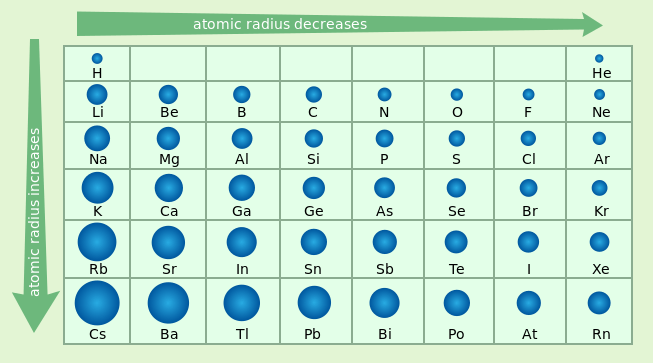
What property is being measured in this diagram?

a)

Density

b)

Ionization Energy

c)

Atomic Radius

d)

Atomic Mass

70.

Which of the following atoms has the greatest atomic radius?

a)

nitrogen

b)

phosphorus

c)

potassium

d)

cesium

71.

If a potassium atom lost one electron, what would be the symbol for that ion?

a)
b)
c)
d)
72.

Which element in period 4 has the highest electronegativity?

a)

potassium

b)

calcium

c)

copper

d)

bromine

73.

Which of these elements in group 1A has the largest atomic radius?

a)

cesium

b)

rubidium

c)

potassium

d)

sodium

74.

The common charge on an atom in group 17 would be....

a)

+1

b)

+7

c)

-7

d)

-1

e)

17

75.

What type of elements are poor conductors of heat and electricity?

a)

transition metals

b)

inner transition metals

c)

metals

d)

nonmetals

76.

What type of elements are malleable and ductile?

a)

noble gases

b)

nonmetals

c)

metals

d)

halogens

77.
Which of the following will have a lower ionization energy than Scandium (Sc)?
a)
Helium (He)
b)
Titanium (Ti)
c)
Calcium (Ca)
d)
Magnesium (Mg)
78.
As you move down a group, atomic radius increases because - 
a)
you add more and more neutrons
b)
you add more and more protons
c)
you add more and more shells (energy levels)
d)
you add more atomic mass
79.
The atom with the largest atomic radius in Group 18 is - 
a)
Ar
b)
He
c)
Kr
d)
Rn
80.
As you move across the periodic table from left to right, the atomic radius decreases.  This is because - 
a)
the number of protons increases, so attraction to electrons increases
b)
the number of energy levels increases
c)
the number of electrons increases
d)
the atomic mass increases
81.
Which atom has the largest atomic radius?
a)
potassium
b)
rubidium 
c)
francium
d)
cesium
82.
Ionization energy is...
a)
the energy required to add an electron to a specific atom
b)
how much energy it takes to remove an electron from an atom
c)
the energy required to shield the outer electrons from the nucleus
d)
a measure of the ability of an atom to attract electrons
83.
Which of the following will have a lower ionization energy than Scandium (Sc)?
a)
Helium (He)
b)
Titanium (Ti)
c)
Calcium (Ca)
d)
Magnesium (Mg)
84.
Which of the following will have a higher ionization energy than arsenic (As)?
a)
Gallium (Ga)
b)
Neon (Ne)
c)
Antimony (Sb)
d)
Germanium (Ge)
85.
What term is used to describe "an atom's tendency to attract electrons to itself when is is chemically combined with another element"
a)
electronation
b)
electron affinity
c)
electronegativity
d)
electrolysis
86.
The electronegativity of Cl is the highest in Period 2.  Why?
a)
Cl is the largest and has the greatest effective nuclear charge
b)
Cl is the smallest and has the lowest effective nuclear charge
c)
Cl is the largest and has the lowest effective nuclear charge
d)
Cl is the smallest and has the greatest effective nuclear charge
87.
As atoms of elements in group 16 are considered in order from top to bottom, the electronegativity of each successive element....
a)
decreases
b)
increases
c)
remains the same
d)
none of the above
88.
How many d orbitals are there in a given sublevel?
a)
1
b)
3
c)
5
d)
7
89.
How many p orbitals are there in a sublevel?
a)
2
b)
1
c)
4
d)
3
90.
Which is associated with more energy? 
a)
2p
b)
2s
c)
3p
d)
1s
91.
What electron configuration matches an oxygen atom?
a)
1s22s22p63s2, 3p64s23d104p5
b)
1s22s22p4
c)
1s22s22p6
d)
1s22s22p63s23p64s23d1
92.

Electrons fill energy levels and sublevels _____ in energy first.

a)

lower

b)

higher

93.
What atom matches this electron configuration?
1s2s2p3s2
a)
Neon
b)
Magnesium
c)
Aluminum
d)
Potassium
94.
How many valence electrons does Chlorine have?
a)
5
b)
2
c)
7
d)
5
95.
Which orbital shows a violation of the Pauli Exclusion Principle?
a)
A
b)
B
c)
C
d)
D
96.
Rows on the period table are called _____ while columns are called _____.
a)
groups, families
b)
groups, periods
c)
periods, groups
d)
families, groups
97.
What do you start electron configuration with?
a)
1s2
b)
1d10
c)
1f14
d)
1p6
98.

It is the measure of the mean distance from the center of nucleus to the boundary of the surrounding cloud where the electron revolves.

a)

Electronegativity

b)

Atomic radius

c)

Electron affinity

d)

Metallic property

99.

Given: Na, Cl, Ba, and Al.

Which has the greatest tendency to accept electrons to form negative ions?

a)

Na

b)

Cl

c)

Ba

d)

Al

100.

Given: Al, O, Cl, and N.

Which has the greatest tendency to lose electrons to form positive ions?

a)

Al

b)

Cl

c)

O

d)

N

101.

Which of the following are the characteristics of the most active nonmetals?

a)

Small radii and high ionization energies

b)

Large atomic radii and low ionization energies

c)

Small radii, low ionization energies

d)

Large atomic radii, high ionization energies

102.

The element with the lowest ionization energy in Period 3 is __________________.

a)

Sodium

b)

Chlorine

c)

Magnesium

d)

Argon

103.

Which periodic group has the smallest atomic radius?

a)

Alkali metals

b)

Halogens

c)

Noble gases

d)

Transition metals

104.

The element with the highest electronegativity in the halogens is ________________.

a)

Astatine

b)

Fluorine

c)

Chlorine

d)

Bromine

105.

Which element is the most metallic?

a)

Na

b)

Mg

c)

Cs

d)

Fr

106.

The change of energy accompanies the addition of an electron to a gaseous atom.

a)

Electronegativity

b)

Atomic radius

c)

Electron affinity

d)

Metallic property

107.

Given: At, F, Cl and Br.

Which sets correctly arranged the given elements in order of increasing electron affinity?

a)

At, Br, Cl, F

b)

F, Cl, Br, At

c)

Cl, Br, At, F

d)

Br, At, Cl, F

108.

The _____ do not have defined values for electronegativity.

a)

alkaline earth metals

b)

alkali metals

c)

noble gases

d)

halogens

109.

The elements in group 3-12 are the

a)

alkaline earth metals

b)

alkali metals

c)

transition metals

d)

halogens

110.

When electrons that are blocked from the full force of the nucleus' positive charge

a)

shielding

b)

inner transition metals

c)

valence

d)

electronegativity

111.

Tendency for an atom to attract electrons when chemically bonded to another atom.

a)

shielding

b)

valence

c)

ionization

d)

electronegativity

112.

The energy required to remove the 2nd most loosely held electron.

a)

2nd Ionization Energy

b)

1st Ionization Energy

c)

2nd Electonegativity

d)

1st Electronegativity

113.

The anion form of an atom is always ______ than its neutral form.

a)

smaller

b)

larger

c)

the same

d)

unable to tell

114.

The cation form of an atom is always ____ than its neutral form.

a)

smaller

b)

larger

c)

the same

d)

unable to tell

115.

The ___ of an atom is found by measuring the distance between the nuclei of two like atoms and halving the distance.

a)

electronegativity

b)

atomic size

c)

ionic size

d)

ionization energy

116.

Which atom has the smaller atomic size?

a)

As

b)

Br

117.

Which atom has the larger electronegativity?

a)

B

b)

In

118.

Which atom has the larger electronegativity?

a)

Rb

b)

Cs

119.

Which atom has the larger first ionization energy?

a)

Si

b)

Sn

120.

Which atom has the larger first ionization energy?

a)

Ti

b)

Mn

121.

Which atom or ion is larger?

a)

Fe2+

b)

Fe3+

122.

Which atom or ion is larger?

a)

N3-

b)

N

123.

Which atom or ion is larger?

a)

Ca2+

b)

Ca

124.

Which atom or ion is larger?

a)

P2-

b)

P1-

125.

Which atom or ion is larger?

a)

Br1-

b)

Br

126.

Which atom or ion is larger?

a)

Ca2+

b)

Ca

127.

Which atom or ion is larger?

a)

S

b)

S2-

128.

As you move from left to right across the periodic table the size of the atom will

a)

increase

b)

decrease

c)

not change

129.

Within a period the elements will have the same number of occupied _______

a)

orbitals

b)

sublevels

c)

Energy levels

130.

The ionization energy of the elements will _____ as you move down a group on the Periodic table.

a)

increase

b)

decrease

c)

no change

131.

As you move across a period from left to right the electronegativity of an element will _______.

a)

increase

b)

decrease

c)

stay the same

132.

As you move down a group, the electronegativity of an element will ______.

a)

increase

b)

decrease

c)

stay the same

133.

As the negative charge on an ion increases, the size of the atom will ______.

a)

increase

b)

decrease

c)

stay the same

134.

The highest possible value for electronegativity is

a)

4.0

b)

7.0

c)

5.0

d)

8

135.
As you move down a group, atomic radius increases because - 
a)
you add more and more neutrons
b)
you add more and more protons
c)
you add more and more shells (energy levels)
d)
you add more atomic mass
136.
The atom with the largest atomic radius in Group 18 is - 
a)
Ar
b)
He
c)
Kr
d)
Rn
137.
As you move across the periodic table from left to right, the atomic radius decreases.  This is because - 
a)
the number of protons increases, so attraction to electrons increases
b)
the number of energy levels increases
c)
the number of electrons increases
d)
the atomic mass increases
138.
The atom with the largest atomic radius in Period 4 (row 4) is - 
a)
K
b)
Kr
c)
Fe
d)
Fe
139.
Francium (Fr) has the lowest ionization energy in Group 1 because - 
a)
it has the smallest number of valence electrons
b)
it has the greatest atomic mass
c)
it has the greatest number of protons, so it attracts its electrons the strongest
d)
its 1 valence electron is very far from the nucleus, so little energy is needed to remove it
140.
The element with the smallest ionization energy in Period 6 is - 
a)
Rn
b)
Cs
c)
Os
d)
Tm
141.
As you move across the periodic table atoms tend to get smaller because, ______________.
a)
the atoms have more mass.
b)
the atoms have less mass
c)
the atoms have more protons.
d)
the atoms have less electrons.
142.
The energy required to remove electrons is the definition of: 
a)
Electronegativity
b)
Atomic Number
c)
Atomic Radius
d)
Ionization
143.
What is the name of family I
a)
Alkaline Earth Metals
b)
Boron Family
c)
Alkali Metals
d)
Halogen Family
144.
Group B is known as the:
a)
Inner Metals
b)
Transition Metals
c)
Weirdos
d)
Changelings 
145.
Families all have similar 
a)
Names
b)
atomic numbers
c)
atomic masses
d)
properties
146.
Electronegativity is...
a)
the ability of an atom to attract/ accept electrons
b)
the ability of an atom to lose electrons
c)
the energy required to remove an electron from a specific atom
d)
how easy it is to make friends. 
147.
Which has the greater Electronegativity: 
N or C?
a)
C
b)
N
148.
Electronegativity __________ from left to right within a period and __________ from top to bottom within a group.
a)
decreases, increases 
b)
increases, increases
c)
increases, decreases 
d)
stays the same, increases
149.
Atomic Radius is...
a)
the relative size of the atom's nucleus
b)
the relative size of the atom's electron cloud
c)
the energy required to shield the outer electrons from the nucleus
d)
a measure of the ability of an atom to attract electrons
150.
As you move down the periodic table atoms get bigger.  This is because ____________.
a)
The atoms have more mass.
b)
The atoms have more protons.
c)
The atoms have more energy levels
d)
The atoms have more nuetrons
151.
As you move across the periodic table atoms tend to get smaller because, ______________.
a)
the atoms have more mass.
b)
the atoms have less mass
c)
the atoms have more protons.
d)
the atoms have less electrons.
152.
Which atom has the largest atomic radius?
a)
potassium
b)
rubidium 
c)
francium
d)
cesium
153.
The atom with the largest atomic radius in Group 18 is - 
a)
Ar
b)
He
c)
Kr
d)
Rn
154.
Which periodic group has the smallest atomic radius?
a)
Alkali metals
b)
Halogens
c)
Noble Gases
d)
Transition metals
155.
Ionization energy is...
a)
the energy required to add an electron to a specific atom
b)
how much energy it takes to remove an electron from an atom
c)
the energy required to shield the outer electrons from the nucleus
d)
a measure of the ability of an atom to attract electrons
156.
Which of the following will have a lower ionization energy than Scandium (Sc)?
a)
Helium (He)
b)
Titanium (Ti)
c)
Calcium (Ca)
d)
Magnesium (Mg)
157.
Which of the following will have a higher ionization energy than arsenic (As)?
a)
Gallium (Ga)
b)
Neon (Ne)
c)
Antimony (Sb)
d)
Germanium (Ge)
158.
Electronegativity is...
a)
how good an atom is at attracting electrons
b)
the ability of an atom to lose electrons
c)
the energy required to remove an electron from a specific atom
d)
how easy it is to make friends. 
159.
Atoms that have a high electronegativity, _______________.
a)
give up their electrons more easily.
b)
hold on to their electrons more tightly.
c)
have more electron shells.
160.
Which of the following will have a higher electronegativity than arsenic (As)?
a)
Carbon (C)
b)
Neon (Ne)
c)
Antimony (Sb)
d)
Germanium (Ge)
161.
As atoms of elements in group 16 are considered in order from top to bottom, the electronegativity of each successive element....
a)
decreases
b)
increases
c)
remains the same
d)
none of the above
162.
The electronegativity of Cl is the highest in Period 2.  Why?
a)
Cl is the largest and has the greatest effective nuclear charge
b)
Cl is the smallest and has the lowest effective nuclear charge
c)
Cl is the largest and has the lowest effective nuclear charge
d)
Cl is the smallest and has the greatest effective nuclear charge
163.
What term is used to describe "an atom's tendency to attract electrons to itself when is is chemically combined with another element"
a)
electronation
b)
electron affinity
c)
electronegativity
d)
electrolysis
164.
What term is used to describe "The energy required to remove an electron from gaseous atoms"
a)
excitation energy
b)
ionization energy
c)
polarization energy
d)
electrolytic energy 
165.
What term is used to describe "A measure of the size of an atom"
a)
chemical reactivity
b)
atomic radius
c)
energy levels
d)
orbit
166.

Which element in Period 2 has the greatest atomic radius?

a)

Be

b)

C

c)

Na

d)

Li

167.

Of the halogens, which has the smallest radius?

a)

F

b)

Br

c)

He

d)

At

168.
As you move across the periodic table from left to right, the atomic radius decreases.  This is because - 
a)
the number of protons increases, so attraction to electrons increases
b)
the number of energy levels increases
c)
the number of electrons increases
d)
the atomic mass increases
169.
Ionization energy is...
a)
the energy required to add an electron to a specific atom
b)
how much energy it takes to remove an electron from an atom
c)
the energy required to shield the outer electrons from the nucleus
d)
a measure of the ability of an atom to attract electrons
170.
Electronegativity __________ from left to right within a period and __________ from top to bottom within a group.
a)
decreases, increases 
b)
increases, increases
c)
increases, decreases 
d)
stays the same, increases
171.

Which of the following will have a lower ionization energy than Scandium (Sc)?

a)

Helium (He)

b)

Titanium (Ti)

c)

Calcium (Ca)

d)

Magnesium (Mg)

172.

Which of the following will have a higher electronegativity than arsenic (As)?

a)

Carbon (C)

b)

Neon (Ne)

c)

Antimony (Sb)

d)

Germanium (Ge)

173.
In the modern periodic table elements are arranged by:
a)
atomic mass
b)
atomic number
c)
valence electrons
d)
number of isotopes
174.
Which of these is a property of metals?
a)
It's malleable
b)
It can't conduct electricity
c)
They are used in food
d)
It's very brittle
175.

What is a cation's charge?

a)

positive

b)

negative

c)

neutral

d)

depends on the element

176.

What is an anion's charge?

a)

positive

b)

negative

c)

neutral

d)

depends on the element's charge

177.

The vertical (up and down) columns in the Periodic Table are called

a)

groups

b)

towers

c)

periods

d)

atomic numbers

178.
Identify the element that is non-reactive (inert) with 4 energy levels.
a)
Krypton
b)
Argon
c)
Potassium
d)
Calcium
179.

Identify the Alkali Metal with the lowest mass.

a)

Lithium

b)

Potassium

c)

Calcium

d)

Helium

180.

When atom gains an electron, the size will

a)

increase

b)

decrease

c)

have no change

d)

smaller

181.

When atom loses an electron, the size will

a)

be greater

b)

increase

c)

have no change

d)

be smaller

182.
Name group 2 on the periodic table.
a)
alkali metals
b)
alkaline earth metals
c)
noble gases
d)
transition metals
183.
Name groups 3 - 12 on the periodic table.
a)
noble gases
b)
halogens
c)
metalloids
d)
transition metals
184.
Which has the greater EN: 
Cl or Al?
a)
Cl
b)
Al
185.
Which has the greater EN: 
N or C?
a)
C
b)
N
186.
Which has the greater EN: 
H or F?
a)
H
b)
F
187.
Which of the following will have a larger radius than Zinc?
a)
Gallium
b)
Aluminum
c)
Magnesium
d)
Strontium
188.
Which of the following will have a higher electronegativity than arsenic (As)?
a)
Carbon (C)
b)
Neon (Ne)
c)
Antimony (Sb)
d)
Germanium (Ge)
189.
Which of the following will have a lower ionization energy than Scandium (Sc)?
a)
Helium (He)
b)
Titanium (Ti)
c)
Calcium (Ca)
d)
Magnesium (Mg)
190.
Based on electronegativity trends in the periodic table, which of the following is the most likely value for the electronegativity of silicon?
a)
2.44
b)
1.23
c)
2.22
d)
2.03
191.
Which periodic group has the smallest atomic radius?
a)
Alkali metals
b)
Halogens
c)
Noble Gases
d)
Transition metals
192.
The element with the lowest electronegativity in Period 3 is - 
a)
Na
b)
Cl
c)
Ar
d)
Mg
193.
The element with the largest electronegativity in the halogens is - 
a)
At
b)
F
c)
Cl
d)
Br
194.
Which statement correctly and completely identifies a trend?
a)
Atomic radius decreases across a period and increases down a group.
b)
Electronegativity decreases across a period and decreases down a group.
c)
Ionization energy increases across a period and increases down a group.
d)
Ionic radius increases across a period and increases down a group.
195.
Metals have the largest - 
a)
atomic radius and electronegativity
b)
electronegativity and ionization energy
c)
atomic radius only
d)
ionization energy and atomic radius
196.
Metals are good conductors of heat and electricity.
a)
true
b)
false
197.
Ionization energy is...
a)
the energy required to add an electron to a specific atom
b)
how much energy it takes to remove an electron from an atom
c)
the energy required to shield the outer electrons from the nucleus
d)
a measure of the ability of an atom to attract electrons
198.
Electronegativity is...
a)
how good an atom is at attracting electrons
b)
the ability of an atom to lose electrons
c)
the energy required to remove an electron from a specific atom
d)
how easy it is to make friends. 
199.
Atoms that have a high electronegativity, _______________.
a)
give up their electrons more easily.
b)
hold on to their electrons more tightly.
c)
have more electron shells.
200.
As you move across the periodic table atoms tend to get smaller because, ______________.
a)
the atoms have more mass.
b)
the atoms have less mass
c)
the atoms have more protons.
d)
the atoms have less electrons.
201.
As you move down the periodic table atoms get bigger.  This is because ____________.
a)
The atoms have more mass.
b)
The atoms have more protons.
c)
The atoms have more energy levels
d)
The atoms have more nuetrons
202.

How does the ionization energy change across a period ?

a)

increases

b)

decreases

c)

stays the same

203.

which of the following is the most stable electron configuration ?

a)

[Ar] 4s2 3d4

b)

[Ar] 4s1 3d5

c)

[Ar] 3d5