
 Worksheets
Electron Configuration and Orbital Notation
Total questions: 199
Worksheet time: 2hrs 21mins

1s22s22p63s23p64s23d10




What element has this electron configuration?
hydrogen
helium
lithium
beryllium

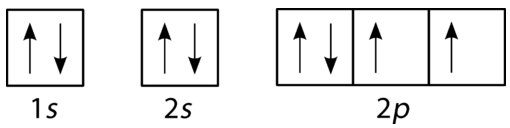
What element has this orbital notation?
lithium
beryllium
boron
carbon

What element has this electron configuration?
helium
lithium
beryllium
boron

What element has this electron configuration?
boron
carbon
nitrogen
oxygen

Which element is represented by this orbital notation?
carbon
nitrogen
oxygen
fluorine

Which element is represented by this electron configuration?
neon
sodium
magnesium
aluminum

Which element is represented by this orbital notation?
neon
sodium
magnesium
aluminum
Which of the following is the electron configuration for Fluorine


Which of the following is the electron configuration for neon?


Which of the following is the electron configuration for silicon?


Which of the following is the orbital notation for oxygen?


What is the element?
Neon
Chlorine
Aluminum
Argon

What is the element?
sulfur
chlorine
phosphorus
silicon
Which is the electron configuration for beryllium?


What is incorrect about this orbital diagram?
Both arrows in the 2p box should be pointing up.
There is nothing incorrect with this diagram.
There should only be 1 arrow in the first 2p box and one in the 2nd 2p box.
All the arrows should be pointing up.

This shape is that of a/n:
s orbital
p orbital
d orbital
f orbital


The element with electron configuration 1s22s22p63s23p2
Si
Mg
S
C


Proposed that electrons move around the nucleus in specific layers, or shells.
Bohr
Rutherford
Chadwick
Thomson
Which of the following sub-levels is correctly designated?
1p5
3f9
2p6
3d11
Which of the following main energy levels of an atom can accommodate a maximum of 18 electrons?
1st energy level
2nd energy level
3rd energy level
4th energy level
If the 1st energy level is already filled up with 2 electrons, what level should be filled up next?
Second
Third
Fourth
Fifth
“An electron should occupy the lowest energy level first before the higher energy level” is stated in what rule?
Hund's rule
Pauli Exclusion Principle
Aufbau Principle
All of the above.
What rule states that single electrons must occupy each equal-energy orbital before additional electrons can occupy the same orbitals.
Hund's rule
Pauli Exclusion Principle
Aufbau Principle
None of the choices.

What is the electron configuration of Argon?
1s2 2s2 2p6
1s2 2s2 2p6 3s1
1s2 2s2 2p6 3s2
1s2 2s2 2p6 3s2 3p6

Which atom has an electron configuration of 1s2 2s2 2p6?
He
Ne
Ar
Xe
What is the electron configuration of Gallium, 31Ga?
1s2 2s2 2p6 3s2 3p5 4s2 3d10 4p1
1s2 2s2 2p6 3s2 3p6 4s2 3d10 4p1
1s2 2s2 2p6 3s2 3p6 4s2 3d9 4p2
1s2 2s2 2p6 3s2 3p5 4s2 3d10 4p2
Which one of the following electron configurations is INCORRECT?
1s2 2s2 2p6 3s2 3p6
1s2 2s2 2p6 3s2 3p6 4s2 3d10 4p3
1s2 2s2 2p6 3s2 3p6 4s2 3d10 4p5
1s2 2s2 2p6 3s2 3p6 4s2 3d9 4p2
Which of the following electron configurations is CORRECT?
1s2 2s3
1s2 2s2 2p6
1s2 2s2 3s2
1s2 2s2 2p6 3s2 4s2
Who used theoretical calculations and experimental results to devise and solve a mathematical equation describing the behavior of the electron in a hydrogen atom?
JJ Thomson
Niels Bohr
Erwin Schrodinger
James Chadwick

What orbital is shown in the picture?
s orbital
p orbital
d orbital
f orbital
What is the difference in a 1s orbital and a 2s orbital?
The shape of the orbital
The size of the orbital
The number of electrons it can hold
None of the above
Which quantum number represents the shape of the orbital?
principal quantum number
azimuthal (angular momentum) quantum number
magnetic quantum number
spin quantum number
Which of the following values does NOT represent a valid electron?
n=(2), l=(1), ml=(1), ms=(+1/2)
n=(4), l=(2), ml=(-1), ms=(-1/2)
n=(2), l=(0), ml=(0), m=(-1/2)
n=(4), l=(2), ml=(-3), ms=(+1/2)
Which quantum number represents the orientation of the orbital?
principal quantum number
azimuthal (angular momentum) quantum number
magnetic quantum number
spin quantum number
When atoms _____________ energy, their electrons move to higher energy levels. These electrons _____________ energy by emitting light when they return to lower energy levels.
lose, absorb
absorb, lose
lose, lose
absorb, absorb
Which form of radiation has the highest frequency?
radio waves
ultraviolet
x-ray
gamma
Heisenberg's Uncertainty Principle states that it is impossible to know both the ___________ and the __________ of a particle at the same time.
velocity, position
velocity, energy
position, energy
velocity, speed
In a wave, the distance between two crests is called
amplitude
wavelength
frequency
The number of wave cycles to pass a given point per unit of time is called the __________.
amplitude
wavelength
frequency
The SI unit of frequency is the __________.
meter
second
hertz
meter per second
Which of the following colors of visible light has the highest frequency?
Blue
Green
Orange
Red
Violet
Which of the following colors of visible light has the lowest frequency?
blue
green
yellow
red
violet
Which of the following colors of visible light has the longest wavelength?
Blue
Green
Yellow
Red
Violet
Which of the following colors of light is associated with the greatest amount of energy?
blue
green
yellow
red
violet
Which color of light moves at the fastest speed?
blue
green
yellow
red
All light travels at the same speed.
On the electromagnetic spectrum, what type of radiation has the longest wavelengths?
radio waves
visible light
gamma rays
microwaves
x-rays
When an electron absorbs energy, it moves ________.
from a higher energy level to a lower energy level
from a lower energy level to a higher energy level
in a circle
toward the nucleus
When an electron moves from a higher energy level to a lower energy level, it ____________.
it releases energy in the form of light
it absorbs energy in the form of light
it breaks in half
it releases a sonic boon
In the speed of light equation, c stands for
frequency
wavelength
the speed of light
Carbon
The Lyman series contains the ultraviolet portion of hydrogen's emission spectrum which corresponds to an electron falling to ________.
the first energy level
the second energy level
the third energy level
the nucleus
In the Balmer series, when an excited electron falls to the second energy level, it emits _______ light.
infrared
visible
ultraviolet
Neils Bohr's atomic theory is similar to the concept of the
solar system
circles with dots
spinning wheel
None of the above
'Quantum numbers' are...
used to describe amount of things an atom can react with.
used when describing number of electrons.
used when describing the energy levels available to atoms and molecules.
used when labelling parts of a wave.
Select the Quantum number with the highest energy...
n=1
n=3
n=5
n=7
___________ __________ is the lowest energy level an electron will occupy in an atom at an ordinary condition
ground state
excited state
highest state
none of the above
Soon after the electron absorbs energy, this energy is released in a form of light or photon. True or False?
True
False


Which of the following sub levels does not exist
2p
3d
2d
5f
4f
There may be a maximum of ____ p orbitals at a given energy level.
2
6
3
8

This shape is that of a...
s orbital
d orbital
p orbital
f orbital
The spin of an electron is represented by this variable:
n
m
L
s, ms

This is a ____ orbital
s
d
p
d
Orbital sublevels, or L, represents:
orbital color
orbital shape
electron spin
energy level
How many electrons total are found in the f orbital?
2
6
10
14
With each higher energy level, the electrons are
lower in energy
more stable
weaker
farther from the nucleus
What is the noble gas configuration for Neon?
[Ne]
[He]2s22p6
[F]2p1
[Ne]2s21p6


What element's orbital notation is pictured here?
Ar
Br
Cu
Cl

Energy levels are denoted by:
letters
numbers
a combination of letters and numbers
subscripts
Which rule is violated in the following orbital diagrams?
Hund's Rule
Aufbau Principle
Pauli's Exclusion Principle
X has 10 electrons. What is the the possible set of quantum number of the 10th electron?
(n=2, l= 1, m=0, s=+1/2)
(n=2, l= 0, m=0, s=+1/2)
(n=1, l= 0, m=0, s=-1/2)
(n=2, l= 1, m=+2, s=+1/2)
p3, p6 configurations are more stable than p4, p5 configurations.
True
False
Which one of the following atoms have three unpaired electrons?
B
C
N
O
According to Bohr’s theory, electrons can be found in:
orbit around the nucleus at varying distances
a cloud around the nucleus with higher energy electrons further away
hanging out on the corner
orbit the nucleus at constant distances related to their energy level
The biggest problem with the Bohr's model of the atom is that:
it doesn't work for anything but hydrogen
nothing, it's perfect
it doesn't accurately explain any photons emitted by atoms
it doesn't explain why the electrons orbit in circles
Electrons in energy levels farther from the nucleus have ________ energy than/as electrons in energy levels closer to the nucleus.
less
depends on the element
greater
the same
What was Louis de Broglie's contribution to solving the problems in the Bohr model?
discovering that electrons go into the lowest energy state available
applying probability wave theory to electrons
defining the four quantum numbers
treating the electrons as wave particles
Schrodinger improved on Bohr's work by:
applying probability wave functions to the electron energy levels and discovering orbitals in the electron cloud
theorizing that electrons have wave-particle duality just like photons
determining that it was impossible to know both the position and location of an electron
showing that each electron in an atom must have a unique set of quantum numbers
The magnetic quantum number, or orbital number, tells us:
the orientation of the orbital
the shape of the orbital
the size of the orbital
the direction of electron spin
There are ___ orbitals in the f sublevel, so the f sublevel can hold ___ electrons.
1, 2
3, 6
5, 10
7, 14
Which area on the periodic table represents the electrons in the "d" sublevel (d orbitals)?
representative elements
columns 3-8
rare earth elements
transition elements


How many sublevels are in this atom?
4
6
12
Impossible to determine

Which sublevel has the most energy in this diagram?
1s
4p
3d
they are all the same
According to Bohr's model of the atom:
electrons excite from a lower energy level to a higher energy level when they absorb a photon of the correct energy
electrons release photons when they are excited from one energy level to a higher one
electrons can switch from one energy level to another by trading energy with other electrons
energy is continuous in an atom
Electrons in energy levels farther from the nucleus have ________ energy than/as electrons in energy levels closer to the nucleus.
less
depends on the element
greater
the same
What was Louis de Broglie's contribution to solving the problems in the Bohr model?
discovering that electrons go into the lowest energy state available
applying probability wave theory to electrons
defining the four quantum numbers
treating the electrons as wave particles
Schrodinger improved on Bohr's work by:
applying probability wave functions to the electron energy levels and discovering orbitals in the electron cloud
theorizing that electrons have wave-particle duality just like photons
determining that it was impossible to know both the position and location of an electron
showing that each electron in an atom must have a unique set of quantum numbers
The second quantum number is known as the ____________ number.
sublevel
spin
orbital
energy level
The magnetic quantum number, or orbital number, tells us:
the orientation of the orbital
the shape of the orbital
the size of the orbital
the direction of electron spin


Which shows the correct orbital diagram for Cobalt?


Which area on the periodic table represents the electrons in the "d" sublevel?
representative elements
columns 3-8
rare earth elements
transition elements
Each row on the periodic table represents:
an energy level
a sublevel
an electron
an orbital
Choose the correct shortcut configuration for iodine.
[Ar]4s24d104p5
[Kr]5s24d105p5
[Xe]5s25d105p5
none of the above
Choose the Noble Gas that you would use to begin the shorthand configuration of the following element.
Iron
[He]
[Ne]
[Ar]
[Kr]
Choose the Noble Gas that you would use to begin the shorthand configuration of the following element.
Plutonium (Pu)
[Xe]
[Ne]
[Rn]
[Kr]

What is the shorthand configuration for Tin?
[Xe]5s24d105p2
[Xe]5s24d105p2
[Kr]5p2
[Kr]5s24d105p2
What is the shorthand configuration for Lead?
[Xe]6s24f145d106p2
[Xe]6s25d106p2
[Rn]6s25d106p2
[Rn]6s24f145d106p2


