
 Worksheets
Chemistry End of the Year Review
Total questions: 200
Worksheet time: 3hrs 14mins
Name
Class
Date
1.
Which is true of matter?
a)
It takes up space but does not have mass.
b)
It has mass and takes up space.
c)
It does not take up space.
d)
Matter is not found on earth.
2.
A table in which the chemical elements are arranged in order of increasing atomic number
a)
Material Table
b)
Periodic Table
c)
Particle Table
d)
Element Table
3.
A pure substance that cannot be changed into simpler substances; found on the periodic table
a)
Mixture
b)
Compound
c)
Element
d)
Valence
4.
The smallest particle of an element
a)
Valence
b)
Molecule
c)
Compound
d)
Atom
5.
A negatively charged atomic particle that orbits around the nucleus of an atom
a)
Electron
b)
Proton
c)
Neutron
d)
Megatron
6.
A positively charged particle found in the nucleus of an atom
a)
Cybertron
b)
Neutron
c)
Electron
d)
Proton
7.
A particle found in the nucleus of an atom that has no charge
a)
Proton
b)
Neutron
c)
Notron
d)
Electron
8.
A pure substance made of two or more types of elements that are chemically combined
a)
Compound
b)
Matter
c)
Mixture
d)
Molecule
9.
A scientific principle stating that mass cannot be created nor destroyed within a closed system
a)
Conservation of Energy
b)
Conservation of Science
c)
Conservation of Atomics
d)
Conservation of Mass
10.
A type of mixture in which the substances are visibly distinguished (example: trail mix)
a)
Homogeneous Mixture
b)
Heterogeneous Mixture
c)
Multi-level Mixture
d)
Reversible Mixture
11.
A type of mixture were the substances are evenly mixed but cannot be visibly distinguished (example: salt water)
a)
Homogeneous Mixture
b)
Heterogeneous Mixture
c)
Multi-level Mixture
d)
Reversible Mixture
12.
The outermost shell (level) of an atom; contains electrons; involved in bonding
a)
Shore
b)
Vacant
c)
Valence
d)
First
13.
Can be observed or measured without changing the composition of the matter of the substance; includes appearance, texture, color, odor, and others.
a)
Neutral Properties
b)
Positive Properties
c)
Chemical Properties
d)
Physical Properties
14.
The characteristics of a material that become evident when the material undergoes a chemical reaction. Cannot be physically observed.
a)
Physical Properties
b)
Chemical Properties
c)
Positive Properties
d)
Neutral Properties
15.
The property that describes the relationship between the mass of a material and its volume (D=M/V)
a)
Density
b)
Malleability
c)
Ductility
d)
Speed
16.
The property of metals that allow them to be hammered into flat sheets
a)
Density
b)
Malleability
c)
Ductility
d)
Instability
17.
The property of metals that allow them to be drawn into a wire
a)
Density
b)
Malleability
c)
Ductility
d)
Instability
18.
The change in one or more visual properties (example: change in size, color, text or state)
a)
Chemical Change
b)
Physical Change
c)
Positive Change
d)
Negative Change
19.
Results in the formation of one or more new substances with new chemical and physical properties.
a)
Chemical Change
b)
Physical Change
c)
Positive Change
d)
Negative Change
20.
An element with same number of protons, but a different number of neutrons
a)
Monotope
b)
Isotope
c)
Hypertope
d)
Octatope
21.
The numbers to the lower right of the chemical symbols in a formula
a)
Coefficient
b)
Subscript
c)
Exponent
d)
Variable
22.
Indicates the number of molecules (or atoms) involved in the reaction. Written in front of element symbol within a chemical formula
a)
Subscript
b)
Exponent
c)
Variable
d)
Coefficient
23.
Which of these recorded observations is qualitative, rather than quantitative?
a)
A chemical reaction is complete in 2.3 s.
b)
The solid has a mass of 23.4 g.
c)
The compound melts at 87.5°C.
d)
Iron is denser than aluminum.
24.
The unit cm3 is used to express
a)
length.
b)
mass.
c)
volume.
d)
time.
25.
The SI base units for time and temperature are
a)
hour and degree Celsius.
b)
second and degree Celsius.
c)
hour and kelvin.
d)
second and kelvin.
26.
Which of these shows SI unit prefixes arranged in order from smallest to largest?
a)
centi, milli, kilo
b)
milli, centi, kilo
c)
kilo, milli, centi
d)
kilo, centi, milli
27.
The conversion factor 1L/103 mL would be used to change
a)
milliliters to liters.
b)
liters to milliliters.
c)
units of volume to units of length.
d)
units of length to units of volume.
28.
A sample of bismuth has a mass of 343 g and a volume of 35.0 cm3. What is the density of bismuth?
a)
0.102 g/cm3
b)
9.80 g/cm3
c)
378 g/cm3
d)
1.20 × 10⁴ g/cm3
29.
The SI base unit for mass is the
a)
gram.
b)
cubic centimeter.
c)
meter.
d)
kilogram.
30.
Which of these is not an SI base unit?
a)
meter
b)
pound
c)
kelvin
d)
ampere
31.
Precision is related to all of these except
a)
reproducibility of measurements.
b)
range of measurement values.
c)
number of significant figures.
d)
closeness of a measurement to the accepted value.
32.
A student determined the density of aluminum by averaging the results of three density calculations. Each value was different, but the average was equal to the accepted value for aluminum’s density. The results of this investigation are best described as
a)
accurate, but not precise.
b)
precise, but not accurate.
c)
both precise and accurate.
d)
neither precise nor accurate.
33.
The measurement 0.0265 g, rounded off to two significant figures, would be
a)
0.026 g.
b)
0.027 g.
c)
0.03 g.
d)
0.030 g.
34.
In division and multiplication, the answer should have the same number of significant figures as the
a)
number in the calculation with the fewest significant figures.
b)
number in the calculation with the most significant figures.
c)
average number of significant figures in the calculation.
d)
total number of significant figures in the calculation.
35.
The number of significant figures in the measurement 170.040 km
a)
three.
b)
four.
c)
five.
d)
six.
36.
The dimensions of rectangular solid are measured to be 1.27 cm,
1.3 cm, and 2.5 cm. The volume should be recorded as
1.3 cm, and 2.5 cm. The volume should be recorded as
a)
4.128 cm3
b)
4.12 cm3
c)
4.13 cm3
d)
4.1 cm3
37.
Samples with masses of 0.12 g, 1.8 g, and 0.562 g are mixed together. The combined mass of the three samples, expressed to the correct number of significant figures, should be recorded as
a)
2.4 g.
b)
2.48 g.
c)
2.482 g.
d)
2.5 g.
38.
Expressed in scientific notation, 0.0930 m is
a)
9.30 × 10⁻⁴ m.
b)
9.30 × 10⁻² m.
c)
9.3 × 10⁻³ m.
d)
93 × 10−3 m.
39.
How many sig figs are in 0.0340 m?
a)
2
b)
3
c)
4
d)
5
40.
Round 0.010229 to four sig figs
a)
1022
b)
1023
c)
0.01023
d)
0.01022
41.
Convert 0.0000000043 into correct scientific notation.
a)
4.3 x 10^-9
b)
4.3 x 10^9
c)
0.43 x 10^-8
d)
0.43 x 10^8
42.
Convert 119 mm to km
a)
119000000 km
b)
0.000000119 km
c)
119000000000 km
d)
0.000119 km
43.
Convert 0.25 Mm to cm (Answer in the correct number of significant digits.)
a)
2.5 x 10 ^ -2 cm
b)
2.5 x 10 ^ -1 cm
c)
2.50 x 10 ^ -2 cm
d)
2.50 x 10 ^ -1 cm
44.
Find the mass of 250.0 mL of benzene. The density of benzene is 0.8765 g/mL.
a)
219.1 g
b)
285.2 g
c)
0.003506 g
d)
0.0035 g
45.
Calculate 12.47 m ÷ 3.2 s and give your answer with the appropriate number of significant figures.
a)
4 m/s
b)
3.9 m/s
c)
3.90 m/s
d)
3.897 m/s
46.
These values were recorded as the mass- 8.83 g, 8.84 g, 8.82 g. The actual mass was 8.60 g. The values are:
a)
accurate, but not precise
b)
precise, but not accurate
c)
both accurate and precise
d)
neither accurate nor precise
47.
150 mL = _______cm3
a)
15
b)
25
c)
150
d)
30
48.
Which of these is the smallest?
a)
ug (microgram)
b)
ng
c)
cg
d)
kg
49.
μm
a)
meter
b)
micrometer
c)
millimeter
d)
Megameter
50.
m
a)
meter
b)
micrometer
c)
millimeter
d)
Megameter
51.
The SI unit for length
a)
meter
b)
kilogram
c)
second
d)
mole
52.
The SI unit for the amount of a substance
a)
meter
b)
kilogram
c)
second
d)
mole
53.

The SI unit for temperature is __?__.
a)
degree fahrenheit (° F)
b)
degree celsius (° C)
c)
kelvin (K)
d)
degree centigrade (°C)
54.
Experimental Value = 86 cm
Accepted Value = 78 cm
Percent Error?
Accepted Value = 78 cm
Percent Error?
a)
12%
b)
10 %
c)
8%
d)
6%
55.
Experimental Value = 50 cm
Accepted Value = 55 cm
Percent Error = ?
Accepted Value = 55 cm
Percent Error = ?
a)
9%
b)
-9%
c)
10 %
d)
-10%
56.
Convert 7069 g to ounces.
453.6 g=1 lb
16 oz = 1 lb
453.6 g=1 lb
16 oz = 1 lb
a)
249.3 oz
b)
250 oz
c)
51300000 oz
d)
0.974
57.

What is the correct measurement for the location marked by the arrow?
a)
52.4 cm
b)
51.8 cm
c)
52 cm
d)
51 cm
58.
This causes the mass of the nucleus to increase.
a)
adding an electron
b)
adding a neutron
c)
more orbitals
d)
adding negatively charged particles
59.
This particle determines what element you have - the elements identity.
a)
electron
b)
proton
c)
neutron
d)
valence shell
60.
Which particle has a positive charge?
a)
electron
b)
orbital
c)
proton
d)
neutron
61.
Choose the particle that has no charge.
a)
nucleus
b)
neutron
c)
proton
d)
electron
62.
The subatomic particle that determines the identity of an element.
a)
neutron
b)
proton
c)
electron
d)
outer shell
63.
What charge does the nucleus have and why?
a)
positive - the neutrons do not have a charge
b)
positive - the neutrons and protons are positively charged particles
c)
neutral - the neutral charge dominates the positive charge
d)
neutral - electrons cancel out the positive charge of the atom
64.
What is the mass number and name of an element with 8 protons and 8 neutrons?
a)
16 - Carbon
b)
16 - Oxygen
c)
24 - Oxygen
d)
8 - Neon
65.
An element with a mass number of 10 and an atomic number of 6 has how many protons?
a)
5
b)
8
c)
6
d)
10
66.
An element with a mass number of 11 and an atomic number of 5 has how many neutrons?
a)
11
b)
5
c)
6
d)
16
67.
An atom has 10 protons, 15 neutrons and 10 electrons what is its mass number.
a)
20
b)
10
c)
5
d)
25
68.
What is the difference between the atomic mass and the mass number?
a)
the atomic mass is always a whole number
b)
the atomic mass equals the atomic #
c)
mass number is the rounded atomic mass - always a whole number
d)
electrons
69.

What is the number of protons that the element in this image contain?
a)
14
b)
7
c)
15
d)
18
70.
Protons and Electrons balance the charge of an atom.
a)
True
b)
False
71.

Which letter represents a proton?
a)
A
b)
B
c)
C
d)
D
72.

What is the element name of the atom pictured?
a)
Fluorine
b)
Neon
c)
Argon
d)
Potassium
73.
What is the atomic number of the atom pictured?
a)
9
b)
10
c)
18
d)
19
74.
Which scientist conducted experiments using alpha particles and thin gold foil, which later helped him develop his model for the atom?
a)
Ernest Rutherford
b)
Kneels Bore
c)
Niels Bohr
d)
Earnest Rutherfraud
75.
Which scientist discovered the electron, which helped him develop a model of the atom?
a)
Niels Bohr
b)
John Dalton
c)
Ernst Rutherford
d)
J.J Thompson
76.
What is an atom mostly made up of?
a)
protons
b)
electrons
c)
empty space
d)
neutrons
77.
An isotope has three forms. 30% have a mass of 4 amu, 20% have a mass of 5 amu and 50% have a mass of 3 amu. Average atomic mass will be closest to
a)
2 amu
b)
3 amu
c)
4 amu
d)
5 amu
78.
Using your Periodic Table, identify the element that is represented by this model.
a)
Beryllium
b)
Oxygen
c)
Fluorine
d)
Boron
79.
Which statement best describes the locations of the subatomic particles?
a)
The protons and electrons are found in the nucleus, while neutrons are in the cloud outside the nucleus
b)
The neutrons are in the nucleus, while the protons and electrons are in the cloud outside the nucleus
c)
The protons and neutrons are in the nucleus, while the electrons are in the cloud outside the nucleus
d)
The electrons and neutrons are in the nucleus, while the protons are in the cloud outside the nucleus
80.
If the number of electrons in an atom changes you make a(n) __________________.
a)
ion
b)
isotope
c)
new element
d)
isomer
81.
Carbon-12 has 98.2% abundance, carbon-13 has 1.7% abundance, and carbon-14 has 0.1% abundance. Which isotope contributes most to the average atomic mass?
a)
Carbon-12
b)
Carbon-13
c)
Carbon-14
d)
They all contribute equally
82.
Atomic Number: 26
Neutrons: 30
Electrons: 25
Neutrons: 30
Electrons: 25
a)
Normal Atom
b)
Isotope
c)
Anion
d)
Cation
83.

Gaining or losing electrons in an atom changes its...
a)
element type.
b)
charge.
c)
isotope type.
d)
atom type.
84.
1. To change Li to Li⁺, you need to:
a)
add one electron
b)
remove one electron
c)
remove one proton
d)
add one neutron
85.
2. Fe²⁺ and Fe³⁺ are different iron:
a)
ions
b)
elements
c)
isotopes
d)
atoms
86.
3. ¹⁴₆C and ¹²₆C are examples of carbon:
a)
ions
b)
isotopes
c)
molecules
d)
valences
87.
⁴₆C has how many protons?
a)
6
b)
14
c)
12
d)
20
88.
5. Li⁺ and Cu²⁺ are examples of:
a)
anions
b)
isotopes
c)
cations
d)
molecules
89.
What is the symbol for an ion which has 8 protons and 10 electrons?
a)
N³⁻
b)
O²⁻
c)
F⁻
d)
O³⁻
90.
8. Li⁺ has how many electrons? (hint: the atomic number of lithium is 3)
a)
0
b)
1
c)
2
d)
3
91.
9. How many protons, neutrons, and electrons does ⁷₄Be²⁺ have?
a)
4,3,2
b)
4,3,6
c)
4,3,4
d)
4,6,3
92.

How many valence electrons are represented here?
a)
7
b)
5
c)
2
d)
8
93.
How many total electrons does element 15 have?
a)
5
b)
2
c)
8
d)
15
94.
How does the energy of an electron change when the electron moves closer to the nucleus?
a)
it decreases.
b)
it increases.
c)
it stays the same.
d)
it doubles.
95.
The energy of an electron __________ as it moves further away from the nucleus
a)
increases
b)
decreases
c)
remains the same
96.
Each column in the periodic table is called a
a)
period
b)
group
c)
cluster
d)
unit
97.
most of the elements on the periodic table are
a)
non metals
b)
metals
c)
metalloids
d)
none
98.
Each row in the periodic table is called a
a)
group
b)
period
c)
cluster
d)
unit
99.
What atom matches this electron configuration?
1s2 2s2 2p6 3s2
1s2 2s2 2p6 3s2
a)
Neon
b)
Magnesium
c)
Aluminum
d)
Potassium
100.
Which is the electron configuration for an oxygen atom?
a)
1s22s22p63s23p64s2
b)
1s22s22p4
c)
1s22s22p6
d)
1s22s22p63s23p6
101.
How many d orbitals are there in a given sublevel?
a)
1
b)
3
c)
5
d)
7
102.
How many p orbitals are there in a sublevel?
a)
2
b)
1
c)
4
d)
3
103.
What is this element?
1s22s22p63s23p6
4s23d104p6
1s22s22p63s23p6
4s23d104p6
a)
Argon
b)
Krypton
c)
Selenium
d)
Bromide
104.
What atom matches this electron configuration?
[Xe] 6s2 4f14 5d9
[Xe] 6s2 4f14 5d9
a)
Mercury
b)
Gold
c)
Platinum
d)
Thallium
105.
What is the shorthand electron configuration for Sulfur atom?
a)
[Ar] 3p4
b)
[He] 3s23p4
c)
[Ne] 3s23p4
d)
[Na] 3s23p3
106.
How many valence electrons does Chlorine have?
a)
5
b)
2
c)
7
d)
5
107.
How many valence electrons does phosphorus have?
a)
5
b)
2
c)
8
d)
15
108.
What element has the valence shell configuration
3s2 3p2
3s2 3p2
a)
Al
b)
B
c)
Si
d)
Ga
109.

Which element is pictured?
a)
neon
b)
fluorine
c)
magnesium
d)
argon
110.

How did Mendeleev arrange the elements?
a)
alphabetical
b)
density
c)
melting point
d)
atomic mass
111.

Pure forms of these elements are stored in oil so they won't react with oxygen and water in the air.
a)
Alkali Metals
b)
Alkaline-earth metals
c)
Halogens
d)
Noble Gases
112.

What group of elements don't have individual names?
a)
Alkaline-earth Metals
b)
Transition Metals
c)
Alkali Metals
d)
Halogens
113.
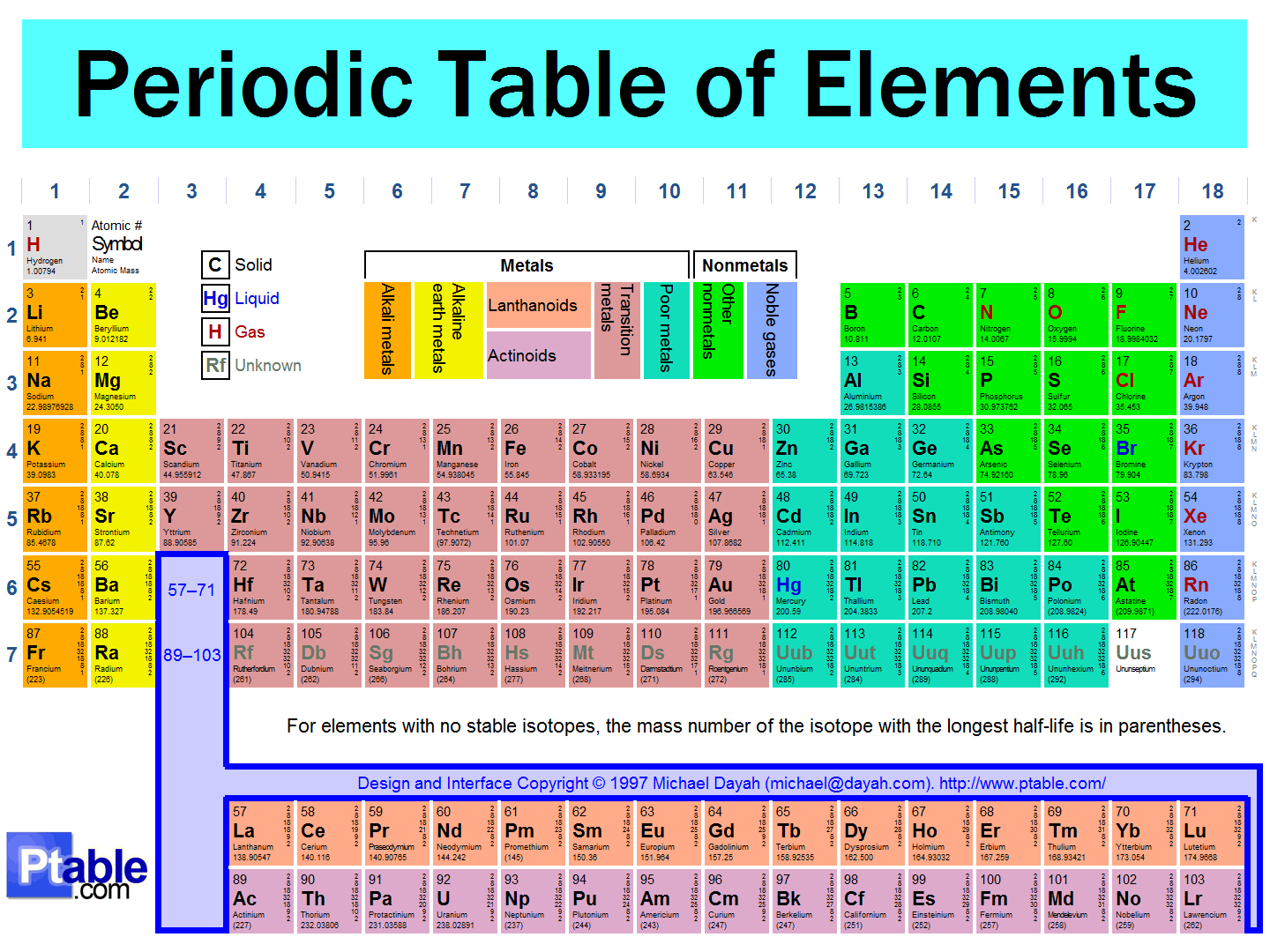
This class of elements are sometimes called "semiconductors."
a)
Metals
b)
Nonmetals
c)
Metalloids
d)
Groups
114.
Which is a halogen?
a)
Helium
b)
Chlorine
c)
Oxygen
d)
Neptune
115.
Which is an alkali metal?
a)
Magnesium
b)
Iron
c)
Sodium
d)
Europium
116.
Which has the greater EN:
Cl or Al?
Cl or Al?
a)
Cl
b)
Al
117.
Which of the following will have a larger radius than Zinc?
a)
Gallium
b)
Aluminum
c)
Magnesium
d)
Strontium
118.
Which of the following will have a lower ionization energy than Scandium (Sc)?
a)
Helium (He)
b)
Titanium (Ti)
c)
Calcium (Ca)
d)
Magnesium (Mg)
119.
As you move down the periodic table atoms get bigger. This is because ____________.
a)
The atoms have more mass.
b)
The atoms have more protons.
c)
The atoms have more energy levels
d)
The atoms have more nuetrons
120.
As you move across the periodic table atoms tend to get smaller because, ______________.
a)
the atoms have more mass.
b)
the atoms have less mass
c)
the atoms have more protons.
d)
the atoms have less electrons.
121.
Atoms that have a high electronegativity, _______________.
a)
give up their electrons more easily.
b)
hold on to their electrons more tightly.
c)
have more electron shells.
122.
Electronegativity is...
a)
how good an atom is at attracting electrons
b)
the ability of an atom to lose electrons
c)
the energy required to remove an electron from a specific atom
d)
how easy it is to make friends.
123.
Ionization energy is...
a)
the energy required to add an electron to a specific atom
b)
how much energy it takes to remove an electron from an atom
c)
the energy required to shield the outer electrons from the nucleus
d)
a measure of the ability of an atom to attract electrons
124.
Metals are good conductors of heat and electricity.
a)
true
b)
false
125.
The atom with the largest atomic radius in Group 18 is -
a)
Ar
b)
He
c)
Kr
d)
Rn
126.
The element with the largest electronegativity in the halogens is -
a)
At
b)
F
c)
Cl
d)
Br
127.
The element with the lowest electronegativity in Period 3 is -
a)
Na
b)
Cl
c)
Ar
d)
Mg
128.
When forming an ionic bond, a metal atom
a)
Gains electrons to form a cation
b)
Loses electrons to form a cation
c)
Gains electrons to form an anion
d)
Loses electrons to form an anion
129.
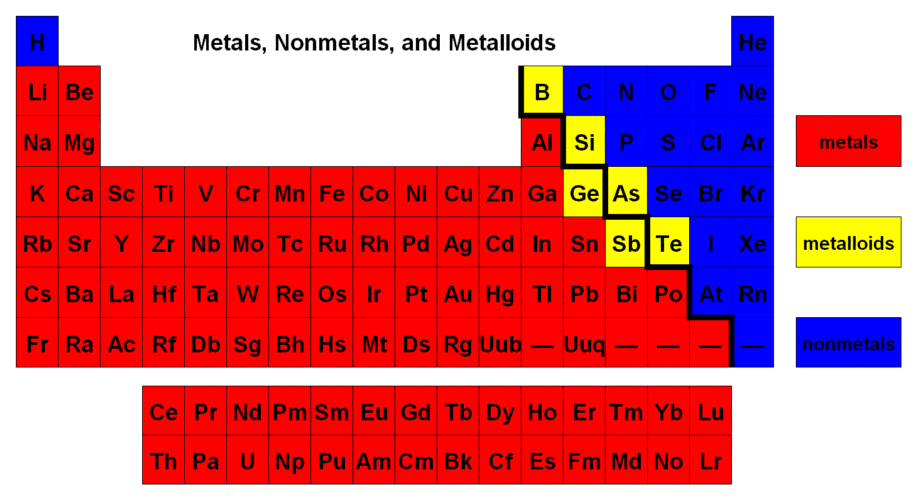
What elements generally make an ionic bond?
a)
metal and nonmetal
b)
2 or more nonmetals
c)
metal
d)
none of the above
130.
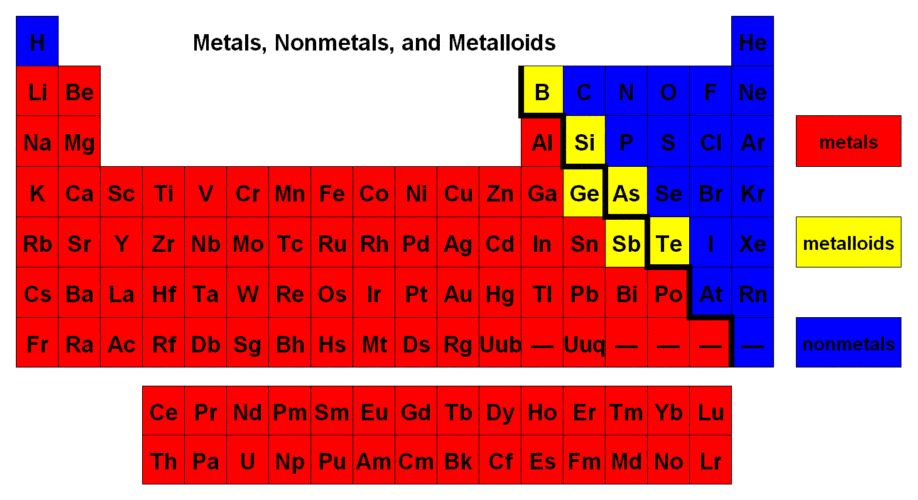
What elements generally make a covalent bond?
a)
metal and nonmetal
b)
2 or more nonmetals
c)
metal
d)
none of the above
131.
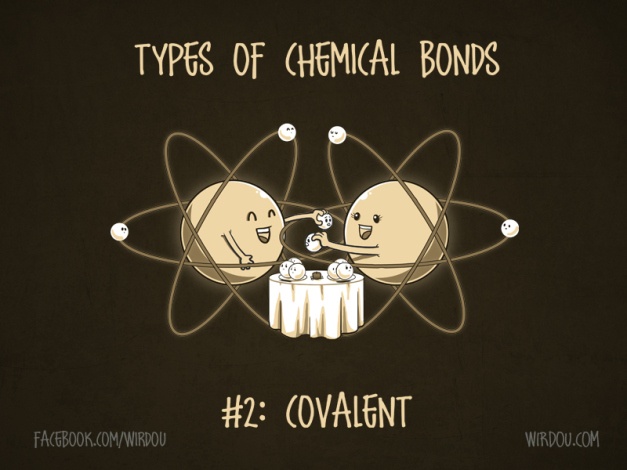
In chemical compounds, covalent bonds form when
a)
the electronegativity difference between two atoms is very large.
b)
electrons are completely transferred between two metals.
c)
pairs of electrons are shared between two nonmetal atoms.
d)
two nonmetal atoms are attracted to each other by opposite charges.
132.
Predict the bond that will form between Be and F.
a)
Ionic
b)
Covalent
133.
Predict the bond that will form between Se and Cl.
a)
Ionic
b)
Covalent
134.

What type of diagram is this?
a)
Electron Dot Diagram
b)
Bohr Model
c)
Alkali Diagram
d)
Chemical Diagram
135.

How many valence electrons in this structure?
a)
6
b)
5
c)
4
d)
7
136.

How many atoms of Oxygen are in this compound?
a)
4
b)
1
c)
12
d)
7
137.

How many elements make up this compound?
a)
6
b)
4
c)
2
d)
3
138.
If an atom loses two electrons what charge will it have?
a)
+ 2
b)
- 2
c)
+1
d)
-1
139.
Predict the bond that will form between Se and Cl.
a)
Ionic
b)
Covalent
c)
Metallic
d)
Nonpolar
140.
Which is the correct formula for:
three hydrogen (H)
one sulfur (S)
four oxygen (O)
three hydrogen (H)
one sulfur (S)
four oxygen (O)
a)
H3SO4
b)
HSO4
c)
H4S3O
d)
H2O
141.
How many Sodium (Na) are in 6NaCl?
a)
1
b)
12
c)
6
142.
The arrow symbol used in a chemical equation
a)
Yield sign
b)
Subscript
c)
Coefficient
d)
Chemical formula
143.
The small number that is written below the symbol and shows how many atoms of each element is present.
a)
Compound
b)
Molecule
c)
Coefficient
d)
Subscript
144.
A way to show the number and type of elements (atoms) in a molecule or compound with a combination of symbols and numbers.
a)
Molecule
b)
Chemical formula
c)
Physical change
d)
Coefficient
145.
The large number written in front of a chemical formula. It shows the number of molecules.
a)
Molecule
b)
Compound
c)
Coeffiecient
d)
Subscript
146.
Ca+2P-3
a)
PCa
b)
P2Ca3
c)
CaP
d)
Ca3P2
147.
Al+3, S-2
a)
AlS3
b)
Al2S3
c)
S3Al2
148.
Ba+2, Br-1
a)
BrBa
b)
Br2Ba2
c)
BaBr2
d)
Br2Ba
149.
Ca+2, O-2
a)
CaO
b)
OCa
c)
Ca-2O+2
d)
Ca2O2
150.
K+, O-2
a)
KO
b)
K2O
c)
K-2O2
d)
O2K
151.
The name of Mg₃N₂ is
a)
manganese nitride
b)
magnesium nitride
c)
magnesium (III) nitride
d)
trimagnesium dinitride
152.
The name of FeCl₂ is
a)
iron chloride
b)
iron (II) chloride
c)
iron (I) chloride
d)
iron dichloride
153.
The name of Cu₃N₂ is
a)
copper (III) nitride
b)
copper (II) nitride
c)
copper nitride
d)
tricopper dinitride
154.
The chemical formula of magnesium phosphide is
a)
MgP
b)
Mg₂P₃
c)
Mg₃P₂
d)
Mg₃(PO₄)₂
155.
Ionic compounds are written with
a)
cation (+ ion) first then anion (- ion)
b)
anion (- ion) first then cation (+ ion)
c)
either way is fine
d)
polyatomic ions first
156.
When adding a subscript to a polyatomic ion, you should...
a)
multiply any subscripts on the polyatomic ion by the subscript you are adding
b)
put parentheses around the polyatomic ion before adding a subscript
c)
write the new subscript next to any subscripts on the polyatomic ion
d)
put the polyatomic ion in square brackets before adding the subscript
157.
How do the following two elements bond together?
Pb4+ O2-
Pb4+ O2-
a)
PbO
b)
Pb4O2
c)
PbO2
d)
Pb2O4
158.
Whats the formula
Sr+2 + (CO3)-2
Sr+2 + (CO3)-2
a)
Sr(CO3)
b)
Sr2 (CO3)2
c)
Sr1(CO)5
d)
Sr(CO5)
159.
What is the formula for sodium phosphate?
a)
Na3PO4
b)
Na3PO3
c)
Na3P
d)
Na3PO
160.
What is the formula for calcium carbonate?
a)
CaCO
b)
CaCO2
c)
CaCO3
d)
Ca3CO3
161.
What is the FORMULA for
calcium chloride
calcium chloride
a)
CaCl2
b)
Cl2Ca
c)
Ca2Cl
d)
CaCl
162.
What is the FORMULA for
ammonium sulfide
ammonium sulfide
a)
(NH4)2S
b)
NH4 S
c)
(NH4)2S4
d)
NH2S
163.
What is the FORMULA for
Potassium chloride
Potassium chloride
a)
KCl2
b)
Cl2K
c)
K2Cl
d)
KCl
164.
What is the formula for Lead II Phosphate?
a)
Pb₃(PO₃)₂
b)
Pb₃(PO₄)₂
c)
Pb₂PO₄
d)
Pb₂P
165.
What is the formula for Dichlorine Monoxide?
a)
Co₃O
b)
ClO₂
c)
Cl₂O
d)
(Cl₂)₂O
166.
What is the formula for Phosphorous Trichloride?
a)
P₃Cl
b)
PCl₃
c)
KCl₃
d)
K₃Cl
167.
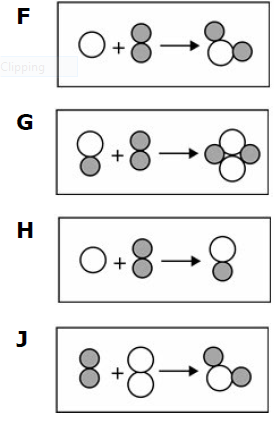
Which of the following models best demonstrates a balanced chemical equation?
a)
F
b)
G
c)
H
d)
J
168.
Identify this type of reaction,
Cl2 + 2KI --> I2 + 2KCl
Cl2 + 2KI --> I2 + 2KCl
a)
Synthesis
b)
Single displacement
c)
Double displacement
d)
Decomposition
169.
2 RbNO3 + BeF2 --> Be(NO3)2 + 2 RbF
a)
single displacement
b)
double displacment
c)
decomposition
d)
synthesis
170.
Which of the following is the general formula for a decomposition reaction?
a)
A + B → AB
b)
AB → A + B
c)
AB + C → AC + B
d)
AB + CD → AC + BD
171.
2 AgNO3 + Cu --> Cu(NO3)2 + 2 Ag
a)
single displacement
b)
double displacement
c)
decomposition
d)
synthesis
172.
NO2 →N2 + O2
a)
Synthesis (combination)
b)
Decomposition
c)
Single replacement
d)
Combustion
173.
Mg + N2 →Mg3N2
a)
Synthesis (combination)
b)
Decomposition
c)
Single replacement
d)
Combustion
174.
2NaCl →2Na +Cl2
a)
Synthesis Reaction
b)
Decomposition Reaction
c)
Single Displacement Reaction
d)
Double Displacement Reaction
175.
C + O2 → CO2
a)
Synthesis Reaction
b)
Decomposition Reaction
c)
Single Displacement Reaction
d)
Double Displacement Reaction
176.

Is burning wood a chemical or physical change?
a)
chemical
b)
physical
177.
Which of the following is NOT an example of a physical change?
a)
crumpled paper
b)
pencil sharpening
c)
shrunken clothing
d)
sour milk
178.
_P4+_O2 → _P2O3
a)
3 P4+1 O2 → 2 P2O3
b)
1 P4+1 O2 → 2 P2O3
c)
1 P4+ 3 O2 → 2 P2O3
d)
1 P4+ 2 O2 → 3 P2O3
179.
_AgNO3 + _Cu →_Cu(NO3)2 + _Ag
a)
2 AgNO3 + 2 Cu → 3 Cu(NO3)2 + 1 Ag
b)
2 AgNO3 + 1 Cu → 1 Cu(NO3)2 + 2 Ag
c)
1 AgNO3 + 2 Cu → 2 Cu(NO3)2 + 1 Ag
d)
3 AgNO3 + 2 Cu → 3 Cu(NO3)2 + 2 Ag
180.
_BaS + _PtF2 → _BaF2 + _PtS
a)
1 BaS + 1 PtF2 → 1 BaF2 + 1 PtS
b)
4 BaS + 2 PtF2 → 1 BaF2 + 1 PtS
c)
1 BaS + 2 PtF2→ 2 BaF2 + 2 PtS
d)
1 BaS + 3 PtF2 →1 BaF2 + 2 PtS
181.
_HCN + _ CuSO4 → _H2SO4 + _Cu(CN)2
a)
2 HCN + 1 CuSO4 → 1 H2SO4 +1Cu(CN)2
b)
1 HCN + 7 CuSO4 → 3 H2SO4 + 8 Cu(CN)2
c)
1 HCN + 2 CuSO4 → 1 H2SO4 + 2 Cu(CN)2
d)
1 HCN + 1 CuSO4 → 2 H2SO4 + 1 Cu(CN)2
182.
What are the products of this reaction?
Cu+ AgNO3-->
Cu+ AgNO3-->
a)
Cu(NO3)2+Ag
b)
CuNO3 + Ag
c)
CuAg+NO3
d)
Cu+ AgNO3
183.
Write a balanced reaction for this reaction
Zn(s) + H2SO4(aq) -->
Zn(s) + H2SO4(aq) -->
a)
Zn(SO4)2 + H
b)
ZnSO4 + H2
c)
ZnSO4 + H
d)
Zn2SO4 + H2
184.
Write a balanced equation for this DR reactions
NaOH + Fe(NO3)3 -->
NaOH + Fe(NO3)3 -->
a)
NaFe + OH(NO3)3
b)
2NaNO3 + 3Fe(OH)3
c)
NaNO3 + FeOH
d)
3NaNO3 + Fe(OH)3
185.
Write a Balanced Equation for this reaction:
C2H4 + 2 O2 -->
C2H4 + 2 O2 -->
a)
C2O2 + H4
b)
CO2 + HOH
c)
CO + H
d)
2 CO2 + 2H2O
186.
Predict the products for the this reaction:
K + HCl -->
K + HCl -->
a)
KCl + H2
b)
KHCl
c)
KH + Cl2
d)
KCl + H
187.
Predict the products for the this reaction:
AgNO3 + KCl -->
AgNO3 + KCl -->
a)
AgCl + KNO3
b)
AgK + ClNO3
c)
AgNO3 + KCl
d)
KAg + NO3Cl
188.
What is the molar mass of C6H12O6?
a)
180.18
b)
180.12
c)
180.24
d)
180.06
189.
Using the following equation:
Fe2O3(s) + 3H2(g) → 2Fe(s) + 3H2O(l)
How many moles of iron can be made from 6 moles H2?
Fe2O3(s) + 3H2(g) → 2Fe(s) + 3H2O(l)
How many moles of iron can be made from 6 moles H2?
a)
4 moles Fe
b)
6 moles Fe
c)
9 moles Fe
d)
2 moles Fe
190.
N2 + 3H2 → 2NH3
How many moles of hydrogen are needed to react with 2 moles of nitrogen?
How many moles of hydrogen are needed to react with 2 moles of nitrogen?
a)
6
b)
2
c)
3
d)
1
191.
2 NaClO3 (s) --> 2NaCl (s) +3 O2 (g)
12.00 moles of NaClO3 will produce how many grams of O2?
12.00 moles of NaClO3 will produce how many grams of O2?
a)
256 g of O2
b)
576 g of O2
c)
288 g O2
192.
Lowest possible temperature, all motion of particles stops
a)
absolute Kelvin
b)
absolute zero
c)
ideal temperature
d)
Avogadro's Law
193.
instrument used to measure pressure
a)
barometer
b)
thermometer
c)
hydrometer
d)
spectroscope
194.
force per unit area of molecules hitting against the walls of a container
a)
vapor
b)
pressure
c)
gases
d)
atmosphere
195.
the volume of a gas is directly related to its temperature
a)
Boyle's Law
b)
Charles' Law
c)
Avogadro's Law
d)
Gay-Lussac's Law
196.
the volume of a gas is inversely proportional to the pressure of a gas
a)
Boyle's Law
b)
Charles' Law
c)
Gay Lussac's Law
d)
Avogadro's Law
197.
pV = nRT
a)
Boyle's Law
b)
ideal gas law
c)
Avogadro's Law
d)
Gay Lussac's Law
198.
The pressure of a gas increases as the temperature increases
a)
Boyle's Law
b)
Charles' Law
c)
Gay-Lussac's Law
d)
Avogadro's Law
199.
Molar volume of any gas at STP
a)
22.4 L
b)
2.24 L
c)
6.02 x 10²³ L
d)
224 L
200.
Gas molecules can easily be compressed because ___________.
a)
gas molecules are soft
b)
gas molecules are far apart
c)
gas molecules follow the shape of the container
100 %

