wayground logo

Free Printable Worksheets

Font size

S
M
L
XL
Worksheets

Semester 1 Final Exam Review

Total questions: 200

Worksheet time: 4hrs 16mins

Name
Class
Date
1.
When experimenting with the growth of a plant, a scientist uses three (of the same type of) plants, two different fertilizers, equal light, and equal water. What type of variable is the fertilizer?
a)
Dependent
b)
Independent
c)
Control
d)
Compound
2.
Ms. S set up an experiment to see how the mass of a ball affects the distance it rolls off a ramp. Identify the independent variable.
a)
Distance traveled by the ball
b)
Height of the ramp
c)
Mass of the ball
d)
Who set up the experiment (Ms. S, etc)
3.
Carey and Justin are raising money to purchase books for their school's library. The more money they raise, the more books they will be able to purchase for the library.
m = the amount of money Carey and Justin raise
b = the number of books Carey and Justin will be able to purchase

Which of the variables is dependent?
a)
m
b)
b
4.

Which statement below best describes the graph?

a)

Sales bottomed out in May.

b)

Sales levelled off from July.

c)

Sales peaked in June.

d)

Sales increased sharply from June.

5.
 What graph is used to see the percentage in the groups? (aka the percentage of the whole)
a)
Line Chart
b)
Bar Graph
c)
Pie Chart 
d)
Column Chart
6.

What is happening at D?

a)

Stationary

b)

Accelerating

c)

Fast steady speed; moving away from the starting position

d)

Slower steady speed; moving away from the starting position

7.

9 meters = ___________cm

a)

900 cm

b)

90 cm

c)

0.9 cm

d)

0.09 cm

8.

8 kilometers equals how many meters?

a)

800 m

b)

80,000 m

c)

8,000 m

d)

0.008 m

9.
7,000 g = ____ kg
a)
70
b)
700
c)
7
d)
0.07
10.
1 L = _______ mL
a)
1
b)
10
c)
100
d)
1000
11.

Convert 3.65x10^3 out of scientific notation

a)

0.00365

b)

3650

c)

365

d)

0.0365

12.

Distances traveled by trains would best be measured in...

a)

millimeters

b)

centimeters

c)

meters

d)

kilometers

13.

Convert 0.00121 into scientific notation

a)

1.21x10^-3

b)

1.21x10^3

c)

0.121x10^3

d)

0.121x10^4

14.
Your teacher has asked you to explain the difference between quantitative and qualitative observations. Which statement is correct?
a)
Quantitative observations use numbers, qualitative uses the senses.
b)
Quantitative observations use the senses, qualitative uses numbers.
c)
Quantitative observations use measurement, qualitative uses numbers.
d)
Quantitative observations use colors, qualitative uses the senses.
15.
The pendulum made 17 full swings in 30 seconds.
a)
Qualitative
b)
Quantitative
c)
Both
d)
Neither
16.
If your teacher asked you to make qualitative observations about the class’s pet hamster, which group of words might be used?
a)
A  mass of 3 kg, 11 cm long, age of 16 months
b)
A  mass of 3 kg, 11 cm long, cute
c)
A  long hair, white and brown colored, soft
d)
A  temperature, length, weight
17.
What two types of measurements make up DENSITY
a)
Mass and Volume
b)
Temperature and Mass
c)
Grams and Centimeters
d)
Volume and Weight
18.
Look at this image.  Which object has the LOWEST density in water? How
a)
The Ping Pong Ball because it floats to the top 
b)
The bolt because it has sunk to the bottom
c)
The soda cap because it is not just full of air like the Ping Pong ball
19.
Jack has a rock. The rock has a mass of 14g and a volume of 2cm3. What is the density of the rock?
a)
7 mL
b)
7 g/cm3
c)
28 g/cm3
d)
1/7 g/cm3
20.
What units can be used to express density?
a)
g/mL
b)
grams
c)
millimeters
d)
milliliters
21.
If an object has a density of .6 g/mL and you put it into water, will it sink or float?  
a)
sink
b)
float
22.
If an object has a density of 3.6 g/mL and you put it into water, will it sink or float?  
a)
sink
b)
float
23.
What units are used to measure mass?
a)
g
b)
cm3
c)
g/cm3
d)
cm3/g
24.
An object should float in a liquid if it is 
a)
Denser than the liquid 
b)
Less dense than the liquid
c)
Lighter than metal
d)
 Shaped like a ball 
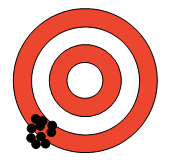
25.
This bullseye demonstrates...
a)
High Accuracy & High Precision
b)
High Accuracy & Low Precision
c)
Low Accuracy & High Precision
d)
Low Accuracy & Low Precision
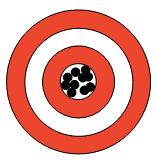
26.
?
a)
High Accuracy & High Precision
b)
High Accuracy & Low Precision
c)
Low Accuracy & High Precision
d)
Low Accuracy & Low Precision
27.
Archimedes used density to discover if the crown of gold was real because
a)
Substances have their own unique densities
b)
Substances can change densities depending on their size
c)
Substances can change densities depending on their mass
d)
Substances can change densities depending on their volume
28.

A control in an experiment is what we use to compare other variables to. In the fortune fish experiment, what was the control?

a)

The really wet hand.

b)

The moist hand.

c)

The normal, dry hand.

29.

Mass is______________

a)

The amount of matter, the amount of stuff something has.

b)

The amount of space something takes up.

c)

A triple beam balance.

30.

Volume is__________________

a)

The amount of matter, the amount of stuff, something has.

b)

The amount of space something takes up.

c)

graduated cylinder

31.

This tool is called a______________ it is used to measure________

a)

graduated cylinder, volume

b)

meter stick, distance

c)

triple beam balance, mass

32.

This tool is called a_____________it is used to measure___________

a)

graduated cylinder, volume

b)

meter stick, distance

c)

triple beam balance, mass

33.
What is the method that uses water to measure the volume of an object called?
a)
displacement
b)
displaced
c)
discontent
34.
What do you call the "dip" in the water of the graduated cylinder that we use to measure the volume of an irregular object?
a)
a measurement dip
b)
menicus
c)
eclipsis
35.
If you start with a water level at 150 mLs in a graduated cylinder & you drop in a stone and the level raises to 157 mLs, what is the volume of the stone?
a)
6 mLs
b)
7 mLs
c)
157 mLs
36.
If you start with 150 mLs in a graduated cylinder and add an irregular shaped object and the water level raises to 157.6 mLs, what is the volume of your irregular shaped object?
a)
7 mLs
b)
157.6 mLs
c)
7.6 mLs
37.
What label of measurement do we use when we measure the volume of an irregularly shaped object with water in a graduated cylinder?
a)
liters
b)
mili-liters
c)
kilo-liters
38.
How much water has been displaced in the image shown?
a)
40 mL
b)
65 mL
c)
20 mL
d)
25 mL
39.

What is the density of water?

a)

2 g/cm3

b)

1 g cm3

c)

1.2 g/cm3

d)

0.5 g/cm3

40.

How do you find the volume of a cube?

a)

Length times width times volume (LxWxV)

b)

Height times height times mass (HxHxm)

c)

Length times width times height (LxWxH)

d)

Width times height times density (WxHxD)

41.

Matter that has a definite shape and volume.

a)

solid

b)

gas

c)

liquid

d)

plasma

42.

A change from one phase of matter to another phase of matter is what kind of change?

a)

physical

b)

property

c)

chemical

d)

none of the above

43.

Matter in which the particles are free to move in all directions.

a)

solid

b)

gas

c)

liquid

d)

plasma

44.

Matter in which the particles slide past each other is?

a)

solid

b)

gas

c)

liquid

d)

plasma

45.

As a sample of matter is heated, what do the particles do?

a)

stop moving

b)

move more slowly

c)

move more quickly

d)

are not affected

46.

Properties that DO depend on the amount of matter present.

a)

Mass

b)

Hardness

c)

Extensive

d)

Intensive

47.

Properties that depend on the identity of substance.

a)

Mass

b)

Hardness

c)

Extensive

d)

Intensive

48.

Which of the following is an extensive property?

a)

Color

b)

Mass

c)

Odor

d)

Luster

49.

Which of the following is an extensive property?

a)

Hardness

b)

Boiling Point

c)

Density

d)

Weight

50.
Blue Color
a)
Physical Property
b)
Chemical Property
51.
Density
a)
Physical Property
b)
Chemical Property
52.
Flammability (burns)
a)
Physical Property
b)
Chemical Property
53.
Supports combustion
a)
Physical Property
b)
Chemical Property
54.
What is matter?
a)
a pure substance
b)
anything that occupies space and possesses mass
c)
an element
d)
a compound
55.
Which of the following is not a chemical property? 
a)
rusting 
b)
boiling 
c)
rotting 
d)
burning 
56.
Which one of these is a chemical property?
a)
melting point
b)
boiling point
c)
color
d)
flammability
57.
Ability to rust is this type of property:
a)
Physical property
b)
Chemical property
58.
Which is an example of a physical property?
a)
ability to react with acid
b)
 state of matter
c)
flammability
d)
ability to react with oxygen
59.
Which of the following is a chemical change?
a)
human digestion
b)
cutting a tree down
c)
melting a chocolate bar
d)
Has a density of 1 gm/mL
60.
What kind of properties can only be observed when a substance changes into a different substance?
a)
physical properties
b)
chemical properties
c)
liquid properties
d)
real properties
61.
Properties that can be observed without trying to change the identity of the substance.
a)
Physical
b)
Chemical
62.
2 NaBr + 1 Ca(OH)2 ----> 1 CaBr2 + 2 NaOH
a)
Synthesis (or combination)
b)
Decomposition
c)
Single displacement
d)
Double displacement
63.
2 NH3+ 1 H2SO4 ----> 1 (NH4)2SO4
a)
Synthesis (or combination)
b)
Decomposition
c)
Single displacement
d)
Double displacement
64.
3 Pb + 2 H3PO4 ----> 3 H2 + 1 Pb3(PO4)2
a)
Synthesis (or combination)
b)
Decomposition
c)
Single displacement
d)
Double displacement
65.
1 Li3N + 3 NH4NO3 ----> 3 LiNO3 + 1 (NH4)3N
a)
Synthesis (or combination)
b)
Decomposition
c)
Single displacement
d)
Double displacement
66.
3 HBr + 1 Al(OH)3 ----> 3 H­2O + 1 AlBr3
a)
Synthesis (or combination)
b)
Decomposition
c)
Single displacement
d)
Double displacement
67.
Pb + FeSO4 ----> PbSO4 + Fe
a)
Synthesis (or combination)
b)
Decomposition
c)
Single displacement
d)
Double displacement
68.
CaCO3 ----> CaO + CO2
a)
Synthesis (or combination)
b)
Decomposition
c)
Single displacement
d)
Double displacement
69.
P4 +  3 O2 ----> 2 P2O3
a)
Synthesis (or combination)
b)
Decomposition
c)
Single displacement
d)
Double displacement
70.
Provides evidence that a chemical reaction has occurred. 
a)
dissolving 
b)
melting
c)
formation of a gas
d)
bending
71.
Describes the number of atoms in a compound of each element. 
a)
coefficient 
b)
superscript 
c)
subscript 
d)
SI unit 
72.
Which of the following examples shows that a chemical reaction has occurred? 
a)
A rock breaks into smaller pieces when it is struck with a hammer.
b)
Rust forms on a hammer that has been left outside to long. 
c)
A cup of water turns pink when a few drops of red food coloring are added. 
d)
A solid is formed when heat is removed from a sample of water. 
73.
A student places a piece of a potato into a container of hydrogen peroxide. One observation the student makes is that bubbles form around the potato. The presence of bubbles might indicate the formation of a new substance because bubbles - 
a)
could show that a gas is forming
b)
always rise to the top of a liquid. 
c)
are almost always perfectly spherical.
d)
usually burst after a few minutes.
74.
Hydrogen peroxide breaks down to form water and oxygen gas. Which observation is evidence that a chemical reaction has occurred?
a)
The mass of the solution remains the same.
b)
 Phase changes are observed.
c)
 The color of the solution remains clear.
d)
The temperature of the solution increases. 
75.
A clear liquid from a flask is poured into another clear liquid in a beaker. Which of the following results of this procedure would indicate a new substance was formed?
a)
The level of the substance in the beaker is higher after the other liquid is added.
b)
A yellow solid forms and then settles to the bottom of the beaker.
c)
Small white crystals are left behind in the flask that held the first liquid.
76.
Which of the following is an example that includes evidence of a chemical reaction?
a)
A sample of zinc is placed in water and it settles to the bottom
b)
A solid block of ice is heated and it completely melts into a liquid. 
c)
Sugar that is burned gives off an odor and turns brown and then black.
d)
A tomato is placed into a blender and chopped up into smaller pieces.
77.

What are the products of the chemical reaction pictured?

a)

CH4 and CO2

b)

CH4 and O2

c)

CO2 and H2O

d)

O2 and H2O

78.
Consider the chemical equation CH4 + 2 O2 → CO2 + 2 H2O. In this equation, CH4 is a
a)
product
b)
reactant
c)
displacement
79.
What is the left part of a chemical equation called?
H2 + O → H2O
a)
Reactants
b)
Products 
c)
Yields 
d)
Chemical Equation 
80.
In chemical reactions, what does the principle of conservation of mass mean?
a)
Matter is not created or destroyed.
b)
The total mass of the reactants is greater than the total mass of the products.
c)
The total mass of the reactants is less than the total mass of the products.
d)
Matter is not changed.
81.
2H2 + O2 ----> 2H2O What is the product?
a)
------>
b)
2H2O
c)
2H2+ O2
82.
a)
element
b)
compound
c)
homogeneous mixture
d)
heterogeneous mixture
83.
Cl-Cl
a)
element
b)
compound
c)
homogeneous mixture
d)
heterogeneous mixture
84.
a)
element
b)
compound
c)
homogeneous mixture
d)
heterogeneous mixture
85.
a)
element
b)
compound
c)
homogeneous mixture
d)
heterogeneous mixture
86.
kool-aid with ice
a)
element
b)
compound
c)
homogeneous mixture
d)
heterogeneous mixture
87.
no pulp
a)
element
b)
compound
c)
homogeneous mixture
d)
heterogeneous mixture
88.
sulfur
a)
element
b)
compound
c)
homogeneous mixture
d)
heterogeneous mixture
89.
a)
element
b)
compound
c)
homogeneous mixture
d)
heterogeneous mixture
90.
Which scientist developed the atomic theory?
a)
JJ Thomson
b)
Ernest Rutherford
c)
John Dalton
d)
James Chadwick
91.
He developed the planetary model of the atom.
a)
Rutherford
b)
Bohr
c)
Chadwick
d)
Dalton
92.
What did Thomson discover?
a)
electron
b)
proton
c)
neutron
d)
electron cloud
93.

Subatomic particles with a negative charge

a)

Electrons

b)

Neutrons

c)

Protons

d)

Quarks

94.
Subatomic particles with a positive charge
a)
neutrons
b)
atomic mass
c)
protons
d)
isotopes
95.
Subatomic particles that are neutral in charge
a)
Neutrons
b)
Protons
c)
Nucleus 
d)
Electrons
96.
A tiny but very dense, positively charged portion of the atom that holds most of the atomic mass
a)
Electron Shells
b)
Orbitals
c)
Electron Cloud
d)
Nucleus
97.
Where electrons are likely to be found as they travel around the nucleus
a)
Nucleus
b)
Electron Cloud
c)
Within a Proton
d)
Within a Neutron
98.
The scientist responsible for "discovering" the nucleus is:
a)
Bohr
b)
Rutherford
c)
Schroedinger
d)
Einstein
99.

State the type of particles exist in calcium fluoride, CaF?

a)

atoms

b)

molecules

c)

ions

100.

Choose the correct statement.

a)

When a gas is heated, the kinetic energy of the particle increases and particles will vibrate faster.

b)

When a gas is heated, the kinetic energy of the particle decreases and particles will vibrate slower.

c)

When a gas is cooled, the kinetic energy of the particles decreases and particles will vibrate slower.

d)

When a gas is cooled, the kinetic energy of the particles increases and particles will vibrate faster.

101.

Diagram above are the representation for solid, liquid and gas. Identify X, Y and Z.

a)

X = solid

Y = liquid

Z = gas

b)

X = liquid

Y = solid

Z = gas

c)

X = gas

Y = liquid

Z = solid

d)

X = solid

Y = gas

Z = liquid

102.

____________________ has a fixed volume and fixed shape. The particles are closely packed and arranged in orderly arrangement.

a)

solid

b)

liquid

c)

gas

103.
What is the atomic number?
a)
number of protons
b)
number of neutrons
104.
Which element has 31 protons ?
a)
Gallium 
b)
Germanium
c)
Gadolinium
d)
Polonium
105.
What number indicates the nucleus?
a)
1
b)
2
c)
3
d)
4
106.
Oxygen’s atomic number is 8. This means that an oxygen atom must have
a)
8 electrons
b)
8 protons
c)
8 neutrons
d)
a mass number of 8
107.
Which statement best describes an electron?
a)
Smaller mass than a proton and a negative charge
b)
Smaller mass than a proton and a positive charge
c)
Greater mass than a proton and a negative charge
d)
Greater mass than a proton and a positive charge
108.
Which two particles make up the nucleus of an atom?
a)
Protons and Electrons
b)
Protons and Neutrons
c)
Molecules and Compounds
d)
Neutrons and Electrons
109.
The particles with no charge in an atom are the _______.
a)
electrons
b)
neutrons
c)
protons
d)
protons and neutrons
110.
The negatively charged particles of an atom are the ______.
a)
electrons
b)
protons
c)
neutrons
d)
protons & neutrons
111.
Most of the atom is filled with
a)
electrons
b)
empty space
c)
the nucleus
d)
protons
112.

What are the elements in group 1 (the far left) of the periodic table called?

a)

Alkali metals

b)

Alkaline earth metals

c)

Halogens

d)

Noble gases

113.

What are the elements in group 2 of the periodic table called?

a)

Alkali metals

b)

Alkaline earth metals

c)

Halogens

d)

Noble gases

114.

What are the elements in group 18 (the far right) of the periodic table called?

a)

Alkali metals

b)

Alkaline earth metals

c)

Halogens

d)

Noble gases

115.

What are the elements in group 17 of the periodic table called?

a)

Alkali metals

b)

Alkaline earth metals

c)

Halogens

d)

Noble gases

116.

What are the elements found along the "staircase" called? They have properties of both metals and non-metals.

a)

Metalloids

b)

Non-metals

c)

Transition metals

d)

Metals

117.

Hydrogen is a:

a)

Alkali metal

b)

Metalloid

c)

Non-metal

d)

Noble gas

118.

The horizontal rows on the periodic table are called:

a)

Shells

b)

Periods

c)

Groups

d)

Horizontals

119.

The total number of protons and neutrons in an atom's nucleus is equal to the:

a)

Atomic number

b)

Atomic mass

c)

Number of valence electrons

d)

Number of electron shells

120.

The vertical columns on the periodic table that have common properties are called

a)

Groups

b)

Periods

c)

Shells

d)

Valences

121.

The subatomic particles that are located the farthest from the nucleus are:

a)

Valence electrons

b)

Valence protons

c)

Periodic electrons

d)

Periodic protons

122.

The number of electron shells an atom has is equal to the element's:

a)

Period number

b)

Group number

c)

Valence number

d)

Atomic number

123.

The number of valence electrons an element has is equal to its:

a)

Period number

b)

Group number

c)

Valence number

d)

Atomic number

124.

The model of an atom that uses dots surrounding the atomic symbol to represent valence electrons is called the:

a)

Bohr Model

b)

Lewis Dot Structure

c)

Rutherford Model

d)

Thomson Model

125.
The first orbital can hold a maximum of how many electrons?
a)
2
b)
3
c)
8
d)
6
126.

An atom that has gained energy beyond normal is said to be ...

a)

excited

b)

energized

c)

naturalized

d)

grounded

127.

The rule that states: All orbitals of equal energy are occupied by one electron in one spin direction before any single orbital is occupied by a second electron.

a)

Aufbau principle

b)

Pauli exclusion principle

c)

Hund’s rule

d)

Core Notation

128.

How many orientations (m quantum number) can the d-orbital have?

a)

1

b)

3

c)

5

d)

7

129.

Which letter represents the principal quantum number?

a)

n

b)

l

c)

m

d)

ms

130.
What atom matches this electron configuration?
1s2s2p3s2
a)
Neon
b)
Magnesium
c)
Aluminum
d)
Potassium
131.

Which color has the highest frequency?

a)

red

b)

orange

c)

green

d)

blue

132.
The blue section of the wave is measuring _________________.
a)
wavelength
b)
crest
c)
trough
d)
amplitude 
133.
An electron occupies the lowest energy orbital that can receive it.
a)
Hund’s rule
b)
Pauli exclusion principle
c)
Bohr model of the atom
d)
Aufbau principle
134.
No two electrons in the same atom can have the same four quantum numbers.
a)
Aufbau principle
b)
Pauli exclusion principle
c)
Hund’s rule
d)
Noble gas notation
135.

Which sublevel will be filled FIRST?

a)

3p

b)

2s

c)

2p

d)

1s

136.

What do the superscripts (exponents) in the electron configuration mean? ex. 1s22s23p4

a)

Energy level

b)

Location of orbital

c)

Number of electrons

d)

Hund's Rule

137.

The relationship between wavelength & frequency is....

a)

Directly Proportional

b)

Indirectly Proportional

138.
What elements generally make an ionic bond?
a)
metal and nonmetal
b)
2 nonmetals
c)
metal
d)
none of the above
139.
What elements generally make a covalent bond?
a)
metal and nonmetal
b)
2 nonmetals
c)
metal
d)
none of the above
140.
In chemical compounds, covalent bonds form when
a)
the electronegativity difference between two atoms is very large.
b)
electrons are completely transferred between two metals.
c)
pairs of electrons are shared between two nonmetal atoms.
d)
two nonmetal atoms are attracted to each other by opposite charges.
141.
Predict the bond that will form between Be and F.
a)
Ionic
b)
Covalent
142.
Predict the bond that will form between Se and Cl
a)
Ionic
b)
Covalent
143.
What atom matches this electron configuration?
1s22s22p63s2
a)
Neon
b)
Magnesium
c)
Aluminum
d)
Potassium
144.
What happens when an atom loses an electron?
a)
It becomes Negatively Charged
b)
It remains neutral because the proton also leaves.
c)
It becomes Positively Charged
d)
It stays the same.
145.
The number of _____ is most important in determining how an atoms will bond. 
a)
Neutrons
b)
Protons
c)
Valence Electrons
d)
Electron sin the innermost shell
146.
If an oxygen atom has 8 protons (+) and 10 electrons (-), what is it's charge?
a)
O10-
b)
O8+
c)
O2-
d)
O10+
147.
How many valence electrons does helium need to have a filled outermost energy level?
a)
1
b)
2
c)
4
d)
8
148.
Why do atoms bond with each other? 
a)
To have the most electrons 
b)
To become stable 
c)
To gain protons 
d)
To be like the halogens 
149.
The number of bonds an element will form in a covalent compound will be equal to
a)
the number of valence electrons
b)
eight electrons
c)
the number of electrons needed to reach an octet
d)
the group number
150.

How many energy levels (rings) would you draw for potassium's Bohr diagram? (use your periodic table)

a)

19

b)

4

c)

1

d)

39

151.

How many electrons can the second shell hold on a Bohr diagram?

a)

2

b)

8

c)

18

d)

10

152.

Which is the correct Lewis Diagram of Silicon?

a)

A

b)

B

c)

C

d)

D

153.
How many p orbitals are there in a sublevel?
a)
2
b)
1
c)
4
d)
3
154.
How many electrons can the d sublevel hold?
a)
8
b)
10
c)
2
d)
4
155.
What is the shorthand electron configuration for Sulfur atom?
a)
[Ar] 3p4
b)
[He] 3s23p4
c)
[Ne] 3s23p4
d)
[Na] 3s23p3
156.
Which element is pictured?
a)
neon
b)
fluorine
c)
magnesium
d)
argon
157.
What noble gas should be used to write the shorthand configuration for Te?
a)
Ar
b)
Kr
c)
Xe
d)
Sb
158.
Identify the element in Period 5 that has 1 valence electron?
a)
Rb
b)
Nb
c)
Ag
d)
Sb
159.
Which of these is a property of metals?
a)
It's malleable
b)
It can't conduct electricity
c)
They are used in food
d)
It's very brittle
160.
What physical properties are used to classify elements as metals, non-metals, or metalloids?
a)
Color, smell, physical state
b)
Reactivity, streak, hardness
c)
Ability to burn, mass, density
d)
Luster, conductivity, malleability
161.
When an object changes shape when struck by a hammer.
a)
luster
b)
malleable
c)
brittleness
d)
ductile
162.
Describe what luster means
a)
How an object reflects light
b)
How soft an object is
c)
If an object floats
d)
If an object can be dug out of the earth.
163.

I am an insulator and have a dull luster.

a)

Metal

b)

Metalloid

c)

Non Metal

164.
Which of the following is NOT a characteristic of most metals?
a)
Brittle
b)
Good conductor
c)
Ductile
d)
Malleable
165.
Where are the non-metallic elements found in the periodic table?
a)
In the middle
b)
In the top rows
c)
On the left-hand side
d)
On the right-hand side
166.
Which elements are found on the left to middle of The Periodic Table? 
a)
Metals
b)
Nonmetals
c)
Metalloids
d)
Candles
167.
Which of these grouping of elements could have the characteristic of luster (shiny)?
a)
Metal
b)
Nonmetal
c)
metalloids
d)
Both metals and metalloids
168.
If a material can easily be drawn into the shape of a wire, it is
a)
Ductile
b)
Magnetic
c)
Malleable
d)
Reactive
169.
Which of the following is an Alkali Metal? 
a)
Magnesium
b)
Chromium
c)
Sodium
d)
Fluorine 
170.
Which of the following is an Alkaline Earth Metal? 
a)
Calcium
b)
Lithium
c)
Phosphorus
d)
Copper 
171.
Which of the following is a transition metal? 
a)
Iron
b)
Oxygen
c)
Neon
d)
Barium
172.
Which of the following is a Halogen? 
a)
Bromine
b)
Rubidium
c)
Argon
d)
Beryllium
173.
Which of the following is a Noble Gas? 
a)
Krypton
b)
Chlorine
c)
Radium
d)
Gallium
174.
Which of the following is the most reactive group of metals? 
a)
Alkali
b)
Alkaline Earth
c)
Halogen
d)
Transition Metals
175.
Which of the following is the most reactive group of non-metals? 
a)
Alkali
b)
Alkali Earth
c)
Halogen
d)
Noble Gas
176.
How many valence electrons does an alkaline earth metal have? 
a)
1
b)
2
c)
7
d)
8
177.
How many valence electrons does a halogen have? 
a)
1
b)
2
c)
7
d)
8
178.

Identify the following compound as ionic or covalent: MgO

a)

ionic

b)

covalent

179.

Identify the following compound as ionic or covalent: CF4

a)

ionic

b)

covalent

180.

Which of the following will form an anion?

a)

Titanium

b)

Iron

c)

Calcium

d)

Sulfur

181.

Which of the following will form a cation?

a)

Aluminum

b)

Sulfur

c)

Iodine

d)

Nitrogen

182.

Which of the following will form an anion?

a)

Oxygen

b)

Cobalt

c)

Strontium

d)

Cesium

183.

Which of the following will form a cation?

a)

Tellurium

b)

Iodine

c)

Nitrogen

d)

Nickel

184.
 Li2O
a)
Dilithium oxideDilithium oxide
b)
Lithium oxide
c)
Lithium dioxide
185.
CsCl
a)
Monocesium monochloride
b)
Cesium monochloride
c)
Cesium Chloride
186.
Which is most likely to form a negative ion?
a)
an element from group 17
b)
a metal
c)
an element from group 1
d)
an element with atoms that have eight valence electrons
187.
What is the correct formula for Sodium Oxide?
a)
NaO
b)
NaO2
c)
Na2O
d)
Na2O2
188.
Which of these compounds is ionic? 
a)
Carbon dioxide
b)
Dinitrogen Trioxide
c)
Silicon tetrachloride
d)
Lithium bromide
189.

An atom that has gained energy beyond normal is said to be ...

a)

excited

b)

energized

c)

naturalized

d)

grounded

190.
What is incorrect about this orbital diagram?
a)
Both arrows in the 2p box should be pointing up
b)
There is nothing incorrect with this diagram
c)
In the 2p box there should only be 1 electron in the first 2p box and one in the 2nd 2p box
d)
All the arrows should be pointing up.
191.
Which orbital shows a violation of Hund's Rule?
a)
A
b)
B
c)
C
d)
D
192.
Which orbital shows a violation of the Aufbau Principle?
a)
A
b)
B
c)
C
d)
D
193.
Which orbital shows a violation of the Pauli Exclusion Principle?
a)
A
b)
B
c)
C
d)
D
194.
A wave with a large wavelength will have a ______ frequency and _____ energy
a)
high, low
b)
high, high
c)
low, high
d)
low, low
195.

What is the saying that can help you remember the order of the visible spectrum?

a)

ROYGBIV

b)

RYOBIVG

c)

ROYBVIG

d)

RIBYOVG

196.
How many minutes are in a year?
a)
31,536,000 min
b)
525,600min
c)
52,560min
197.
The length of a desk is 3.5 feet. How many centimeters is the length? 
(there are 2.54 cm in an inch)
a)
60 cm
b)
120.23 cm
c)
106.68 cm
d)
117.12 cm
198.

How many kilograms of calcium are there in 173 pounds of calcium? (1 pound = 454 grams; 1 kg = 1000 g)

a)

1.10 kg

b)

78.5 kg

c)

110 kg

d)

78500 kg

199.
Gas costs $3.05 a gallon, and your car travels at 27 miles for each gallon of gas. How far can you travel in your car with $95 in your pocket?
a)
11 miles
b)
840 miles
c)
7800 miles
d)
870 miles
200.

A bicycle has a speed of 6.00 m/s. What is its speed in km/h?

a)

21.6 km/h

b)

16.67 km/h

c)

2.16 km/h

d)

1.67 km/h