
 Worksheets
Electrons and Electricity
Total questions: 30
Worksheet time: 37mins
Name
Class
Date
1.
The flow of electricity in a circuit-
a)
current
b)
flow
c)
circuit
2.
Electricity that flows in a closed path is called a
a)
path
b)
current
c)
circuit
3.
To complete a circuit the switch must be
a)
unattached
b)
open
c)
closed
4.
Two batteries in a circuit make the lights in the circuit brighter than one battery.
a)
true
b)
false
5.
If the lights are on, the circuit is
a)
closed
b)
open
6.
If the lights are off, the circuit is
a)
closed
b)
open
7.
In a parallel circuit the current
a)
makes one circle
b)
stays in one path
c)
splits and goes through two components
8.
Two types of circuits are
a)
parallel and magnetic
b)
electromagnetic and series
c)
series and parallel
9.
The flow of electricity requires a
a)
complete path
b)
incomplete path
c)
insulated current
10.
When socks get stuck to towels in your dryer, this is an example of________________
a)
current electricity
b)
static electricity
11.
What is the major difference between static electricity and current electricity?
a)
Current electricity involves a continuous flow of neutrons; static electricity is a sudden transfer of protons
b)
Current electricity can be deadly; static electricity is almost always safe
c)
In current electricity, there's a single transfer of electrons; in static electricity, there's a steady flow of electrons
d)
Current electricity involves a flow of electrons; static electricity involves a single transfer of electrons
12.

This is an example of a _______ circuit
a)
open
b)
series
c)
parallel
d)
square
13.
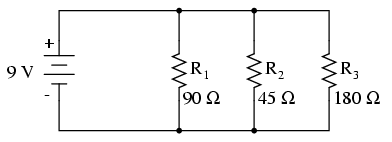
This is an example of a ______ circuit
a)
Series
b)
Parallel
c)
Open
d)
Dihexihedral
14.
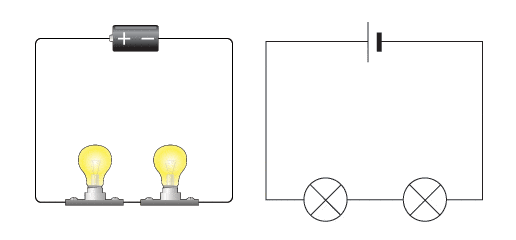
What kind of circuit is this?
a)
Series
b)
Consecutive
c)
Parallel
d)
Training
15.

What kind of circuit is this?
a)
Series
b)
Consecutive
c)
Parallel
d)
Training
16.

What kind of circuit is this?
a)
series
b)
parallel
17.
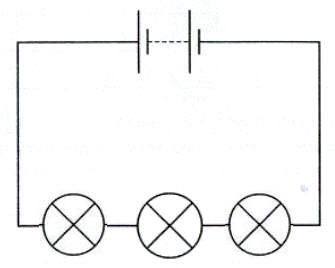
what kind of circuit is this?
a)
parallel
b)
series
c)
chris barton
d)
open
18.
This circuit has more than one loop. When one light goes out, the others stay on.
a)
closed circuit
b)
series circuit
c)
parallel circuit
d)
open circuit
19.
What size resistor would produce a 3 Amp current flow with a 12 Volt battery
a)
1 Ohm
b)
3 Ohms
c)
4 Ohms
d)
12 Ohms
20.
What is current measured in?
a)
Ω (Ohms)
b)
V (Volts)
c)
A (Amps)
d)
W (Watts)
21.
What is resistance measured in?
a)
Ω (Ohms)
b)
V (Volts)
c)
A (Amps)
d)
W (Watts)
22.
What is Resistance?
a)
The flow of electrons
b)
Electric potential difference
c)
A battery
d)
The ability to reduce the flow of electrons
23.
What types of charges attract?
a)
Positive and Positive
b)
Positive and Neutral
c)
Negative and Neutral
d)
Positive and Negative
24.
What is the Voltage of a circuit that has a resistance of 5 Ω and a current of 2 A?
a)
25 V
b)
10 V
c)
2.5 V
d)
0.4 V
25.
The mathematical relationship among Voltage, Current, and Resistance
a)
Faraday's Law
b)
Tesla's Law
c)
Edison's Law
d)
Ohm's Law
26.
Current times Resistance equals
(I X R)
(I X R)
a)
Power
b)
Voltage
c)
Amperage
d)
Ohm
27.
If the Voltage is increased and the resistance stays the same, Current will
a)
Increase
b)
Decrease
c)
Stay the same
d)
X
28.
If the Voltage stays the same and Resistance is increased, Current will
a)
Increase
b)
Decrease
c)
Stay the same
d)
X
29.
What word means how hard it is for electrons to flow through.
a)
Current
b)
Voltage
c)
Resistance
d)
Power
30.
What word means how fast the electrons flow.
a)
Current
b)
Voltage
c)
Resistance
d)
Power
100 %

