
 Worksheets
Nwea Science Review
Total questions: 31
Worksheet time: 18mins
Name
Class
Date
1.
The basic unit of structure and function in all living things.
a)
chloroplast
b)
nucleus
c)
cell
d)
cell membrane
2.
Plants perform photosynthesis through this organelle. It captures energy from the sun and uses it to produce food for the cell.
a)
Chlorophyll
b)
Chloroplasts
c)
Mitochondria
d)
Golgi Apparatus
3.
This structure is in plant cells but not animal cells. It is outside of the cell membrane and adds more support/structure/rigidity to the plant.
a)
Cell membrane
b)
Cell Nucleus
c)
Cell Wall
d)
Endoplasmic Reticulum
4.
Behavioral changes of individuals of a species that allow for better survival. (Acquired traits)
a)
Variation
b)
Adaptation
c)
Behavior
d)
Environment
5.
Where the better adapted organisms survive to pass traits along to offspring.
a)
Evolution
b)
Natural Selection
c)
Extinction
d)
Artifical Selection
6.
The theory of evolution by natural selection means that what is changing over time?
a)
The inherited traits of a population.
b)
The acquired traits of a population.
c)
Hair color and eye color
d)
Attractive features.
7.
Why are advantageous traits more likely to be passed onto offspring?
a)
Because they are more likely to survive and reproduce.
b)
Because they come from dominant alleles.
c)
Because they come from recessive alleles.
d)
Because the trait is an acquired phenotype.
8.
What type of galaxy do we live in?
a)
Spiral
b)
Elliptical
c)
Irregular
d)
Coaxial
9.
Galileo proposed that our galaxy is heliocentric. What does this mean?
a)
the sun is the outermost edge of our galaxy
b)
the Earth is the center of our galaxy
c)
the sun is the center of our galaxy
d)
the Earth is the outermost edge of our galaxy
10.
Which of the following is the smallest?
a)
The Milky Way Galaxy
b)
A red giant star
c)
The moon
d)
Jupiter
11.
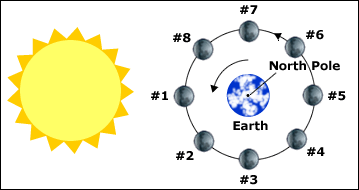
What phase is the moon when in position #1?
a)
New Moon
b)
First Quarter
c)
Full Moon
d)
Third Quarter
12.

What happens when the area in which you live tilts away from the sun?
a)
It is summer because the hemisphere is receiving more direct sunlight
b)
It is summer because the hemisphere is receiving indirect sunlight.
c)
It is winter because the hemisphere is receiving indirect sunlight.
d)
It is winter because the hemisphere is receiving direct sunlight.
13.

Why does the area around the equator stay the same temperature all year?
a)
The equator rotates slower than the poles.
b)
The equator remains the same distance from the sun.
c)
The equator always receives direct sunlight.
d)
The equator has 18 hour days.
14.
The Northern Hemisphere gets __________ sunlight in the summer, which leads to _________ temperatures.
a)
less direct, hotter
b)
less direct, colder
c)
more direct, hotter
d)
more direct, colder
15.
During which season is the sun's path in the sky the shortest?
a)
Summer
b)
Winter
c)
Spring
d)
Fall
16.
Which of the following is where one plate slides under another plate?
a)
submarine zone
b)
divergence zone
c)
subduction zone
d)
lower zone
17.
Oceanic crust is.....
a)
Younger and less dense than continental crust
b)
Thinner, younger, and more dense than continental crust
c)
older, thicker, and less dense than continental crust
d)
Bigger and younger than continental crust
18.
Plate movement is caused by _____
a)
The rotation of the Earth
b)
Ocean tides
c)
Convection current in the mantle
d)
The moon's gravity
19.
What type of boundary creates a new seafloor?
a)
convergent continental to continental
b)
convergent ocean to continental
c)
convergent ocean to ocean
d)
divergent
20.
What is condensation?
a)
The part of the water cycle when the sun heats up water, turning it from a liquid into water vapor or steam. It rises from the ground into the air.
b)
The part of the water cycle when the water vapor in the air gets cold. The water turns back into a liquid and forms clouds.
c)
The part of the water cycle when clouds get heavy and can no longer hold the liquid water. This causes the water to fall from the sky to the earth as rain, snow, sleet, or hail.
21.
Located at the leading edge of a temperature drop off. Bring heavy thunderstorms, rain, and hail. Cool, fair weather is likely to follow.
a)
Warm Front
b)
Cold Front
c)
Occluded Front
d)
Stationary Front
22.
Why are there global winds?
a)
because the cold air sinks from the poles to the equator
b)
because the earth is rotating from east to west
c)
because the sun heats the air at the equator more than anywhere else on earth
23.
a physical law stating that an object tends to stay at rest and an object moving in a straight line at a constant speed tends to continue moving that way
a)
Newton's 1st Law
b)
Newton's 2nd Law
c)
Newton's 3rd Law
24.
If you know the speed and direction of an object, then you also know the _______________________________ of the object.
a)
acceleration
b)
speed
c)
velocity
25.
A student claims that unbalanced forces acting on an object in motion can cause all of the following results: • The object could stop moving • The object could speed up • The object could change directions The best evaluation of this student’s claims is that -
a)
none of the claims is true.
b)
one of the claims is true.
c)
two of the claims are true.
d)
all of the claims are true.
26.

Two horses pull in opposite directions, but together move in the direction shown. Which of the following best describes the forces being applied in this situation?
a)
The forces are balanced, and the net force is zero
b)
The forces are unbalanced, and the force of Horse 1 is greater
c)
The forces are unbalanced, and the force of Horse 2 is greater
d)
The forces are balanced, and the force of Horse 1 is greater
27.

Which explains why the fork looks different under water?
a)
light can't pass through the glass
b)
the wavelength of light lengthens
c)
the amount of light increases when going through water
d)
light is refracted at an angle
28.

______ is a lens that is thicker on its edges and makes an object appear smaller?
a)
mirror
b)
convex lens
c)
concave lens
d)
prism
29.
Energy due to motion is ____________ energy.
a)
Potential
b)
Energy
c)
Kinetic
d)
Friction
30.
__________ is stored energy.
a)
Potential
b)
Kinetic
c)
None of the above
d)
All of the above
31.
Gravitational potential energy depends on the ________ and ________ of the object.
a)
Height and mass
b)
Friction and movement
c)
Mass and Movement
d)
Height and Friction
100 %

