Wayground logo

Free Printable Worksheets

Font size

S
M
L
XL
Worksheets

Ib Photosynthesis and Their Labs

Total questions: 25

Worksheet time: 16mins

Name
Class
Date
1.
What is the function of NADP+?
a)
It absorbs light
b)
It is an electron carrier
c)
It is a light-reflecting pigment
d)
It acts as long-term energy storage
2.
Which of the following molecules is not needed for the Calvin Cycle?
a)
CO2
b)
ATP
c)
NADPH
d)
H2O
3.
What supplies the electrons that are lost in PS I?
a)
the electrons from PS II
b)
water
c)
glucose
d)
oxygen
4.
What is the primary function of the light reactions of photosynthesis?
a)
To produce glucose
b)
To produce NADPH and ATP
c)
To use ATP
d)
To produce RuBP
5.
What is one function of the other pigments  besides chlorophyll, in the chloroplast?
a)
to block damaging wavelengths of light
b)
to absorb different wavelengths than the chloroplasts
c)
to provide different colors to the leaves
d)
to transfer energy to a separate photosystem beside the one using chlorophyll a and b.
6.

The light-dependent reactions occur in the ________ and the light-independent reactions take place in the ________.

a)

Chloroplast / thylakoid membrane

b)

stroma / thylakoid

c)

mesophyl / stomata

d)

thylakoid membrane / stroma

7.
Where does the Calvin cycle take place?
a)
stroma of the chloroplast
b)
thylakoid membrane
c)
outer membrane of the chloroplast
d)
interior of the thylakoid membrane
8.
When oxygen is released as a result of photosynthesis, it is a direct by-product of
a)
reducing NADP+
b)
splitting water molecules
c)
chemiosmosis
d)
electron transfer in photosystem II and I
9.
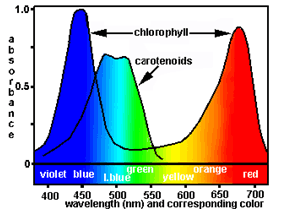
Plants with the largest amount of which pigment will be best suited for growing conditions where light has a green hue.
a)
Chlorophyll A
b)
Chlorophyll B
c)
Carotenoids
d)
A combination of all 3
10.
How many sugar molecules are produced from every six molecules of carbon dioxide that enter the Calvin cycle?
a)
1
b)
3
c)
6
d)
12
11.
The H+ concentration gradient is used to 
a)
make NADPH
b)
split a water molecule
c)
generate ATP
d)
form water
12.
When carbon first enters the Calvin cycle, what molecule does it combine with? 
a)
PGA
b)
G3P
c)
RuBP
d)
ATP
13.
What does ATP synthase do?
a)
Create ATP in chemiosmosis.
b)
Break down ATP in chemiosmosis.
c)
Break down NADPH. 
d)
Create NADPH.
14.
Where is chlorophyll found in the chloroplast?
a)
in the stroma
b)
within photosystems
c)
in the ATP synthase
d)
in the electron carrier molecule
15.
Which of the following is the correct equation for PHOTOSYNTHESIS?
a)
CO2 + light + H2O --> O2 + glucose
b)
CO2 + glucose + H2O --> O2 + light
c)
O2 + light + H2O --> CO2 + glucose
d)
CO2 + O2 + H2O --> Light+ glucose
16.
Which substance from the light-dependent reactions of photosynthesis is a source of energy for the light-independent reactions?
a)
ADP
b)
H2O
c)
NADPH
d)
pyruvic acid
17.

Plants use the following reactants for the light reaction

a)

Water and CO2

b)

Water and NADPH

c)

Water and NADP+

d)

NADPH and ATP

18.

Rubisco is important in which step of photosynthesis

a)

energizing the electrons in chlorophyll

b)

carbon fixation when CO2 is connected to RUBP during calvin cycle

c)

regeneration phase as RUBP is made during calvin cycle

d)

reduction of the carbon chain during the calvin cycle

19.

If the proton (H+) pump in the thylakoid was not working which molecule could not be made during the light reaction?

a)

NADPH

b)

ATP

c)

Water

d)

Oxygen gas

20.

The NADP+ is

a)

oxidized during the light reaction

b)

reduced during the light reaction

c)

oxidized during the Calvin cycle

d)

reduced during the Calvin cycle

21.

Which of the following would have the least affect on photosynthetic rate?

a)

increase the temp from 20 C to 30 C

b)

increasing the CO2 from 400 ppm to 600ppm

c)

increasing the light intesity from 40 Watts to 60 Watts

d)

increasing the amount of O2 from 20% to 30% in the air

22.

ATP is made during the light reaction using all of the following EXCEPT

a)

proton pump

b)

hydrogen ion gradient

c)

electron energy from photosystem II

d)

NADPH donating electrons

23.

During noncyclic photophosphorylation all of the following occur EXCEPT

a)

ATP is made using electron energy that will leave on NADPH

b)

results in oxygen gas being produced

c)

water is split (photolysis)

d)

electrons from photosystem 1 return back to photosystem 1

24.

Where are the light-dependent and light-independent reactions taking place in the diagram below?

a)
b)

B

c)

C

d)

D

25.

What is chemiosmosis?

a)

Coupling of ATP synthesis to the electron transport and proton movement

b)

Phosphorylation of glucose in the mitochondrial matrix

c)

H+ ions moving down a concentration gradient into the mitochondrial matrix

d)

Activation of ATPase in order to synthesize ATP