
 Worksheets
Model Chemistry
Total questions: 21
Worksheet time: 15mins
Name
Class
Date
1.

In the atomic model nicknamed the "plum pudding" model, what do the plums represent?
a)
the nucleus
b)
the atom
c)
the electrons
d)
the positive material
2.
Which scientist proposed a new atomic model after discovering the electron in 1897?
a)
Dalton
b)
Thomson
c)
Rutherford
d)
Bohr
3.
Who discovered that atoms are mostly empty space?
a)
Dalton
b)
Thomson
c)
Rutherford
d)
Bohr
4.
Who proposed that electrons move around the nucleus in circular orbits?
a)
Dalton
b)
Thomson
c)
Rutherford
d)
Bohr
5.
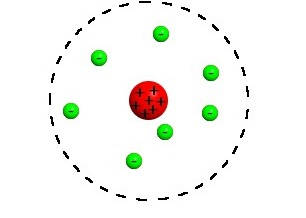
This model this model was the first to show a nucleus, consisting of protons and neutron. Electrons surround the nucleus but are not shown in distinct energy levels.
a)
The "Rutherford Model" of the atom
b)
The "Plum Pudding Model" of the atom
c)
The "Quantum Mechanical Modell" of the atom
d)
Democritus's model of the atom
6.

This was the first model of the atom ever proposed. It was simple and described atoms as tiny spheres that could not be broken down into smaller pieces.
a)
Democritus's model of the atom
b)
The "Plum Pudding Model" of the atom
c)
The "Rutherford Model" of the atom
d)
The "Quantum Mechanical Model" of the atom
7.

This model added on to previous models by showing electrons existed at certain "energy levels". However it does not accurately show what those levels look like.
a)
The "Bohr Model" of the atom
b)
The "Rutherford Model" of the atom
c)
The "Plum Pudding Model" of the atom
d)
The "Quantum Mechanical Model" of the atom
8.

This model was developed after J.J. Thompson discovered electrons, a particle smaller than an atom. Is shows electrons floating freely in a positive space.
a)
The "Plum Pudding Model" of the atom
b)
The "Rutherford Model" of the atom
c)
Democritus's model of the atom
d)
The "Quantum Mechanical Model" of the atom
9.

What does the nucleus of an atom contain?
a)
Electrons & Neutrons
b)
Protons & Neutrons
c)
Neutrinos & Positrons
10.

Ernest Rutherford discovered that atoms were mostly _________________.
a)
negatively charged
b)
positively charged
c)
electrons
d)
empty space.
11.
In the gold foil experiment, most of the positively charged alpha particles passed through the gold foil, but some were deflected or bounced back. What did we conclude because of this?
a)
Atoms are small indivisible spheres
b)
Atoms are mostly empty space with a small, dense, positive center
c)
Atoms have negatively charged particles which orbit the nucleus
d)
Light is a wave, not a particle
12.
Idea was of an indivisible particle of matter he called "atomos"
a)
John Dalton
b)
Aristotle
c)
Democritus
d)
Plato
13.
He discovered the neutron in the nucleus and completed the current atomic model.
a)
J.J. Thomson
b)
Ernest Rutherford
c)
Niels Bohr
d)
James CHadwick
14.
He found that atoms have smaller parts and found negative electrons that he theorized were surrounded in a sphere of positive charges
a)
J.J. Thomson
b)
Ernest Rutherford
c)
Niels Bohr
d)
James Chadwick
15.
He found the positively charged protons in the nucleus and said that electrons moved around the nucleus
a)
J.J. Thomson
b)
Ernest Rutherford
c)
Niels Bohr
d)
James Chadwick
16.
He found that electrons have specific amounts of energy and move in specific orbits around the nucleus, like planets orbiting the sun.
a)
J.J. Thomson
b)
Ernest Rutherford
c)
Niels Bohr
d)
James Chadwick
17.
The atomic particle with no charge is the...
a)
proton
b)
neutron
c)
electron
d)
nucleus
18.
The atomic particle with a positive charge is the...
a)
proton
b)
neutron
c)
electron
d)
nucleus
19.
The atomic particle with a negative charge is the...
a)
proton
b)
neutron
c)
electron
d)
nucleus
20.
The smallest part of the element with the properties of the element is the...
a)
electron
b)
quark
c)
atom
d)
proton
21.

Which is an electron?
a)
A
b)
B
c)
C
100 %

