
NEW
Font size
 Worksheets
Earthquakes P Waves S Waves
Total questions: 35
Worksheet time: 28mins
Which type of wave arrives to a seismic station first?
Primary Waves (P-Waves)
Secondary Waves (S-Waves)
Rayleigh Waves
Love Waves

What is the name for the area beneath the Earth's surface where an earthquake begins?
epicenter
focus
fault line
tectonic plate


These are the secondary waves to be released. They cannot travel through the liquid outer core
S waves
Surface Waves
P waves
What is the name of the area on the surface where an earthquake starts?
focus
epicenter
p waves
plate boundary
A diagram of earthquake motion is called a ___________________.
seismograph
seismogram
seismologist
seismometer

What are the "waves" called that come from an earthquake?
Thunder
Seismic
Lava

Rank the seismic waves in order of appearance when an earthquake first occurs as measured by a seismograph.
S waves, P waves, then surface waves
P waves, S waves, then surface waves
S and P waves at the same time, then surface waves
Surface waves, then S and P waves at the same time
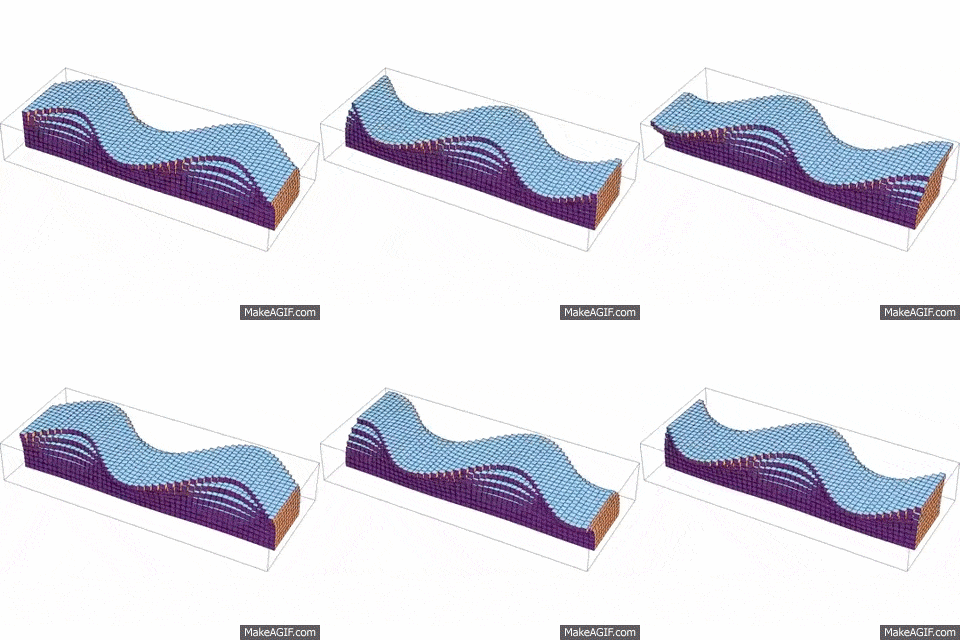
Main type of waves that can travel the earth`s inner layer.
surface waves
body waves
Love waves
Rayleigh waves
Main type of seismic waves that can only travel through the surface of the Earth.
seismic waves
surface waves
body waves
primary waves
Two types of surface waves
Love waves and Rayleigh Waves
P waves and S waves
Two types of body waves
Love waves and Rayleigh waves
P waves and S waves
They are the scientists who study earthquakes.
Seigmographists
Seismologists
Seismologihists
Seismogists
As the distance from the epicenter decreases, the time interval between the arrival of the P-waves and the S-waves on the seismograph will _________________
decrease
increase
remain the same
zero

Which of the statements best describes the relationship between the P and S wave interval (lag time) and distance from epicenter?
The longer the lag time, the closer the distance.
The longer the lag time, the farther the distance.
The shorter the lag time, the farther the distance.
There is no relationship.
To locate the epicenter of an earthquake how many seismographs are needed?
1
2
3
4

If the half life of a radioactive element is 100yrs, how long would it take for the radioactivity to reduce by one half?
200yrs
100yrs
50yrs
300yrs
What is Half-life?
The amount of time it takes for some of the atoms in a sample to decay.
The amount of time it takes for an atom to break in half.
The amount of time it takes for half the atoms in a sample to decay.
the amount of time it takes for double the atoms in a sample to decay
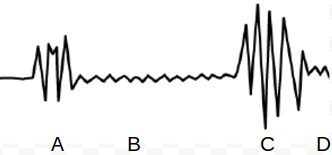
Where are the S-waves located on this seismogram?
A
B
C
D

Generally speaking, the further underground an object is located, the
younger it is
smaller it is
bigger it is
older it is
none of the above
Suppose you have a 24 atom sample. How many atoms would be left after one half-live? After two half-lives? After three half-lives?
8; 4; 2
12; 6; 3
24; 12; 8
24; 12; 6
All plants and animals contain carbon.
True
False
_______________is the method of determining the ages of rocks.
radioactive dating
carbon-14 dating

Challenge Question! The graph shows the radioactive decay of a 50-gram sample of a radioactive isotope.
According to the graph, what is the half-life of this isotope?
100 years
150 years
200 years
300 years

