
NEW
Font size
S
M
L
XL
 Worksheets
Correlation
Total questions: 40
Worksheet time: 1hrs 5mins
Name
Class
Date
1.
States that younger rocks lie above older rocks if the layers have not been disturbed
a)
Law of crosscutting
b)
Law of superposition
c)
Relative Dating
d)
Unconformity
2.

Analyze the seashell found in the white layer. Which statement is true of the rock layer that contains this fossil?
a)
It could also contain a fossil from the bottom layer.
b)
It is older than the layers below it.
c)
It is younger than the layers above it.
d)
It is older than the layers above it.
3.
How do geologists use relative dating?
a)
Placing rocks in order from youngest to oldest
b)
Placing rocks in order by minerals they contain
c)
Classifying rocks by different textures
d)
Classifying rocks by different isotopes
4.

Could the shell be considered an index fossil in this diagram?
a)
Yes
b)
No
5.

Could the Trilobite be considered an index fossil in this diagram?
a)
Yes
b)
No
6.

The process by which running water, wind, or ice carry away bits of broken-up rock
a)
weathering
b)
sedimentation
c)
erosion
d)
cementation
7.

To be considered an index fossil, it had to have lived for a relatively short period of time.
a)
True
b)
False
8.

How have the rocks been disturbed?
a)
tilting
b)
folding
c)
faulting
d)
igneous intrusion
9.

How have the rocks been disturbed?
a)
tilting
b)
folding
c)
faulting
d)
igneous intrusion
10.

How have the rocks been disturbed?
a)
tilting
b)
folding
c)
faulting
d)
igneous intrusion
11.

How have the rocks been disturbed?
a)
tilting
b)
folding
c)
faulting
d)
igneous intrusion
12.
What do you call the preserved remains or evidence of once-living organisms?
a)
Leftovers
b)
Fossils
c)
Minerals
d)
Rocks
13.
You can match up fossils and rocks in different places on the globe using what technique?
a)
Law of Deposition
b)
Correlation
c)
Look-alikes
d)
Law of Horizontality
14.
An organism that only lived once and for a short amount of time before going extinct is called:
a)
Endangered Species
b)
Index Fossil
c)
Intrusion
d)
T-Rex
15.
What was the name of the supercontinent our modern-day continents broke away from?
a)
Superzoic
b)
Rodinia
c)
Gigantica
d)
Pangaea
16.

Index fossils CAN tell us the age of a rock layer.
a)
True
b)
False
17.

On top of Mt. Everest, there are fossilized remains of sea life; this tells us that the rocks at the top of world's highest mountain
a)
used to be above sea level
b)
used to be below sea level
c)
used to be on Mars
d)
came from an asteroid
18.

Which fossil could be classified as an index fossil?
a)
Fossil 1
b)
Fossil 2
c)
Fossil 3
d)
Fossil 4
19.

In the diagram there are 4 outcrops or 4 different locations for rock layers shown. Fossils are found at all 4 locations. Looking at the diagrams, which letter (A, B, C, or D) most likely represents an index fossil?
a)
A
b)
B
c)
C
d)
D
20.
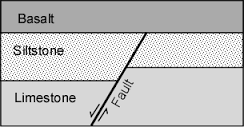
What are the relative ages of the features in order from oldest to youngest?
a)
Limestone, Basalt, Fault, Siltstone
b)
Siltstone, Fault, Basalt, Limestone
c)
Limestone, Fault, Basalt, Siltstone
d)
Limestone, Siltstone, Fault, Basalt
21.

According to the law of superposition, the oldest fossils are found
a)
At the top of the rock layers
b)
Near the bottom of the rock layers
c)
In the middle of the rock layers
d)
Somewhat near the surface
22.

According to the law of superposition, which layer is the youngest?
a)
A
b)
B
c)
C
23.

Which rock layer is the oldest?
a)
A
b)
B
c)
C
d)
E
24.

Which layer is the youngest?
a)
A
b)
B
c)
C
d)
E
25.

A scientist says that layers Y and M are the same age. How does he know this?
a)
They are found in the same type of rock.
b)
They are the lowest layers.
c)
They have the same type of fossil.
d)
They are near each other.
26.

Put the following 3 in order from oldest to youngest: the fault-E, the intrusion-D, layer A?
a)
A-D-E
b)
D-E-A
c)
A-E-D
d)
E-D-A
27.

Which fossil would make a good index fossil?
a)
A
b)
B
c)
C
d)
D
28.

What is the correct order of the rock layers from oldest to youngest?
a)
F, E, C, B, A, D
b)
A, B, C, D, E, F
c)
F, E, D, C, B, A
d)
D, F, E, C, B, A
29.

Scientists know that the Igneous intrusion is younger than the gravel layer because of_____?
a)
The law of superpositon
b)
The law of cross cutting
c)
The law of relative dating
30.

An archaeologist made the following diagram of a dig site. What can be said about the pottery as compared to the skull found in the site?
a)
The rock layer with the pottery is more recent than the rock layer with the skull.
b)
The rock layer with the skull is more recent than the rock layer with the pottery.
c)
The rock layer with the skull is approximately the same age as the rock layer with the pottery.
d)
The rock layer with the skull has an absolute date of 17,000 years.
31.
Faults are younger than the rocks they cut. True or False
a)
True
b)
False
32.
Most fossils are found in __________ rock layers
a)
metamorphic
b)
sedimentary
c)
igneous
33.

The rock formation labeled "P" is a(n)...
a)
fault
b)
intrusion
c)
inclusion
d)
unconformity
34.

What is the last event to happen?
a)
Deposition of Breccia
b)
Igneous Intrusion
c)
Faulting
d)
Deposition of Limestone
35.

Which layer is OLDER? Layer M or Intrusion P?
a)
Layer M
b)
Intrusion P
36.

Which layer is OLDER? Fault E or Intrusion D?
a)
Fault E
b)
Intrusion D
37.

Which layer is OLDER? Intrusion M or Layer D?
a)
Intrusion M
b)
Layer D
38.

Which layer is the oldest?
a)
A
b)
B
c)
C
d)
D
39.

Which layer is the youngest?
a)
D
b)
C
c)
A
d)
B
40.

Which of the following is tue?
a)
A fault is younger than the rock layers that it goes through.
b)
A fault is older than the rock layers that it goes through.
c)
The rock layers are younger than the fault that cuts through it.
Reset

