
 Worksheets
Sun, Earth, Moon Review
Total questions: 36
Worksheet time: 1hrs 21mins
Name
Class
Date
1.
The spinning of an object on its axis is called______
a)
orbit
b)
rotation
c)
revolution
d)
tide
2.
Day and night is caused by the _____________ of earth on its axis.
a)
revolution
b)
orbit
c)
rotation
d)
apparent motion
3.
The earth revolves around...
a)
the sun.
b)
the moon
c)
other planets
d)
It's axis
4.
About how long does it take the Earth to make one REVOLUTION around the Sun?
a)
12 hours
b)
24 hours
c)
365 days
d)
29.5 days
5.
Why does the same side of the moon always face the Earth?
a)
The moon's revolution and rotation take about the same time
b)
The moon revolves but does not rotate
c)
The dark side can't have light on it
d)
The Earth doesn't move fast enough to see the dark side of the moon
6.

Which of these best shows that the Earth revolves around the sun as the moon revolves around the Earth?
a)
Picture A
b)
Picture B
c)
Picture C
d)
Picture D
7.
The moon's revolution around the Earth, and the Earth's revolution around the Sun, can be best described as a(n) ____________________.
a)
parallelogram
b)
circle
c)
ellipse
d)
curve
8.
How long does it take for Earth to rotate on its axis one time?
a)
24 hours
b)
24.25 hours
c)
365 days
d)
365.25 days
9.
What are the reasons for the seasons?
a)
Earth's tilt and rotation.
b)
Earth's rotation and revolution.
c)
Earth's tilt and revolution.
d)
Earth's tilt and revolution
10.

At position D in the Northern hemisphere it would be _____?
a)
Summer
b)
Winter
c)
Spring
d)
Fall
11.

What season is it in the Northern Hemisphere at letter A?
a)
Winter
b)
Summer
c)
Spring
d)
Fall
12.

When the Northern Hemisphere of Earth is Leaning away from the Sun, What season is the Southern Hemisphere experiencing?
a)
Summer
b)
Winter
c)
Spring
d)
Fall
13.

What is the name of the imaginary line running through the North Pole to the South Pole?
a)
orbit
b)
axis
c)
equator
d)
latitude
14.
What degree is the earth tilted?
a)
23
b)
25
c)
23.5
d)
25.5
15.

At position A, what season would it be in the southern hemisphere?
a)
winter
b)
summer
c)
fall
d)
spring
16.
What is the longest day of the year?
a)
winter solstice
b)
summer solstice
c)
fall equinox
d)
spring equinox
17.
The first day of fall, when night and day are equal is called ___________________.
a)
Autumnal Equinox
b)
Summer Solstice
c)
Winter Solstice
d)
Vernal Equinox
18.

Why does the area around the equator stay the same temperature all year?
a)
The equator rotates slower than the poles.
b)
The equator remains the same distance from the sun.
c)
The equator always receives direct sunlight.
d)
The equator has 18 hour days.
19.

What phase comes BEFORE this one?
a)
New Moon
b)
Third Quarter
c)
Waxing Crescent
d)
Full Moon
20.

What Moon phase is this?
a)
Last Quarter
b)
New Moon
c)
Third Quarter
d)
First Quarter
21.

What Moon phase is this?
a)
Waning Crescent
b)
Waxing Crescent
c)
Waxing Gibbous
d)
Waning Gibbous
22.

What Moon phase is this?
a)
Waxing Crescent
b)
Waning Gibbous
c)
Waxing Gibbous
d)
Waning Crescent
23.
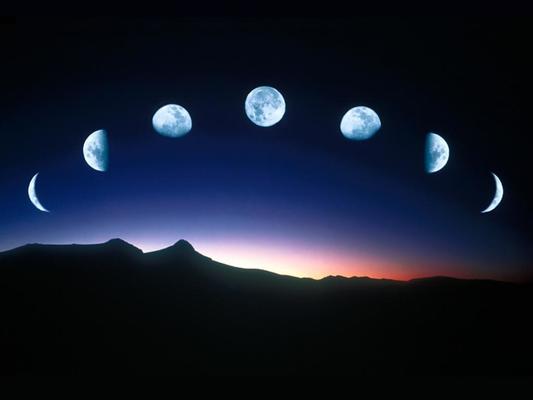
When the moon waxes, it ________.
a)
goes from a new moon to a full moon
b)
makes a full orbit around the Earth
c)
goes from a full moon back to a new moon
d)
Eclipses the Eath
24.

When the moon wanes, it ________.
a)
goes from a new moon to a full moon
b)
goes from a full moon back to a new moon
c)
seems to get larger in size
d)
is being eclipsed by the Earth
25.

What is the correct order of the first five phases of the moon?
a)
full, waning crescent, first quarter, waning gibbous, new moon
b)
new, waxing crescent, waxing gibbous, first quarter, full moon
c)
new, waxing crescent, first quarter, waxing gibbous, full
d)
full, first quarter, waxing gibbous, waxing crescent, new
26.

Which answer best explains why see the phases of the moon?
a)
The moon receives different amount of light as it revolves around Earth
b)
When the moon is closer to the Sun, it wanes, and it waxes when it gets farther away
c)
The moon revolves around Earth, and from Earth we see the moon from different angles
d)
Different amounts of light curve around the moon depending on its position
27.

What phase comes AFTER this one?
a)
Waning Crescent
b)
Waning Gibbous
c)
Waxing Crescent
d)
Third Quarter
28.
During a total lunar eclipse, what color does the moon appear?
a)
Black
b)
Red-orange
c)
Yellow-green
d)
White
29.
A solar eclipse only happens during a ________ moon.
a)
New
b)
Cresent
c)
Gibbous
d)
Full
30.
A lunar eclipse only happens during a ________ moon.
a)
New
b)
Cresent
c)
Gibbous
d)
Full
31.

What is the central, darker part of a shadow called?
a)
the umbra
b)
the penumbra
32.

What must occur for an solar eclipse to occur?
a)
Sun-Earth-Moon in line
b)
Sun-Moon-Earth in line
33.

What is the lighter part of a shadow where light is partially blocked called?
a)
the umbra
b)
the penumbra
34.
Where is the moon located during a partial lunar eclipse?
a)
100% in the umbra
b)
100% in the penumbra
c)
Partially in the umbra, partially in the penumbra
d)
partially in the penumbra, partially outside the penumbra
35.
Why doesn't the moon cover all of the Sun during an annular solar eclipse?
a)
The moon is farther away from the Sun, and appears smaller
b)
The moon is at the wrong angle, and misses most of the Sun
c)
The moon is facing the wrong direction
d)
The moon orbits too low
36.
Why aren't there lunar and solar eclipses every month?
a)
The moon's orbit is tilted, so the shadows often miss
b)
The shadows are usually too small to be noticeable
c)
The Moon's revolution around Earth takes 6 months
d)
The Sun's brightness changes throughout the year
100 %

