
 Worksheets
Evidence of Evolution EOC FSA STAAR Review
Total questions: 24
Worksheet time: 30mins
Name
Class
Date
1.
Animals in which of the following locations will most likely have originated from a common ancestor.
a)
Two species that are separated by a mountain range
b)
Two species that are separated by a large body of water
c)
Two species in different continents
d)
Two species living in the same area
2.
Which of the following is evidence to support the idea that two different species might have a common ancestor?
a)
Their fossils were discovered in the same location
b)
Many of their genes are the same
c)
Their method of respiration are alike
d)
They use the same means of locomotion
3.
Whale fins and bat wings are anatomically similar. Which of the following does this suggest about the animals?
a)
Whales and bats move in the same way
b)
Whales and bats have a common ancestry
c)
Whales and bats have existed for the same amount of time
d)
Whales and bats were once adapted to the same environment
4.
A scientist wants to determine if two species of mammals are related. Which of the following is the best evidence in determining if the species had a common ancestor.
a)
Both species move in similar ways
b)
Both species both live in the same area
c)
Both species have very similar DNA sequences
d)
The embryos of both species are similar
5.
Which of the following is the best example of natural selection?
a)
The lifespan of a chimpanzee is extended to 60 years in captivity
b)
The population size of giraffes changes over time as a result of immigration
c)
A populations of bunnies select for brown fur when winter is approaching
d)
Ants develop poisonous chemicals in response to high predation
6.
The different species of the Hawaiian honeycreepers shown all descended from a single species of North American bird. They now have different beaks, eat different food, sing different songs, and live in different environments on the islands. Which factor probably contributed MOST to the development of these different species?
a)
Loss of habitat
b)
Geographical isolation
c)
Egg size
d)
Predation
7.
Which of the following is the best evidence that mammals evolved from reptiles?
a)
Similarities in the diets of extinct reptiles and modern mammals
b)
Similarities in the average lifespans of modern reptile and modern mammals
c)
Fossils of ancient reptiles and mammals that appear together in the same layers of rock
8.
Which of the following statements best explains why many different finch species originated from the single ancestral species?
a)
Populations adapted to environmental pressures
b)
Recessive traits in populations were elimanted over time
c)
Individuals acquired unique characteristics during their lifetimes
d)
Random mutations caused some individuals to have harmful traits
9.

The picture shows the members of the Camelidae family. The physical features and the geographical origin of these animals provide evidence that -
a)
they live in the same type of environment.
b)
have slowly evolved to become herbivores.
c)
have a common ancestor.
d)
exchanged DNA in the past.
10.
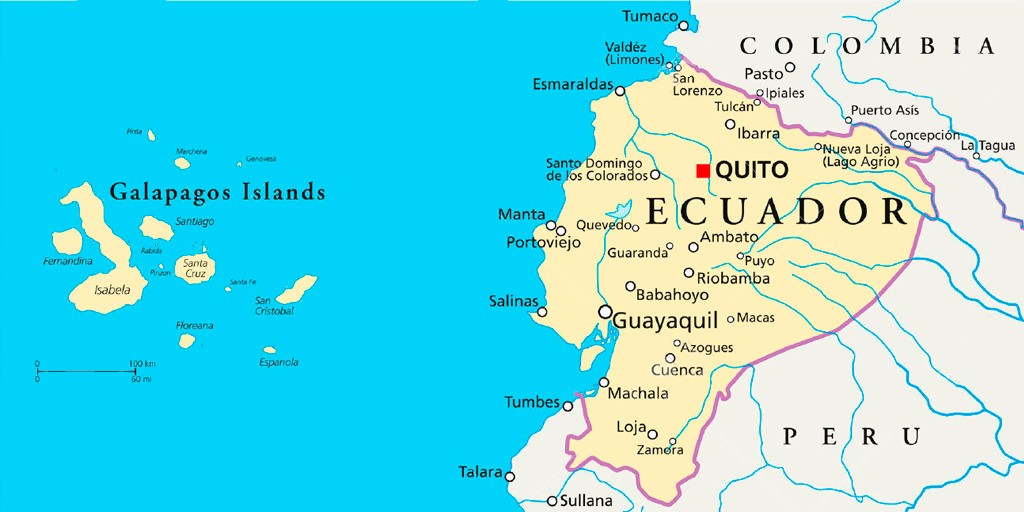
The Galapagos Islands, a small group of islands off the coast of Ecuador, is home to reptiles such as the giant tortoise and the iguana. The eastern islands are much older than the islands to the west. Which statement about the origin of these reptiles is best supported by this information?
a)
The ancestor of each species came from different continents at different times.
b)
The common ancestors of the reptiles probably came from Equador.
c)
The common ancestor of each species evolved in Peru and came to the islands at the same time.
11.
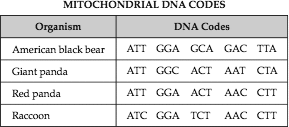
What conclusions can be made based on this table shown?
a)
the American black bear and the giant panda are most closely related
b)
the giant panda and the red panda are most closely related
c)
the red panda and the racoon are the most closely related
12.

The similarities among early stages of the embryos provide evidence that -
a)
these organisms evolved from a common ancestor
b)
the organisms all retained their gills and tails
c)
the organisms belong to the same species
13.

Scientists compare the limbs of organisms to look for evidence of common ancestry. These limbs provide evidence of common ancestry because they -
a)
perform the same function
b)
are the same size
c)
have the same basic structure
d)
are parts of the same animal
14.

Which evidence of common ancestry is being studied in this visual?
a)
biogeography
b)
fossil record
c)
anatomical homology
15.

Which evidence of common ancestry is being studied in this visual?
a)
biogeography
b)
fossil record
c)
anatomical homology
d)
molecular homology
16.

Which statement best represents the illustration to the right?
a)
Wolves, bison, and horses are mammals.
b)
Wolf, bison, and horse structures show no evidence of relationship.
c)
Wolves, bison, and horses evolved in the same habitat.
d)
Wolves, bison, and horses share homologous structures.
17.

These forelimbs are considered to be evidence of common ancestry because of which of the following?
a)
They have the same functions.
b)
They contain similar structures.
c)
They are all from mammals.
d)
They all are all the same basic length.
18.

The diagram shows fossils in different rock layers. Which of these statements about the age of these fossils is most likely correct?
a)
Fossil A and C are the same age
b)
Fossil B is older than fossil C
c)
Fossils A is older than fossil B
d)
Fossil D is older than fossil C
19.
Which of the following is an example of a vestigial structure?
a)
The fins of a shark.
b)
The tailbone of a human.
c)
The hind limbs of a house cat.
d)
The wings of a red-tailed hawk.
20.
If two organisms have similar traits of DNA they are probably
a)
share a common ancestor
b)
share a common environment
c)
share a common population
d)
speciation
21.
Behavioral changes of individuals of a species that allow for better survival. (Acquired traits)
a)
Variation
b)
Adaptation
c)
Behavior
d)
Environment
22.
When every organism of a species has died.
a)
Evolution
b)
Natural Selection
c)
Extinction
d)
Artificial Selection
23.
What is the advantage of having different shaped beaks?
a)
To look different from other species.
b)
To be able to eat the food readily available in the environment.
c)
To protect itself against predators.
d)
To protect itself against prey.
24.
Why are advantageous traits more likely to be passed onto offspring?
a)
Because they are more likely to survive and reproduce.
b)
Because they come from dominant alleles.
c)
Because they come from recessive alleles.
d)
Because the trait is an acquired phenotype.
100 %

