
 Worksheets
Sed Rocks and Fossil Fuels
Total questions: 23
Worksheet time: 6hrs 45mins
Name
Class
Date
1.

This rock formed when bits of other rocks became pressed into a solid. What type of rock is it?
a)
Sedimentary Rock
b)
Metamorphic Rock
2.

Which of the words below describe broken up rock?
a)
sediments
b)
magmas
3.
Erosion is one of the processes involved in the formation of sedimentary rock. Which of these best describes the process of erosion?
a)
Rocks are broken into smaller pieces that remain in the same location.
b)
Pressure compacts layers of sediment and turns them into rock.
c)
Pieces of rock or soil are carried from one place to another.
d)
Sediment grains fall to the bottom of a lake to form sedimentary layers.
4.

The breakdown of rock into smaller particles from the effects of wind, water and ice
a)
erosion
b)
cementation
c)
pressure
d)
weathering
5.

Sediment that is left behind in rivers lakes and oceans
a)
weathering
b)
erosion
c)
cementation
d)
deposition
6.

Preserved parts or traces of animals and plants that lived in the past
a)
natural gas
b)
imprints
c)
photos
d)
fossils
7.
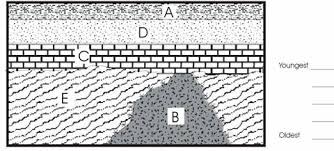
What is the youngest layer in the outcrop?
a)
A
b)
B
c)
C
d)
D
8.
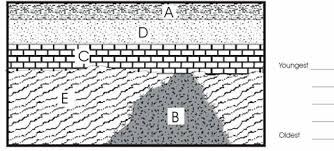
What is the oldest layer in the outcrop?
a)
B
b)
C
c)
D
d)
E
9.

An archaeologist made the following diagram of a dig site. What can be said about the pottery as compared to the skull found in the site?
a)
The rock layer with the pottery is more recent than the rock layer with the skull.
b)
The rock layer with the skull is more recent than the rock layer with the pottery.
c)
The rock layer with the skull is approximately the same age as the rock layer with the pottery.
d)
The rock layer with the skull has an absolute date of 17,000 years.
10.
Which statement is true about the fossil record?
a)
It is a record of all living things
b)
It shows how our climate has remained the same over time
c)
It provides evidence for history of life on Earth
d)
It does not support the theory of evolution
11.
Where can the oldest layer be found?
a)
The top layer
b)
The middle layer
c)
They are all the same age
d)
The bottom layer
12.
How are fossils created?
a)
Traces of organisms get turned into stone.
b)
Dead organisms are quickly buried for millions of years.
c)
Animals get trapped.
d)
All of the above
13.
What must be present for Fossil Fuels to form?
a)
Bones and Sediment
b)
Dead Organisms and Layers of Sediment
c)
Dead Organisms, Layers of Sediment, and Heat & Pressure over time
d)
Bones, Layers of Sediment, and Heat & Pressure over time
14.
Fossil Fuels formed over long periods of time after particles in water settled to the sea floor and formed marine mud. What kinds of particles needed to be present in the marine mud in order for fossil fuels to form.
a)
Mostly sand and a few small bits of wood
b)
Mostly decaying organisms
c)
Mostly lava and a few sedimentary rocks
d)
Mostly metal minerals
15.
Coal often forms where once there was swamps. What characteristic of swamps is important to the formation of coal?
a)
High Temperature
b)
Abundant Plant Life
c)
Frequent Rains
d)
Reptile Predators
16.
What changes buried organic matter into fossil fuels?
a)
Industrial Pollution
b)
Ocean Currents
c)
Volcanic Activity
d)
Heat and Pressure
17.
A student creates a model of the formation of fossil fuels by first placing a layer of leaves, representing organic matter, in the bottom of a cup. What step will come next in the model?
a)
Pouring water over the leaves to model washing away by rivers
b)
adding sand on top of the leaves to model burial in sediments
c)
Burning the leaves to model the decay of organic matter
d)
Putting the leaves in the freezer to model conditions on top of mountains
18.

Which layer formed first?
a)
Rock Layer W
b)
Rock Layer X
c)
Rock Layer Y
d)
Rock Layer Z
19.
What feature is the same in the formation of many sedimentary rocks and all fossil fuels? Many sedimentary rocks and all fossil fuels -
a)
require material to be buried and exposed to heat and pressure
b)
are made out of organic material that stores the sun's energy
c)
form where there are frequent earthquakes and volcanic activity
d)
are produced high in the mountains where temperatures are low
20.
Sedimentary rocks form when broken bits of other rock are deposited and then -
a)
buried and squeezed and cemented together
b)
melted by the heat of the Earth's core
c)
completely dissolved in the salt water of the ocean
d)
used by humans as a natural resource
21.

Which of the following is NOT an example of a fossil?
a)
a petrified dinosaur bone
b)
a footprint captured in mud
c)
a seashell found on the beach
d)
an insect stuck in amber
22.
Which of the following is NOT something you could learn from a fossil?
a)
The size of the animal
b)
What the animal ate
c)
The color of the animal
d)
Where the animal lived
23.
In order for a fossil to form, which of the following events must happen FIRST?
a)
Slowly, minerals in the water replace the bone.
b)
Sediment covers the bone.
c)
An animal dies.
d)
The bone is no longer a bone, but a rock copy.
100 %

