wayground logo

Free Printable Worksheets

NEW

Font size

S
M
L
XL
Worksheets

Electrostatic

Total questions: 30

Worksheet time: 1hrs 12mins

Name
Class
Date
1.

which is the field for opposite charges

a)
b)
c)
d)
2.

What types of charges attract?

a)

Positive and Positive

b)

Positive and Neutral

c)

Negative and Neutral

d)

Positive and Negative

3.

The accumulation of excess electric charge on an object is called

a)

Static electricity

b)

Electric discharge

c)

Resistance

d)

Circuit

4.

Plastic is an example of _______.

a)

an insulator

b)

a conductor

5.

A metal spoon is an example of _____.

a)

a conductor

b)

an insulator

6.
What causes static electricity?
a)
only an object losing electrons
b)
only an object gaining electrons
c)
when positive and negative charges balance
d)
when positive and negative charges are not balanced
7.
Consider the conduction charging shown. 
a)
Electrons move from the insulating stand into the sphere.
b)
Protons move from the bar into the sphere.
c)
Electrons move from the charged metal bar into the sphere.
d)
Protons move from the sphere into the negatively charged bar.
8.

Like charges

a)

attract

b)

repel

c)

ignore each other

9.

Opposite charges

a)

attract

b)

repel

c)

do not interact

10.

If you rub two balloons with the same piece of wool cloth, the balloons will:

a)

Be attracted to each other.

b)

Repel each other.

c)

Have no interaction.

d)

Not enough information is given to determine what will happen.

11.

Which of the following statements is NOT correct about the magnitude of the electric force between two charged objects?

a)

It increases if one of the charges increases.

b)

It increases if the distance between the charges increases.

c)

It increases if both of the charges increase.

d)

It increases if the distance between the charges decreases.

12.
What is the unit of electric charge?
a)
Volts
b)
Amps
c)
Coulombs
d)
Ohms
13.
A perspex rod can be charged positively by rubbing it with a woollen cloth.
How does the rod gain its charge? 
a)
The rod loses electrons.
b)
The rod gains electrons. 
c)
The rod gains protons.
d)
The rod loses protons. 
14.

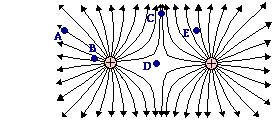
Which of the following labeled points is in the region with the strongest force of electric charge

a)

A

b)

B

c)

C

d)

D

15.

2 charged objects both feel a force of 200 N. If q1 becomes 3 times bigger, what is the new force

a)

203

b)

600

c)

66.7

d)

1800

16.

2 charges are 20 cm apart and feel a force of 500 N. if the distance between them becomes 60 cm, what is the new force

a)

4500

b)

540

c)

1500

d)

55.6

17.
Find the magnitude of the force between two charges of 1.0 C each which are 1.0 meter apart?
a)
9E-9 N
b)
9E9 N
c)
1.1E10 N
d)
1.1E-10 N
18.
Calculate the force exerted between two charged objects separated by a distance of 0.6 m. One object has a charge of -5 C and the other has a charge of +2.0 C.
a)
-1.5E-11 N
b)
2.5E-11 N
c)
-2.5E11 N
d)
-7.5E-10 N
19.
How many electrons are necessary to produce 1.0 C of negative charge? (e = 1.60 × 10⁻¹⁹ C)
a)
6.3 × 10¹⁸ 
b)
6.3 × 10
c)
1.6 × 10¹⁹ 
d)
1.6 × 10
20.
What equation is this:
FE= (k*q1*q2) / r2 
a)
Coulombs law
b)
Ohms law
c)
Newtons law
21.
Consider the electric field lines shown in the diagram below. From the diagram, it is apparent that object A is ____ and object B is ____.
a)
+,+
b)
+,-
c)
-,+
d)
-,-
22.
The electrical force between charges is strongest when the charges are
a)
close together
b)
far apart
c)
 the electric force is constant everywhere.
d)
there is no pattern
23.
What are the charged parts of an atom?
a)
proton and neutron
b)
proton and electron
c)
neutron and electron
d)
proton, neutron, and electron
24.
In this type of collision, objects tend to "stick" together.
a)
elastic
b)
inelastic 
c)
They "stick" together in both types of collisions.
25.
What is the SI unit used to measure force? 
a)
pounds 
b)
grams 
c)
newtons 
d)
friction
26.
Sphere A carries a charge of +8 coulombs, and Sphere B carries a charge of -6 coulombs.  If the two are touched together and then separated, what will the charge on sphere A be?
a)
+1
b)
-1
c)
+2
d)
-2
27.
If an object has an excess charge of -8.0x10^-19C, how many excess electrons does the object have?
a)
2
b)
3
c)
4
d)
5
28.
If an object has an excess of 18 electrons, what is the charge on the object?
a)
12.8x10^-19C
b)
28.8x10^-19C
c)
14.4x10^-19C
d)
6.4x10^-19C
29.
Balloon A simultaneously touches Balloons B and C.  Balloon A started with a charge of -4e, Balloon B started with a charge of +2e, and Balloon C started with a charge of +14e.  What will be the new charge on Balloon A after they were all allowed to touch?
a)
+12e
b)
+6e
c)
+8e
d)
+4e
30.
Electric field strength depends on
a)
charge and distance
b)
charge and mass
c)
coulomb constant and mass
d)
elementary charge and radius