
NEW
Font size
 Worksheets
AP Biology Evidence for Evolution
Total questions: 27
Worksheet time: 31mins
Two plant species live in the same biome but on different continents. Although the two species are not at all closely related, they may appear quite similar as a result of
Allopatric Speciaion
Convergent Evolution
Divergent Evolution
Gene Flow
If two modern organisms are distantly related in an evolutionary sense, then one should expect that
they live in very different habitats.
their chromosomes should be very similar.
they shared a common ancestor relatively recently.
they should share fewer homologous structures than two more closely related organisms.
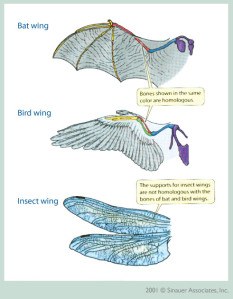
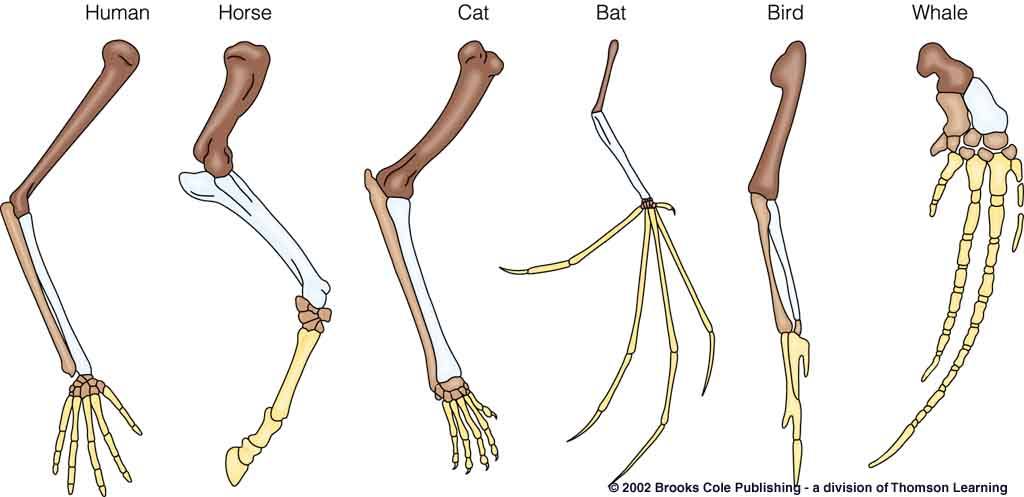
Structures as different as human arms, bat wings, and dolphin flippers contain many of the same bones, these bones having developed from very similar embryonic tissues. How do biologists interpret these similarities?
by identifying the bones as being homologous structures
by proposing that humans, bats, and dolphins share a common ancestor
by the principle of convergent evolution
Three of the statements above are correct.
Two of the statements above are correct.
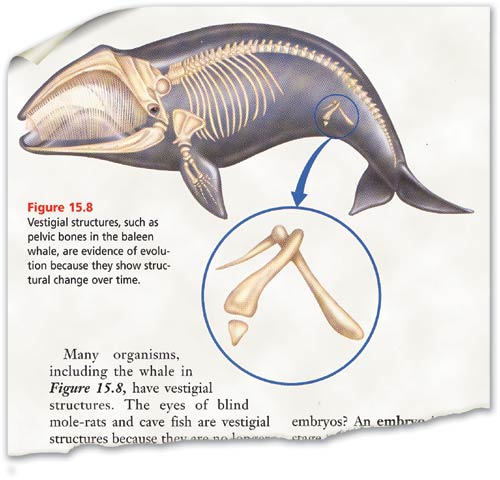
Over evolutionary time, many cave-dwelling organisms have lost their eyes. Tapeworms have lost their digestive systems. Whales have lost their hind limbs. How can natural selection account for these losses?
The ancestors of these organisms experienced harmful mutations that forced them to find new habitats that these species had not previously used.
Under particular circumstances that persisted for long periods, each of these structures presented greater costs than benefits.
Natural selection accounts for these losses by the principle of use and disuse.
Natural selection cannot account for losses, only for innovations.
Which of the following pieces of evidence most strongly supports the common origin of all life on Earth?
All organisms show heritable variation.
All organisms require energy.
All organisms reproduce.
All organisms have undergone evolution.
All organisms use essentially the same genetic code.
Members of two different species possess a similar-looking structure that they use in a similar fashion to perform the same function. Which information would best help distinguish between an explanation based on homology versus one based on convergent evolution?
The two species share many proteins in common, and the nucleotide sequences that code for these proteins are almost identical.
Both species are well adapted to their particular environments.
The sizes of the structures in adult members of both species are similar.
The two species live at great distance from each other.
Ichthyosaurs were aquatic dinosaurs. Fossils show us that they had dorsal fins and tails, as do fish, even though their closest relatives were terrestrial reptiles that had neither dorsal fins nor aquatic tails. The dorsal fins and tails of ichthyosaurs and fish are
examples of convergent evolution.
homologous.
adaptations to a common environment.
Three of the responses above are correct.
Two of the responses above are correct.
Both ancestral birds and ancestral mammals shared a common ancestor that was terrestrial. Today, penguins (which are birds) and seals (which are mammals) have forelimbs adapted for swimming. What term best describes the relationship of the bones in the forelimbs of penguins and seals, and what term best describes the flippers of penguins and seals?
analogous; analogous
homologous; homologous
analogous; homologous
homologous; analogous
What must be true of any organ that is described as vestigial?
It must be both homologous and analogous to some feature in an ancestor.
It must be analogous to some feature in an ancestor.
It must be homologous to some feature in an ancestor.
It need be neither homologous nor analogous to some feature in an ancestor.
According to the concept of punctuated equilibrium, the "sudden" appearance of a new species in the fossil record means that
speciation occurred instantaneously.
the species will consequently have a relatively short existence, compared with other species.
speciation occurred in one generation.
speciation occurred rapidly in geologic time.
According to the concept of punctuated equilibrium,
given enough time, most existing species will gradually give rise to new species.
a new species accumulates most of its unique features as it comes into existence.
natural selection is unimportant as a mechanism of evolution.
transitional fossils, intermediate between newer species and their parent species, should be abundant.
evolution of new species features long periods during which changes are occurring, interspersed with short periods of equilibrium, or stasis.
Speciation
occurs only by the accumulation of genetic change over vast expanses of time.
can involve changes to a single gene.
must begin with the geographic isolation of a small, frontier population.
occurs at such a slow pace that no one has ever observed the emergence of new species.
and macroevolution are synonymous.

Evolution occurring gradually and slowly over long periods of time
Homeostasis
Stasis
Punctuated Equilibrium
Gradualism

Evolution occurring quickly due to catastrophic events
Homeostasis
Gradualism
Statsis
Punctuated Equilibrim
Gradualism occurs when geologic and climatic conditions are _______________.
stable
unstable
long
short
Which form of evolution can occur quickly?
gradualism
punctuated equilibrium
allopatric speciation
sympatric speciation
Gradualism and punctuated equilibrium
can exist together
must exist together
never exist together
must happen after each other

