wayground logo

Free Printable Worksheets

NEW

Font size

S
M
L
XL
Worksheets

Evolutionary Biology

Total questions: 21

Worksheet time: 22mins

Name
Class
Date
1.
Who was the naturalist that traveled the world to study plants and animals?
a)
Albert Einstein
b)
Charles Darwin
c)
Charles Barkley
d)
Isaac Newton
2.

Darwin's expedition was called the Voyage of the _________.

a)

Mayflower

b)

Beagle

c)

World

d)

Galapagos

3.
Darwin's expedition took how many years?
a)
3
b)
4
c)
5
d)
6
4.
Which term refers to the process by which individuals that are better suited to the environment survive and reproduce therefore passing down their genes to their offspring? 
a)
Evolution 
b)
Variation 
c)
Adaptation
d)
Natural Selection 
5.

Darwin wrote that organisms with traits that are best suited to the environment will ________________

a)

reproduce

b)

become extinct

6.
What characteristic did Darwin observe about the finches on the Galapagos Islands?
a)
Their feathers 
b)
Genotypes 
c)
Their beaks
d)
Their body sizes
7.
Genetic differences between organisms of the same species
a)
Variation
b)
Adaptation
c)
Behavior
d)
Environment
8.
Darwin referred to this as survival of the fittest. Over time, it results in changes in the inherited characteristics of a population because organisms with adaptations that make them fit for their environment will survive and reproduce better than those without favorable traits.
a)

Natural Selection

b)

Genetic Variation

c)

Homologous Structures

d)

Struggle for Existence

9.
The gradual change in species over time is...
a)
Evolution
b)
Nucleotide 
c)
Adaptation
d)
Natural Selection
10.
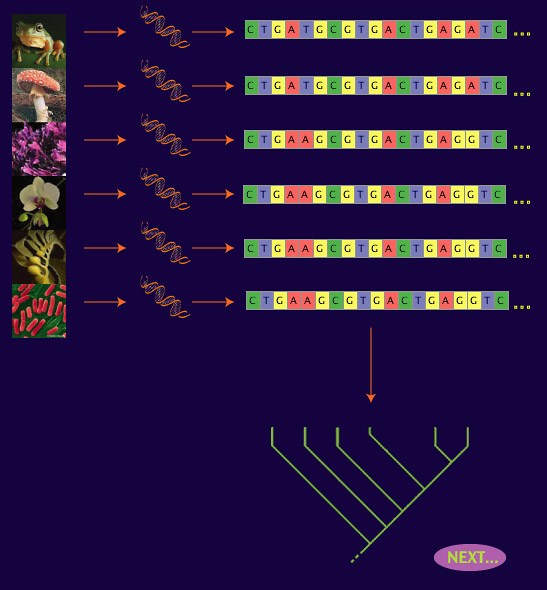
Which species’ DNA is most similar to the DNA of the toothed whale? 
a)
Hippopotamus 
b)
Baleen Whale
c)
Grazing Mammals
d)
Camels
11.
Two organisms that are closely related would have
a)
very similar DNA sequence
b)
exactly the same DNA sequences
c)
no proteins in common
d)
completely different DNA sequence
12.
The separation of a group of individuals from the rest of the population is referred to as 
a)
genetic drift
b)
natural selection
c)
geographic isolation
d)
survival of the fittest
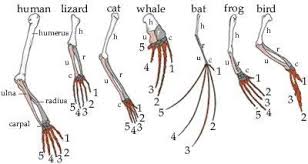
13.
What is this an example of?
a)
vestigial structures
b)
embryology
c)
homologous structures
d)
fossil record
14.

Artificial selection is a result of

a)

The environment

b)

Human behavior

c)

Mutation

d)

Gene Flow

15.
Why are advantageous traits more likely to be passed onto offspring?
a)
Because they are more likely to survive and reproduce.
b)
Because they come from dominant alleles.
c)
Because they come from recessive alleles.
d)
Because the trait is an acquired phenotype.
16.
The diagram shows fossils in different rock layers. Which of these statements about the age of these fossils is most likely correct?
a)
Fossil A and C are the same age
b)
Fossil B is older than fossil C
c)
Fossils A is older than fossil B
d)
Fossil D is older than fossil C
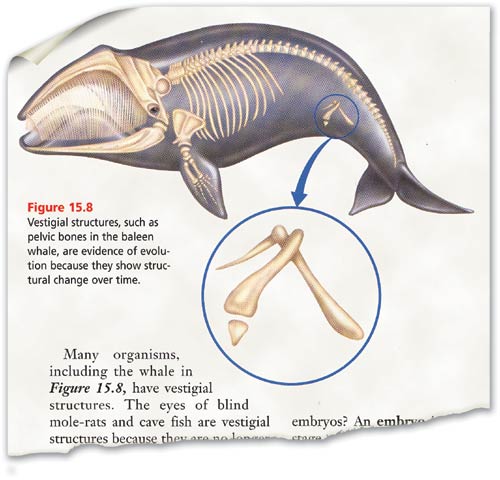
17.

Which of the following is an example of a vestigial structure?

a)

the wings of a red-tailed hawk

b)

the tail of a house cat

c)

the fins of sharks

d)

the wings of a penguin

18.
The study of the early stages of development that is one evidence of evolution is:
a)
Homologous Structures
b)
Embryology
c)
Vestigial Organs
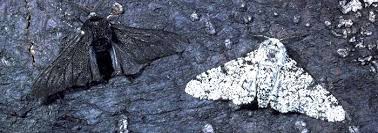
19.
Predict which moth would increase in population
a)

light 

b)

dark

c)

they would be 50:50 due to random variation

20.
Inherited trait that helps an organism survive is a(n) __________.
a)
Fossil
b)
Adaptation
c)
Ancestor
d)
Natural selection
21.

Evolution is considered to be one of the most important theories in science, because it

a)

was developed more than 100 years ago.

b)

is not supported by the fossil record.

c)

unites the fields of biology, geology, chemistry, and ecology.